Curly Bridesmaid Hairstyles: A Practical Style Checklist
The best curly bridesmaid hairstyle is one you recognize as your own, shaped for the wedding rather than pressed into a look that fights your texture. Start with three choices: how much curl you want to show, how much hair you want pinned away, and what needs to feel comfortable from portraits through the last dance. Then use the checklist below to turn inspiration into a clear plan you can test before the wedding morning.
This guide compares four silhouette families, gives you a short reference brief for your stylist, and helps you check the finished style while moving, sitting, and turning your head. Curly hair can mean loose spirals, springy ringlets, waves, or tight coils, so the pictures you save should be starting points. Your own curl pattern, length, density, and preferences decide the final version.
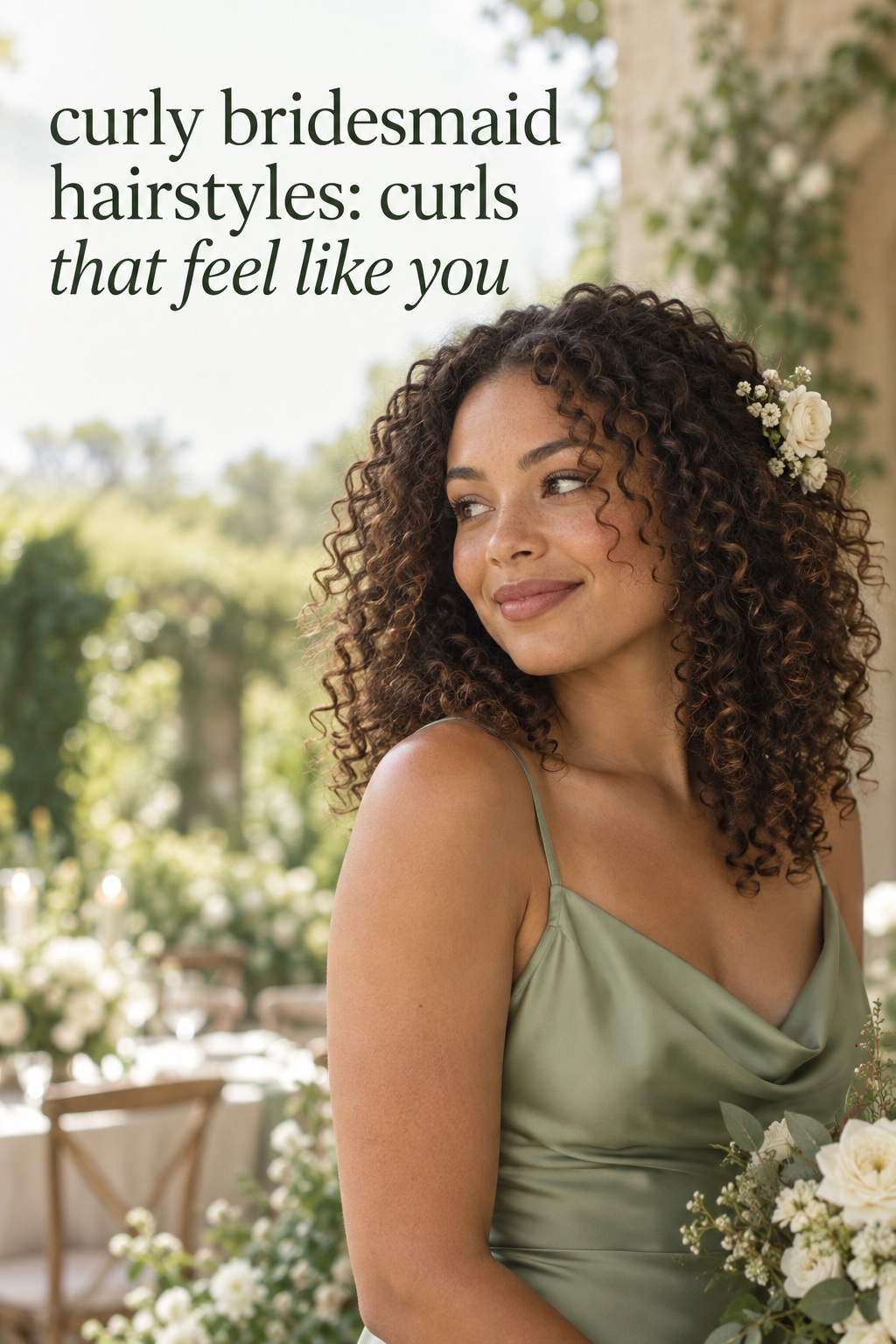
Start With the Wedding-Day Brief, Not a Saved Photo
A hairstyle reference is useful when it tells the stylist what you like. It is less useful when it becomes a demand to reproduce another person’s hair exactly. Two photos of a curly low bun may show very different amounts of volume, face-framing pieces, and visible curl. Before you choose one, name the features you want to keep and the ones you would change.
Begin with the wedding party’s shared direction. It might be soft and romantic, clean and polished, or relaxed and garden-inspired. That broad description provides cohesion without requiring every attendant to wear the same arrangement. The Knot’s bridesmaid examples include natural curly updos and note that a party can share a general feel while allowing personal differences. For curly bridesmaid hairstyles, that flexibility matters because one person may feel most like herself with a defined wash-and-go shape, while another prefers a pinned style.
Turn wedding inspiration into a plan you can actually follow.
Zarellea brings your guest list, budget, vendors, and day-of details into one shared space — so no beautiful idea gets lost in the shuffle.
Next, ask the bride or planner about any real requirements: a particular accessory, a requested level of formality, or a neckline that should remain visible. Clarify whether a flower, comb, or ribbon is supplied and whether the hair must be up for a veil or a costume change. Avoid assuming that a shared dress color means a shared hairstyle. Agreeing on one detail, such as a warm-metal accessory or a polished finish, is often enough to make varied looks feel considered.
Finally, make the brief personal. Write down whether you want your natural curl definition visible, whether you like hair around your face, and how you feel about pins touching your scalp. Mention anything that has bothered you before, such as a tight crown, a heavy accessory, or a style that needs frequent adjustment. These are useful design limits, not fussy demands. A good reference shows the mood; your brief explains how to make that mood wearable for you.
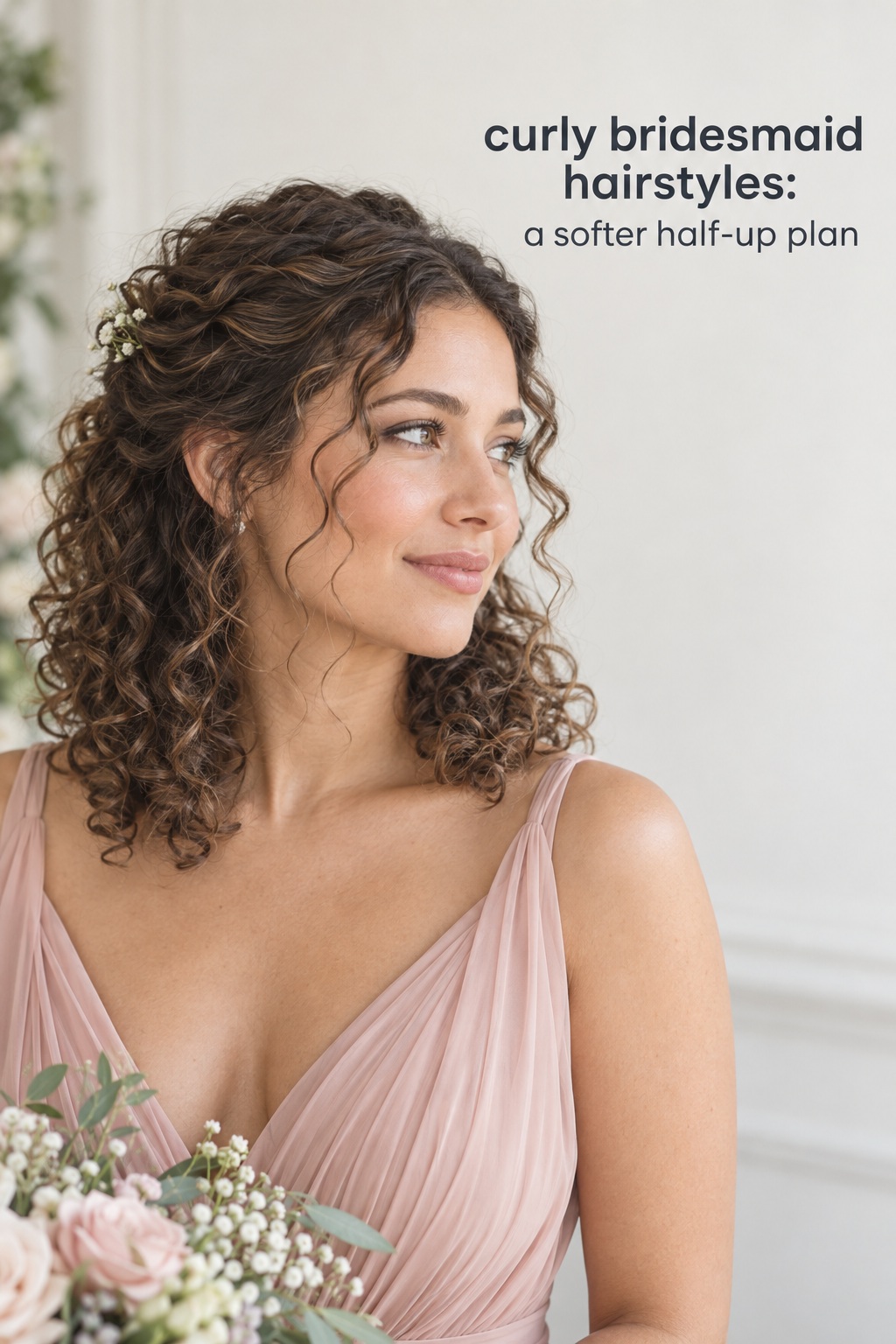
A Quick Checklist for Choosing Curly Bridesmaid Hairstyles
Use this checklist before saving a dozen nearly identical pictures. It narrows the decision to details a stylist can act on and gives you a practical way to compare options.
- Choose your texture goal. Do you want curls fully defined, softly loosened, or gathered so that only a few curls frame the shape? Use words you like rather than relying on a curl-type label.
- Choose how much hair stays down. Consider all down, half-up, braid-led, or mostly pinned. You can show your stylist a hand gesture or photo to explain how much volume you want left free.
- Check face and neckline comfort. Decide whether you want curls near your cheeks and shoulders, and whether you want your ears, earrings, or neckline visible.
- Set a pin and weight limit. If you dislike tight pins, say so before styling begins. If an accessory feels heavy in your hand, ask to test its placement before committing.
- Think about the schedule. A style that needs detailed finishing may require more chair time. Ask the stylist how long the selected version needs and what happens if the wedding morning runs late.
- Plan a refresh, not a rescue. Decide who can help with one loose pin or a misplaced clip, and what small items are worth keeping nearby. Do not assume a style will need no attention at all.
- Test the parts you will actually do. Sit, turn, look down, hug someone, and move your shoulders. If you will wear a shawl, wrap, or jacket, test that too.
After the checklist, pick two finalists rather than trying to combine every detail you admire. For example, choose a half-up shape with a visible curl pattern or a low updo with soft tendrils. A clear main idea makes it easier to judge whether an added braid, flower, or piece of jewelry helps or distracts.
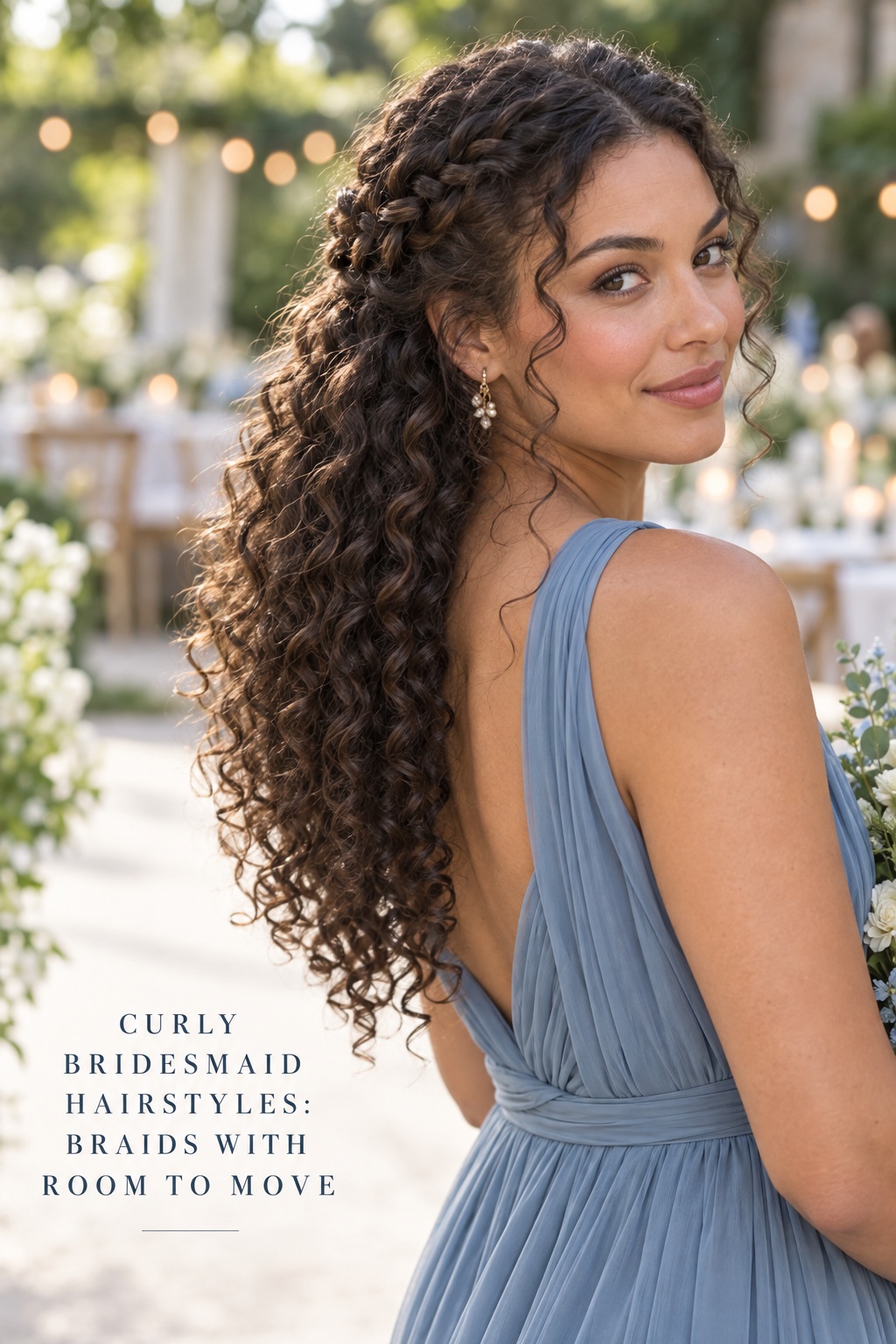
Four Curly Hairstyle Shapes, Compared
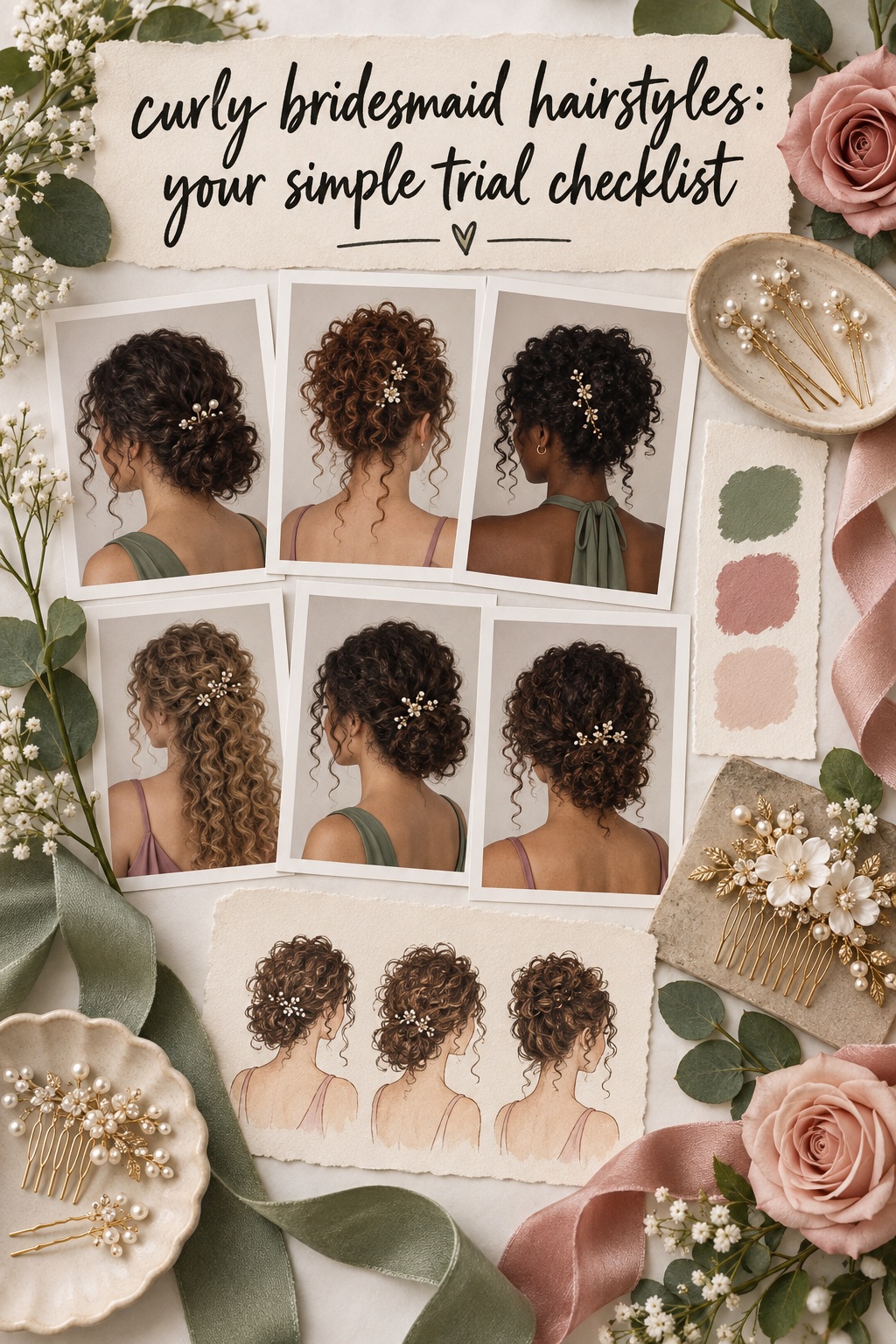
Curly bridesmaid hairstyles can be sorted by how the hair is arranged, not by a ranking of what is prettiest. Each shape makes a different trade-off between visible texture, face clearance, pinned sections, and refresh needs. Treat the notes as prompts for a trial; a stylist can adapt the exact construction to your length and density.
1. Curls worn down
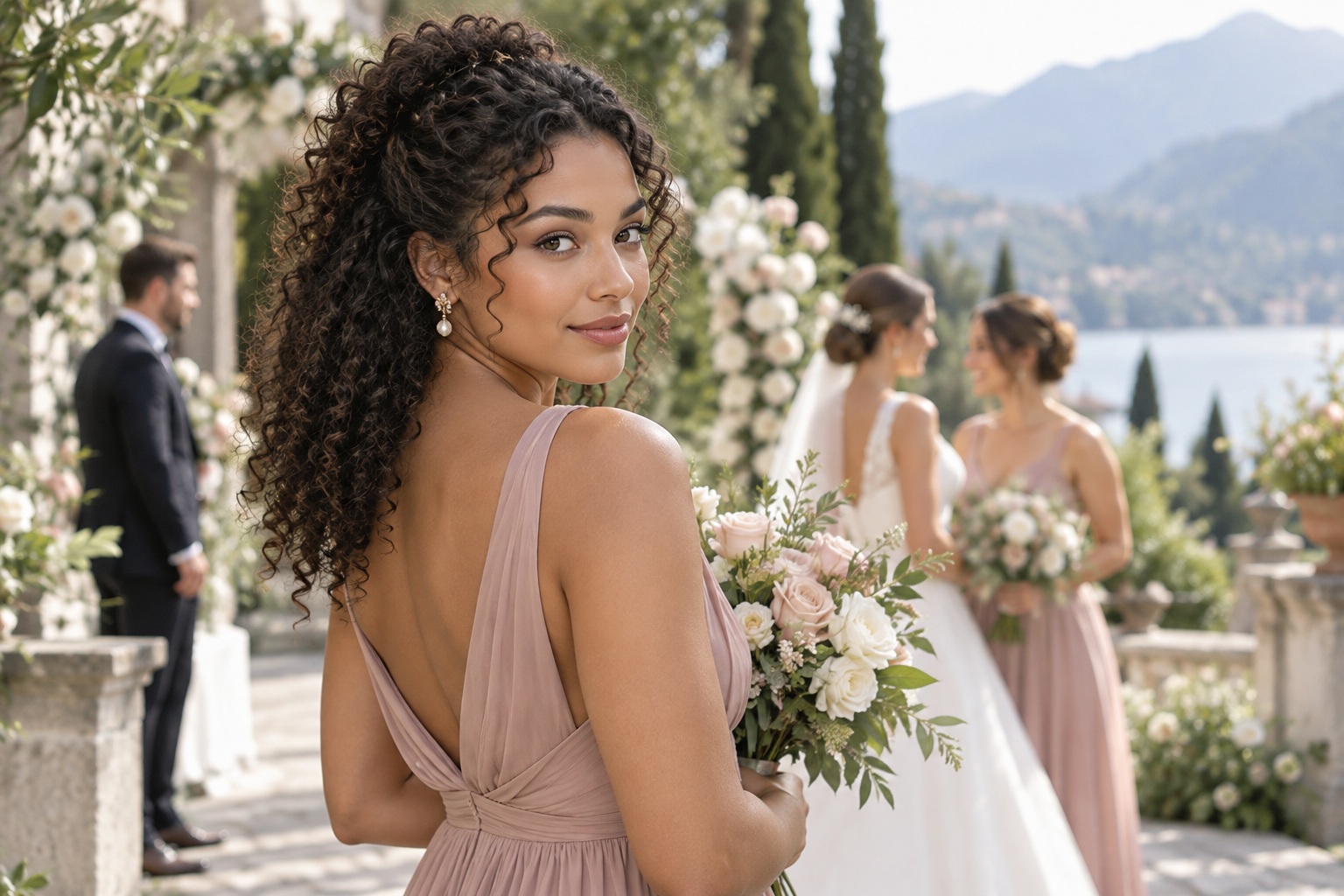
Wearing curls down keeps the texture and shape in full view. A side part, a small clip, or a softly shaped front section can make the look feel finished without changing its overall character. This is a natural option when you enjoy your curls around your shoulders and want the least amount of hair secured. Ask how the front will sit in photos and whether the accessory can be removed easily if it catches on clothing.
The trade-off is that loose hair can move across the face or rub against a dress. Try turning your head, walking, and putting on any outer layer you expect to wear. If the front pieces keep falling where you do not want them, test a small pin-back or a hidden clip instead of switching immediately to a full updo.
2. Half-up curls
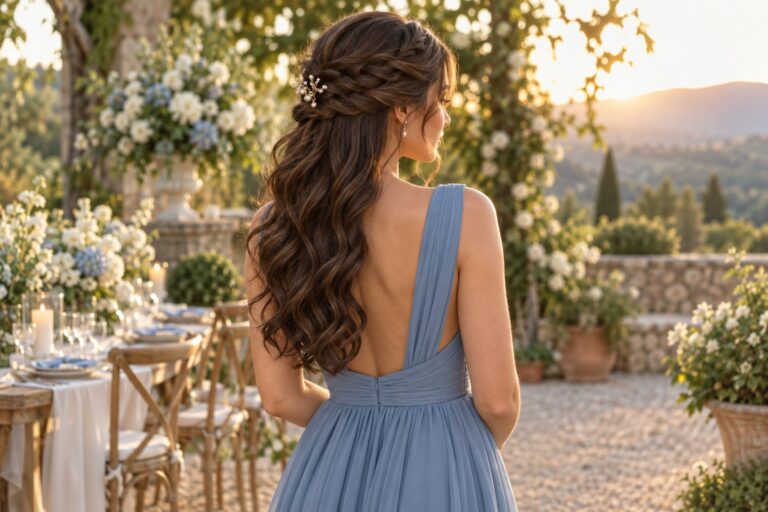
A half-up shape gathers the front or crown while leaving a generous section of curls down. It can give the face a little more clearance while preserving movement at the sides and back. The pinned portion might be a simple twist, a pair of joined sections, or a small braid. Bring references that show the amount of hair left loose, since “half-up” can describe anything from a small crown lift to a much more gathered style.
Check the point where the sections meet. It should feel secure without a pulling sensation, and the pins should not press when you lean back. If your hair is shorter, the stylist may adapt the concept into two small twists or clipped sides. Ask how the look will read from the back and whether the gathering changes your curl volume in a way you like.
3. Braid-led curls
A braid can act as a visible detail, a way to guide the front away from the face, or a foundation that connects pinned and loose curls. Options include a narrow side braid, a braided crown, or a small braid worked into a half-up shape. The braid does not need to be tight or elaborate to look intentional. Its scale should suit your curl volume and the amount of detail already in your dress or jewelry.
Ask the stylist to show where the braid will begin and end, and whether the design works with your actual length. A photo taken on longer hair may need to become two shorter side braids or a braided accent that joins at the back. Check that any tucked ends stay comfortable when you turn your head and that the braid does not need to be pulled so firmly that it changes how your hair feels.
4. Pinned-up curls
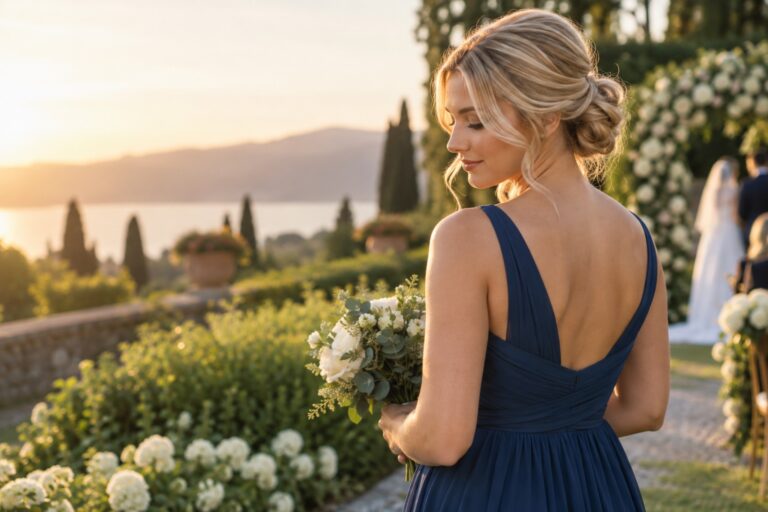
A curly bun, puff, or gathered updo moves most of the length away from the shoulders. The outline may be compact and smooth, or full and textured, with curls arranged visibly across the shape. This family can suit someone who wants a clear neckline or prefers not to manage hair on the back of a dress. A few curls can remain loose near the face if that feels more familiar.
Updos often rely on several pins, so comfort deserves a proper check rather than a quick mirror glance. Tell the stylist if any point feels sharp or unusually tight. Test how the shape feels when you sit against a chair and when you move your neck. Ask what the stylist will do to secure the form without hiding every curl, and whether the accessory is placed into the style or attached afterward.
For more polished bridal-party guidance, Who What Wear’s hairstylist advice also emphasizes working with individual texture, length, and movement and suggests testing bridesmaid styles ahead of the day. Use that as a planning cue, then let your own comfort and stylist’s assessment guide the details.
Work With Length, Density, and Curl Pattern
A hairstyle image may look simple because of the model’s length or the way the hair is arranged for the photograph. Bring it as inspiration, then ask what needs to change for your hair. Curl shrinkage, density, layers, and the amount of length available for pinning can all change a silhouette. You do not need to use technical terms if they are unfamiliar. A photo of your hair on an ordinary good day can help the stylist see its real shape and volume.
Short and shoulder-length curls
Short curls can look dressed up with a defined side part, a small comb, or one side pinned back. A half-up reference may translate into two small twists that meet at the back rather than one large gathered section. For shoulder-length hair, a low gathered shape may be possible depending on the layers and curl length. Ask whether the style needs extra pins, and make sure no short pieces feel forced into a shape they cannot comfortably hold.
If your hair is layered, take a photo from the side and back so the stylist can see which lengths reach the intended pin point. This makes the conversation concrete: perhaps the shape needs a smaller accessory, a lower placement, or a few curls left free. A scaled version of the reference can look more balanced than trying to reproduce its full volume.
Longer or denser curls
Longer or denser hair offers more options for a high puff, low gathered shape, braid accent, or cascading half-up look, but more material can also change the weight and balance of an accessory. Ask the stylist where the shape will sit and what it will feel like over several hours. For a down or half-up look, choose the amount of volume you want at the crown and sides. For an updo, discuss whether the length should be divided into smaller pinned sections.
If your hair is fine or has less density, a reference with a very large bun or braid may require a different construction to create a similar outline. If your curls are dense, a tiny clip from a reference might not be large or secure enough for your hair. Neither difference is a problem; it is a reason to focus on the shape and mood rather than exact proportions.
Coils and tighter curl patterns
Coily hair can be styled with its texture visible in a rounded puff, a twist-based updo, a braid detail, a gathered shape, or a combination chosen with the wearer and stylist. Show references that represent the texture you want to see, and explain whether you want the pattern left as it is, stretched, or arranged into a particular silhouette. Do not let a generic picture imply that your hair should be straightened or reshaped to fit the sample. If you want to maintain your usual routine, say so when you book and ask the stylist what preparation they recommend for your own hair.
For all textures, the useful question is not “Which style is made for my curl type?” but “What version of this shape can my hair support while still feeling comfortable?” An experienced stylist can explain the options after seeing your hair. If you have a protective or established styling routine, include it in the conversation and avoid last-minute experimentation that you have not agreed to.
Coordinate the Bridal Party With One Shared Detail
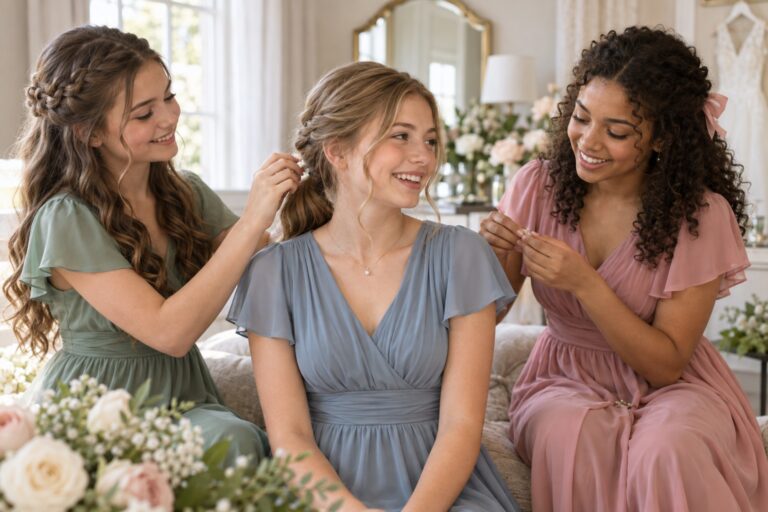
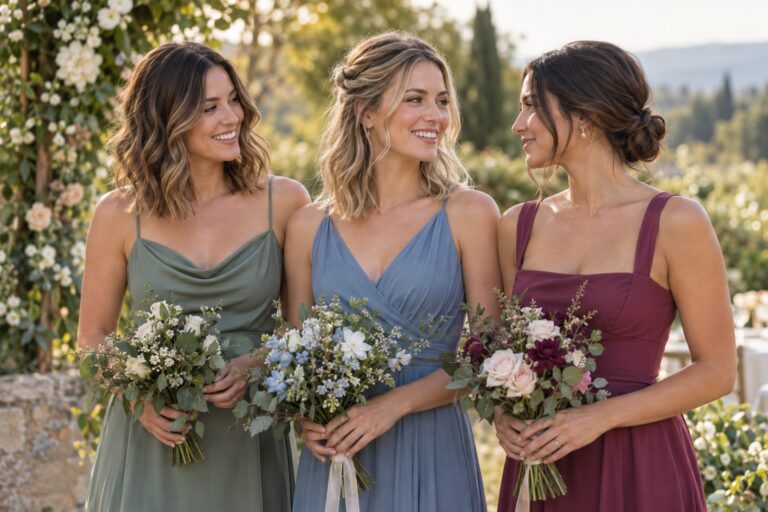
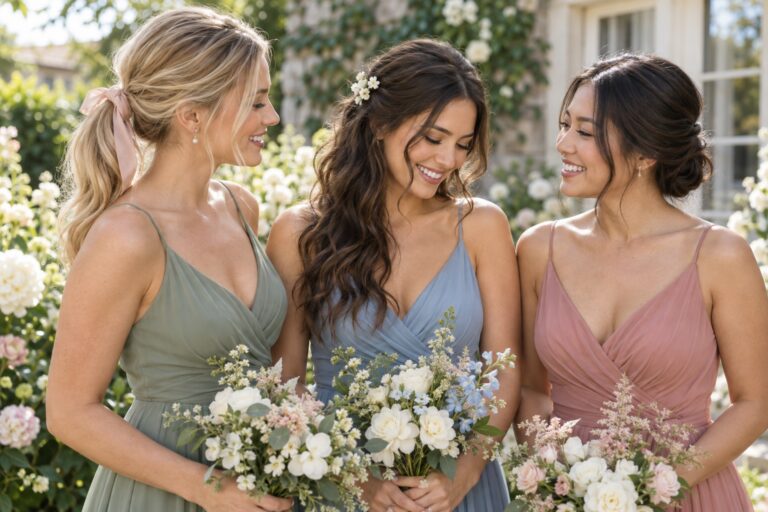
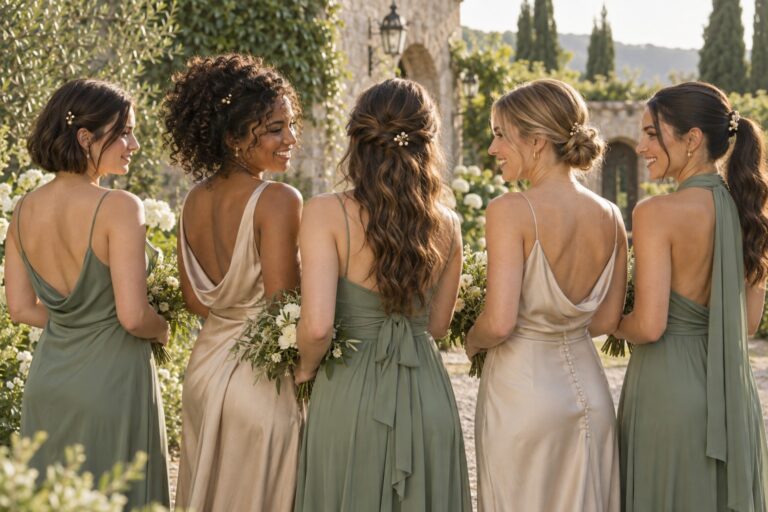
A wedding party can look connected without making every head look alike. Choose one shared cue and leave the rest open. The cue might be a small flower in the same color family, a similar metal finish, a ribbon tone, or a general silhouette such as “hair partly off the face.” Each person can interpret it in a way that suits her own texture and comfort.
For instance, one attendant might wear curls down with a single clip, another might choose a half-up twist, and a third might wear a low curly bun. They can feel part of the same group if the finish and accessory language relate to the wedding. This approach also avoids asking a stylist to force curls into a shape that works better for someone else’s length.
Keep accessory choices practical. Hold a comb or pin against the hair during the trial and check its weight, grip, and placement. A delicate piece may disappear against dense curls, while an oversized one can dominate a short style. Photograph the back and side in ordinary room light so you can judge scale. If flowers are part of the plan, confirm who supplies them and when they will be added; a fresh stem and a metal comb may need different placement.
Use the dress as a context clue, not a rule. A high neckline may make an up shape appealing to someone who wants the fabric visible; an open neckline may leave room for curls over the shoulders. Either way, your preference matters. Try the style with the dress or a similar neckline if possible, and check that straps, collars, earrings, and hair do not compete or catch when you move.
Run a Useful Trial and Wedding-Morning Check
A trial is useful when it answers a question. You do not necessarily need a full rehearsal of every possible look. Bring two or three references, your notes about comfort, and the accessory if it is available. Tell the stylist how long you expect to wear the style and whether you will change outfits, add a wrap, or spend time outdoors. Then agree on what you are testing before styling starts.
- Check the shape from several angles. Take front, side, and back photos. Look for the features you asked to preserve: visible curl, a clear neckline, face-framing pieces, or a particular amount of volume.
- Check comfort after a pause. Wear the style for a while before deciding. Notice whether a pin presses, an elastic pulls, or an accessory feels heavier than expected.
- Check ordinary movement. Turn your head, look down, sit back, raise your arms, and give someone a hug. These simple actions reveal whether the style gets in your way.
- Check the clothing interaction. Try the neckline, earrings, veil, wrap, or jacket you expect to wear. Make sure nothing snags or pushes the hairstyle out of place.
- Write down what the stylist did. Note the part, sectioning, accessory position, and any changes that made the look more comfortable. Ask which steps are essential and which are just finishing touches.
- Agree on a day-of fallback. Decide what to simplify if time is short, such as using one accessory instead of two or choosing the tested half-up version rather than adding another braid.
Before the wedding, confirm the appointment time, who is bringing accessories, and whether your hair should arrive in a particular state. Follow the stylist’s instructions for your own hair rather than relying on a universal wash-day rule. Set aside a few minutes to check the finished style in natural or window light, if available, and make any comfort adjustments before portraits begin.
A small day-of kit can include only the items the stylist recommends, such as a few matching pins or a travel-size product already approved for your hair. Assign one person to hold it so you do not have to search through bags. You should not need to rebuild the hairstyle yourself. The goal is simply to have a calm plan for a loose curl or shifted accessory, and to know when to ask the stylist or attendant for help.
Common Mistakes to Avoid
Choosing only by the front view. Curly hairstyles are often saved from a single flattering angle. Check the side and back, especially if you will be photographed in a line or wear a detailed dress back.
Asking for a copy instead of a translation. A reference model may have different length, density, and curl pattern. Point out the shape, finish, and details you like, then ask how the stylist would adapt them to your hair.
Waiting until the appointment to mention discomfort. If you dislike tight pins or heavy accessories, say so at the start. A stylist can only adjust what she knows is bothering you.
Adding every detail at once. A braid, multiple clips, flowers, tendrils, and a dramatic crown can compete with one another. Choose a lead detail and let the rest support it.
Confusing cohesion with identical hair. Share one detail or a broad finish across the party, then let each attendant choose a silhouette that works for her curls and comfort.
Sources and Methodology
This guide draws on a review of ten organic Google US results for curly bridesmaid hairstyles and close variants. The gallery examples were used to map common shapes, while stylist guidance on individual texture and style testing informed the practical checklist. The hairstyle comparisons are planning prompts, not guarantees of hold or suitability; a stylist should assess the wearer’s hair, preferences, and event needs.
FAQ
What are the best curly bridesmaid hairstyles?
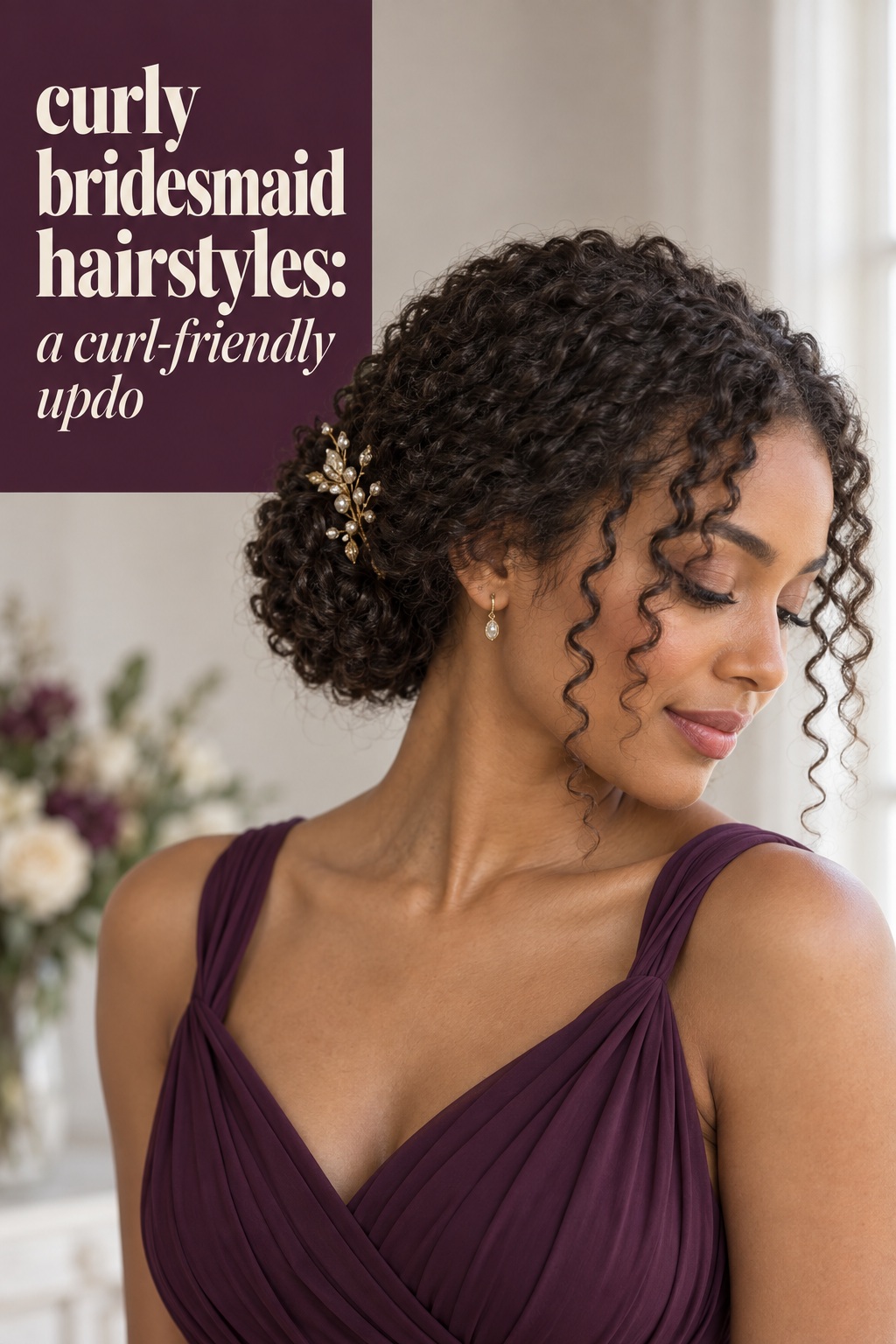
Good starting points include curls worn down, a half-up style, a braid-led shape, and a curly updo. The best option depends on how much texture you want to show, your preferred amount of pinned hair, your length, and the wedding-day brief.
Can bridesmaids wear different hairstyles and still look coordinated?
Yes. Agree on one shared detail, accessory finish, or general level of polish, then let each attendant choose a silhouette that suits her hair. A shared cue can create cohesion without requiring matching curls or identical updos.
Which curly bridesmaid hairstyles work for shorter hair?
A defined side part, one side pinned back, a small clip, or two short twists can dress up shorter curls. A stylist can adapt a half-up or braid reference to your available length and layers.
How should I explain my curl preferences to a stylist?
Bring a photo of your hair on an ordinary day and references that show the shape you like. Explain whether you want your curl pattern visible, how much hair you want pinned, and anything that feels uncomfortable, such as tight pins or heavy accessories.
Should curly bridesmaid hair be worn up or down?
Neither is automatically better. Hair down keeps the full curl shape visible, while an updo moves more length away from the shoulders. Half-up and braid-led options sit between those choices. Select the shape that feels comfortable with your outfit and routine.
What should I test during a curly hairstyle trial?
Check the front, side, and back; wear the style for a while; and test turning, sitting, hugging, and wearing your neckline or accessories. Note any pressure from pins and ask the stylist what can be simplified if the wedding morning runs short on time.
Can coils stay visible in a formal bridesmaid hairstyle?
Yes. Coils can remain visible in a puff, twist-based updo, braid accent, or gathered shape. Share references that represent the texture you want and ask the stylist to adapt the outline to your hair and usual styling preferences.