Modern Muslim Wedding Invitations with Thoughtful Style
The invitation often becomes the first real glimpse of a Muslim wedding: not just the date and venue, but the tone of the nikah, the spirit of the walima, and the way a couple wants faith, family, and celebration to meet on one page. For many U.S. couples, choosing muslim wedding invitations is both an aesthetic decision and a practical one. You may be balancing religious etiquette, modern design, digital convenience, multilingual wording, and a guest list that includes both Muslim and non-Muslim loved ones. A thoughtful invitation can do all of that gracefully when its wording, format, and visual language are chosen with care.
Today’s options are broader than ever. Brands such as Sakinah Studios focus on bespoke and self-editable digital invitations, Zola offers guidance on traditional Muslim invitation etiquette, ShadiCards highlights current invitation trends, IslamicWeddingCards showcases digital and foil collections, and platforms like Swayy Invites, Invitation Street, Scarlet Veils, and Wedding Invitation Wording Ideas focus strongly on wording and templates. Taken together, these approaches point to one clear truth: the best invitation is not simply the most ornate or the most modern. It is the one that fits your wedding events, your guests, your timeline, and the level of formality you want to communicate.
Start with the wedding events you are actually inviting guests to
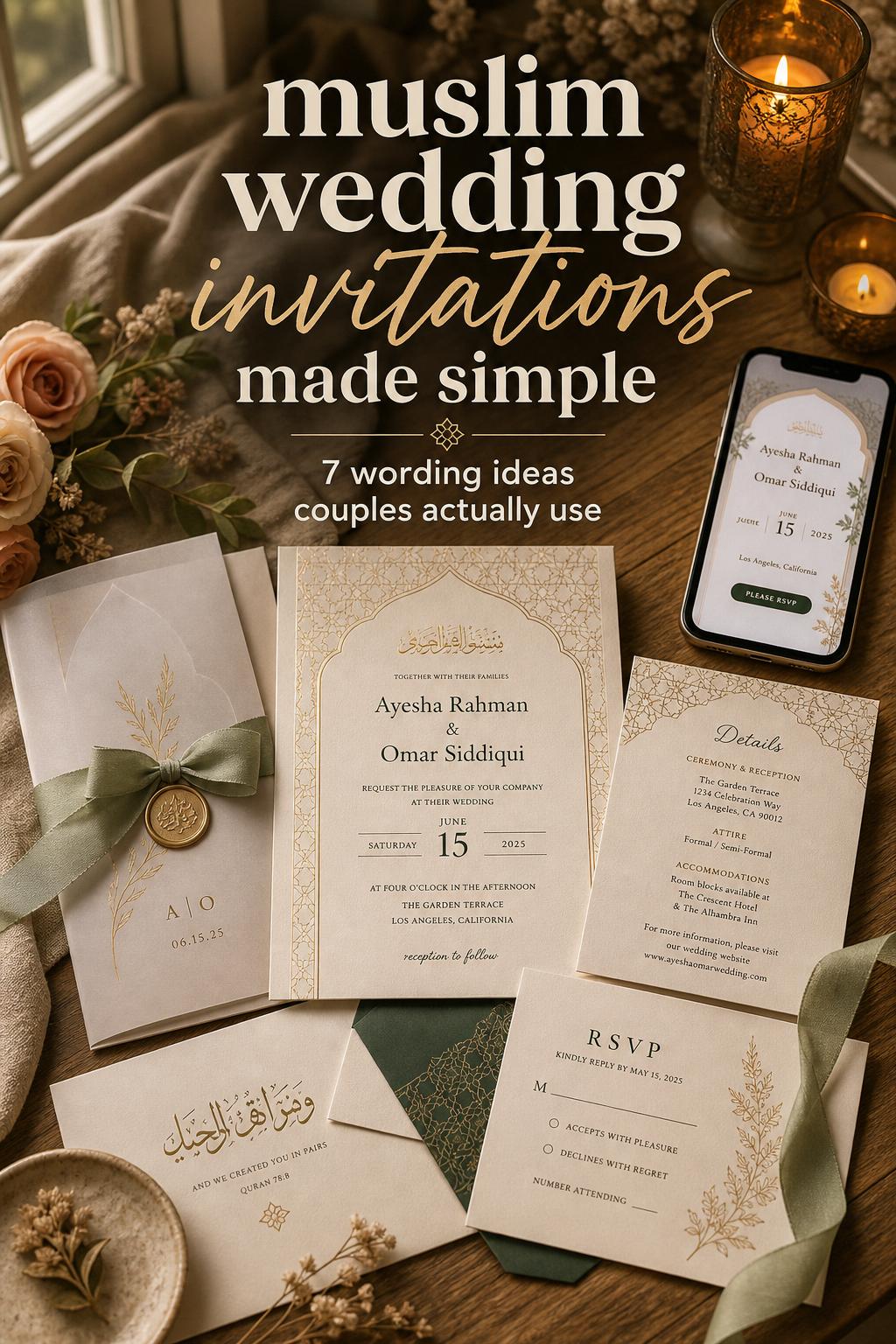
Before choosing paper stock, foil, or digital animation, decide exactly what the invitation needs to cover. In Muslim weddings, two event terms appear repeatedly because they shape the wording and structure of the invitation: nikah and walima. The nikah is the marriage ceremony, while the walima is the wedding reception or celebratory meal that follows. Some couples invite the same guests to both; others host them separately and need different invitation language for each event.
This matters because guests take cues from the invitation. If your nikah is intimate and faith-centered while the walima is larger and more social, one combined card may feel too vague. Separate inserts or a digital suite can make the distinction clearer. If your events are happening across different days or venues, clarity becomes even more important than decoration.
Turn wedding inspiration into a plan you can actually follow.
Zarellea brings your guest list, budget, vendors, and day-of details into one shared space — so no beautiful idea gets lost in the shuffle.
Best for: couples hosting distinct nikah and walima events, families managing formal religious etiquette, and weddings where guest lists vary by event.
Why it works: guests understand what they are attending, how formal the gathering is, and whether the tone is ceremonial, celebratory, or both.
How to make it work: decide early whether you need one invitation, a multi-card printed suite, or a digital invitation set with separate event screens. If the nikah and walima have different dress codes, venues, or hosts, let that information appear clearly instead of trying to keep the layout overly minimal.
Budget tip: if separate printed cards stretch the budget, keep one main printed invitation for the central event and send details for secondary events digitally.
Common mistake to avoid: using elegant but vague wording that leaves guests unsure whether they are invited to the nikah, the walima, or both.
Real-life styling tip: if older relatives prefer printed cards but younger guests respond faster online, use a hybrid plan rather than forcing one format to do everything.
Religious etiquette deserves a place in the design conversation
Traditional Muslim wedding invitation etiquette is not only about what looks appropriate; it is also about what should be included and how it may be handled. Zola’s guidance around the traditional Muslim wedding invitation highlights recurring considerations such as whether to include Quran verses, whether to begin with Bismillah, and how to think about guests who may not be familiar with Islamic customs. That makes etiquette part of the planning process, not an afterthought.
Including Bismillah or Quranic text can make an invitation feel spiritually grounded, especially for a formal nikah. But that choice carries practical implications too. Printed pieces containing sacred text may require more thoughtful handling and disposal. For some couples, that is exactly why they include it. For others, especially when mailing hundreds of cards or inviting a broad mix of guests, a blessing or respectful Islamic phrase may feel more manageable.
There is also the question of inclusivity. If many guests are non-Muslim, the invitation can still reflect faith while remaining easy to understand. A short translation, a simpler blessing, or more direct event labeling can help guests feel welcomed rather than uncertain.
What to think through before adding religious text
- Will all guests understand the meaning, or do you want to add an English explanation?
- Are you comfortable placing sacred text on a mailed printed piece that may be handled casually?
- Does the wording suit a nikah, a walima, or a combined invitation?
- Would a blessing or dua achieve the tone you want without making the layout too dense?
Best for: formal religious ceremonies, couples who want the invitation to feel rooted in Islamic tradition, and families who value traditional phrasing.
Why it works: religious wording immediately establishes the event’s significance and guides the tone with clarity.
How to make it work: keep the layout spacious, especially if using Arabic and English together. Sacred text should not feel squeezed into a decorative corner simply to fill design space.
Budget tip: if custom bilingual typesetting increases design costs, use a simpler invitation face and invest in one beautifully set opening line rather than overloading the entire card.
Common mistake to avoid: choosing religious text purely for visual effect without thinking about readability, meaning, or etiquette.
Real-life styling tip: ask for a proof at full size before printing. Arabic script and English translations often look balanced on screen but feel crowded once held in hand.
Printed, digital, or hybrid: choose the format that matches your real wedding logistics
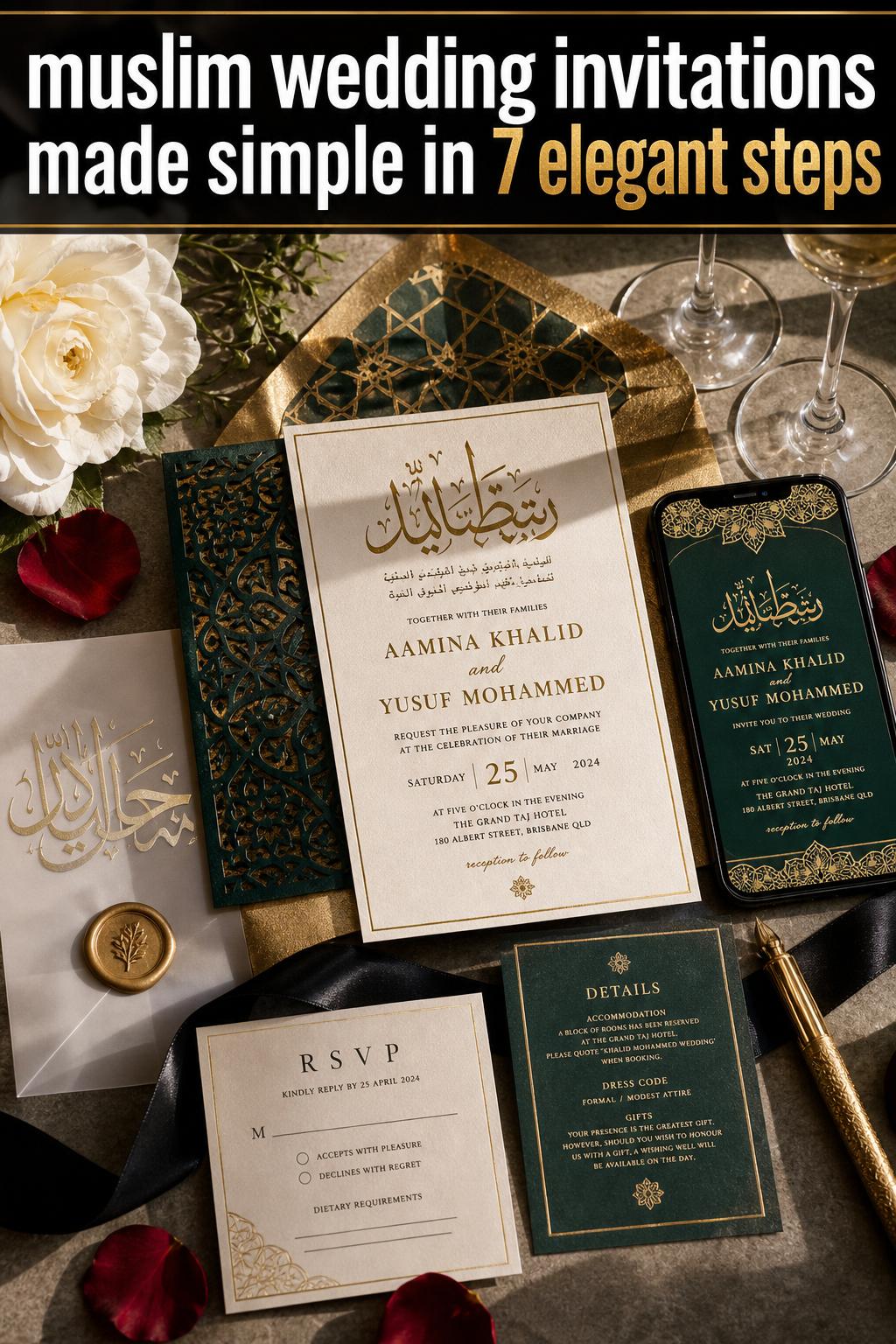
One of the clearest themes across the current market is variety in format. Sakinah Studios highlights bespoke and self-editable digital invitations, IslamicWeddingCards features digital Muslim wedding invitations alongside premium printed collections, and trend coverage from ShadiCards points to continued growth in digital, boxed, and luxury styles. That tells you something important: there is no single “correct” format for Muslim wedding invitations anymore.
Printed invitations still carry weight for formal celebrations, especially when families want a keepsake or when the event includes traditional hosting. Digital invitations appeal to couples planning across cities, managing fast-moving guest counts, or wanting a cleaner RSVP process. Hybrid systems often make the most sense for U.S. weddings, particularly when families have different expectations around formality and convenience.
When printed invitations make the most sense
Printed Islamic wedding cards are often the strongest choice for larger formal weddings, traditional family-hosted events, and designs that depend on tactile finishes like foil. They also suit couples who want the invitation to become part of the wedding memory box. If your venue and celebration style lean luxurious, printed pieces create a stronger first impression than a phone screen usually can.
Best for: classic ballroom weddings, formal walimas, multi-generational guest lists, and families who value mailed stationery.
Common mistake to avoid: underestimating mailing time, proofing time, and reprint risk if details change.
Where digital invitations shine
Digital Muslim wedding invitations work especially well for shorter timelines, destination-adjacent guest travel, or celebrations with multiple updates. They are also practical when you want separate versions for a nikah, walima, or women-only and family-only gatherings without printing many variations. Self-editable templates, like the kind associated with Sakinah Studios, are useful for couples who want speed and flexibility.
Best for: modern city weddings, couples with guests in different states, smaller budgets, and weddings where details may change.
Why it works: it is fast to send, easy to revise, and naturally supports RSVP tracking.
Budget tip: if you love design but need to keep costs down, invest in one custom digital invitation and use matching event slides or detail cards instead of ordering a full printed suite.
The practical appeal of a hybrid invitation plan
Hybrid invitations combine the strengths of both. Many couples mail a printed invitation to close family and older guests, then use digital invitations for reminders, maps, schedule updates, and RSVP collection. This approach often feels less stressful than trying to make one format solve every problem.
Real-life styling tip: keep the visual identity consistent across both formats. The same color palette, calligraphy style, and event wording help the wedding feel coordinated rather than split between “formal” and “practical.”
The invitation style should reflect Muslim heritage without losing readability
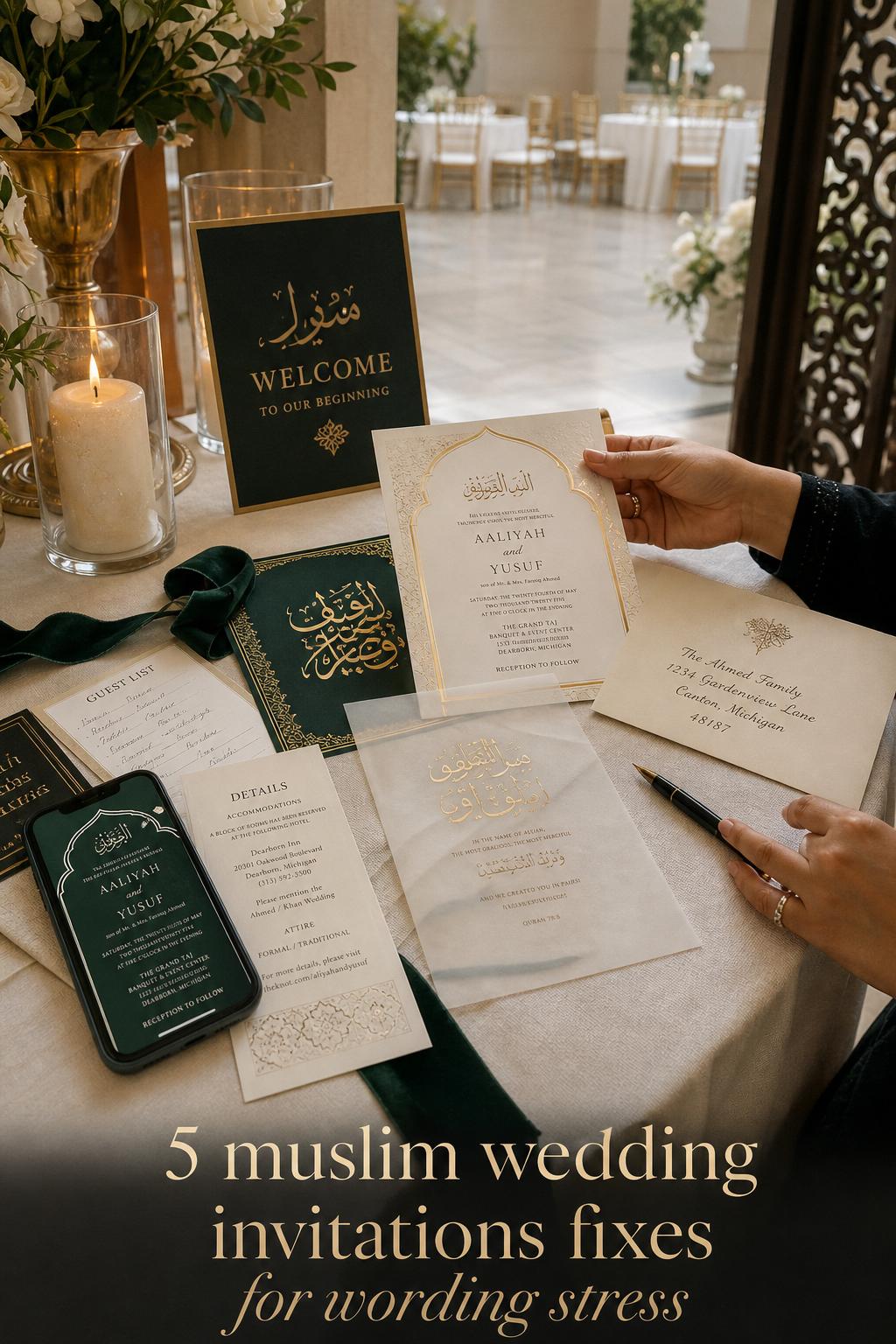
Design motifs appear again and again across invitation brands and template sites: Islamic art references, calligraphy, arabesque-inspired ornament, geometric patterning, and refined typography. That visual direction is one reason Islamic wedding cards feel distinct from generic wedding stationery. But the strongest designs do more than signal heritage. They still need to be readable, mailable, and understandable for every guest who receives them.
This is where many couples make one of two mistakes. Either they choose a design so minimal that it loses all connection to the cultural and religious meaning of the event, or they choose a highly decorative template that overwhelms the wording. The best balance usually comes from letting one or two visual ideas lead: perhaps calligraphy and foil, or geometric pattern and soft color, rather than using every motif at once.
Using calligraphy and typography with intention
The broader conversation around Muslim wedding invitations increasingly points toward calligraphy as both a design feature and a statement of identity. The outline of the category also highlights styles such as Naskh, Diwani, Kufic, and Thuluth as useful ways to think about Arabic script in modern invitations. Whether you use Arabic prominently or just as an accent, legibility matters as much as beauty.
Best for: couples who want the invitation to feel rooted in Islamic visual tradition, especially when the wedding style is elegant, formal, or culturally expressive.
Why it works: calligraphy creates an immediate connection to the occasion and helps the invitation feel more intentional than off-the-shelf generic stationery.
How to make it work: if your guest list is mixed, let decorative script introduce the design while the main event details stay in a clean, highly readable typeface. This keeps the invitation graceful without sacrificing function.
Common mistake to avoid: using ornate script for names, date, venue, and timing all at once. Guests should not have to decode key details.
Budget tip: a single calligraphic heading paired with simpler body text often looks more polished than trying to custom-letter the entire piece.
Motifs that feel traditional, modern, or somewhere in between
Templates and product collections from brands like Scarlet Veils and IslamicWeddingCards show how varied this category has become. Some designs lean heavily into traditional motifs and ornament. Others use a cleaner layout with just a hint of Islamic patterning. Neither approach is automatically better. The right direction depends on venue, guest expectations, and the tone of the events.
- For a formal walima, foil with symmetrical patterning often suits the occasion well.
- For an intimate nikah, a quieter design with soft calligraphy and restrained ornament can feel more personal.
- For a modern city wedding, a digital invite with subtle Islamic motifs may feel more current than a heavily embellished print suite.
Real-life styling tip: match the invitation’s visual density to the wedding environment. A grand venue can support richer detail; a simple home or mosque setting often feels more coherent with a cleaner layout.
Wording that honors faith and still guides every guest clearly
Wording is one of the most searched parts of this topic for a reason. Many couples already know roughly what they want the invitation to look like. What they struggle with is what to say. Resources from Swayy Invites, Wedding Invitation Wording Ideas, Invitation Street, and ShadiCards all reflect the same need: Muslim wedding invitation wording must feel respectful, sincere, and clear.
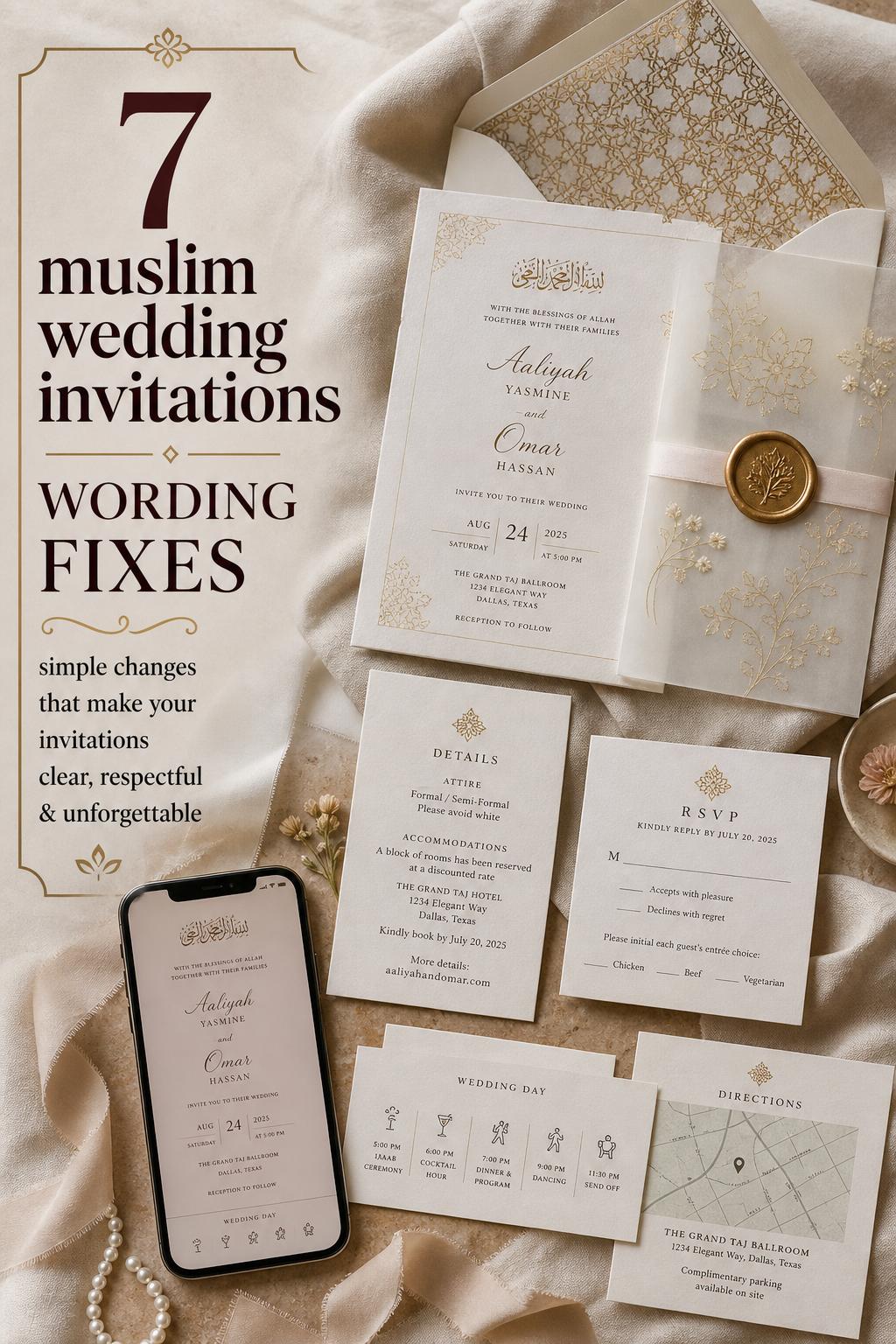
There is rarely one perfect script. Some families prefer traditional phrasing with blessings and religious openings. Others want modern English with a brief Islamic reference. Couples with mixed guest lists often need wording that welcomes everyone without flattening the religious identity of the event. The answer is not to remove faith language. It is to organize it so guests understand both the significance and the practical details.
A strong wording structure for most invitations
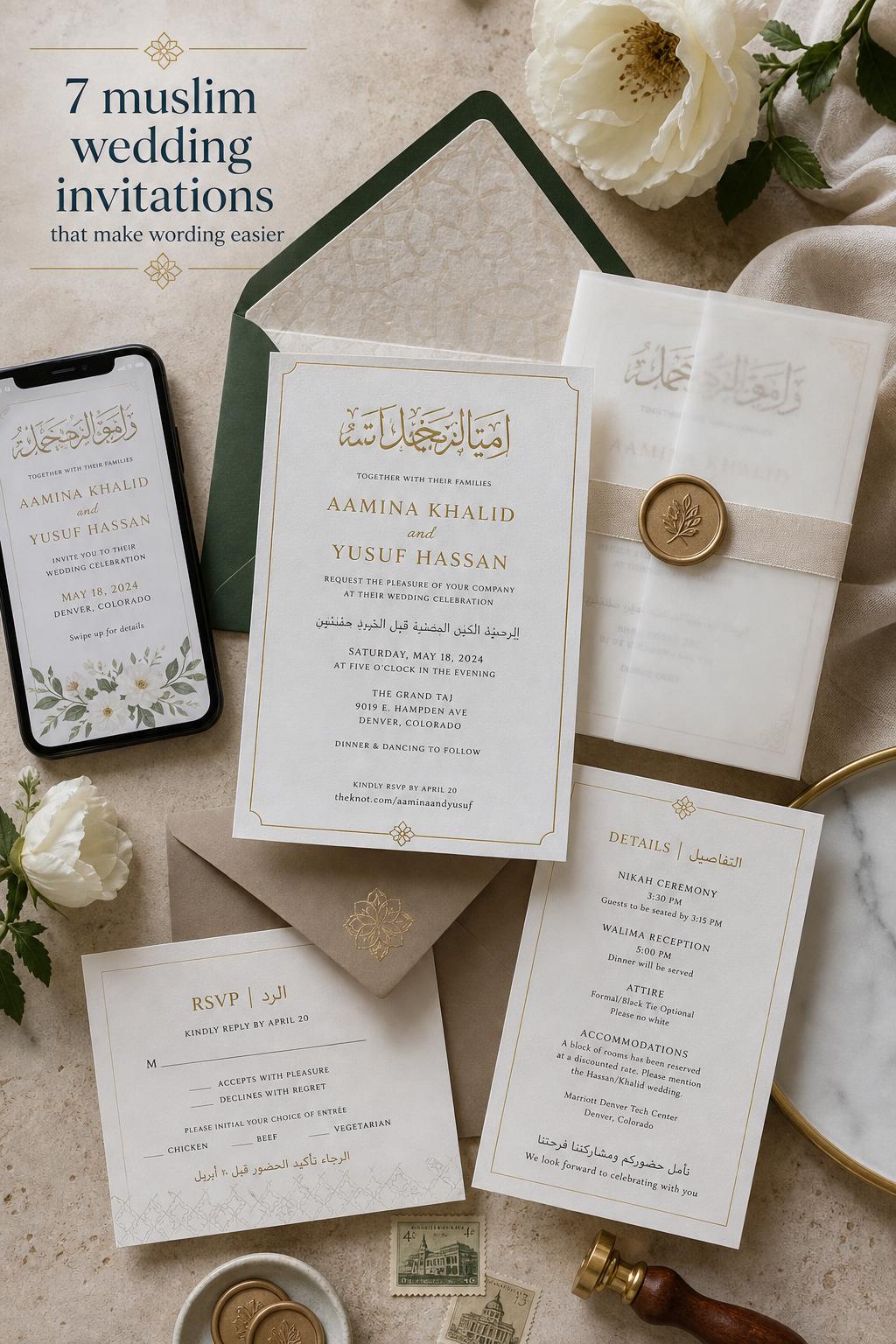
- An opening line, which may include Bismillah, a blessing, or a respectful faith-centered phrase
- The hosts, whether parents, families, or the couple themselves
- A clear invitation to the nikah, the walima, or both
- The names of the couple
- Date, time, venue, and RSVP details
- Any needed note for attire, schedule, or separate event access
Best for: nearly every wedding style, because this structure works whether the tone is traditional, modern, formal, or simple.
Why it works: it lets sacred or meaningful language set the tone without burying the details guests need.
How to make it work: if you include Arabic, make sure the English portion is complete on its own. Guests should not miss key information because it appears only in one language.
Common mistake to avoid: copying wording from another invitation that reflects a different event structure, cultural norm, or host arrangement than your own.
Real-life styling tip: read the wording aloud before approving it. If it sounds formal but confusing, guests will feel the same when they read it.
Traditional wording versus modern wording
Traditional wording often includes blessings, formal host language, and a more ceremonial tone. Modern wording is usually shorter, cleaner, and more direct. Invitation Street and other wording-focused sources show that both styles remain relevant. The better question is which one fits your actual wedding atmosphere.
Choose traditional wording if the ceremony is formal, family-led, or rooted in established custom. Choose modern wording if the couple is hosting directly, the design is minimalist, or many guests are unfamiliar with religious terminology. You can also combine the two by using a traditional opening with modern event details below.
For U.S. weddings, guest clarity matters as much as cultural beauty
A recurring practical issue for Muslim weddings in the United States is that invitation audiences are often diverse. Some guests understand terms like nikah and walima immediately. Others may be attending their first Muslim wedding. This is where thoughtful wording and layout make the biggest difference. The goal is not to dilute the wedding’s identity. It is to make guests feel oriented and respected.
If your invitation uses terms that not everyone will know, pair them with context. A simple subtitle, a separate details card, or a digital event page can explain enough without making the main invitation feel crowded. This is especially useful when the celebration includes secular civil aspects alongside religious events, a point that has particular relevance for U.S. couples balancing ceremony and legal planning.
Practical guest-facing details worth including
- Whether the invitation is for the nikah, the walima, or both
- Whether printed details are final or if updates will follow digitally
- Whether a separate RSVP method will be used
- Any essential scheduling distinction between religious and celebratory portions of the day
Best for: weddings with interfaith friendships, colleagues on the guest list, destination guests, or events split across different venues.
Why it works: guests are less likely to arrive at the wrong time, miss a key event, or feel uncertain about etiquette.
Budget tip: instead of adding multiple printed inserts, place extended information on a matching digital details card or event page.
Common mistake to avoid: assuming guests will ask if they are confused. Many will not; they will simply guess.
Materials and finishes shape the first impression more than couples expect
The visual language of Islamic wedding cards is often tied to materials. IslamicWeddingCards emphasizes digital invites as well as real foil Muslim wedding invitations and broader wedding collections, while ShadiCards’ trend coverage points toward luxury formats, boxed invitations, and eco-conscious options like seed paper. This tells couples something useful: finish and format are not separate decisions. The material itself communicates formality, budget level, and overall style.
Foil, premium finishes, and luxury presentation
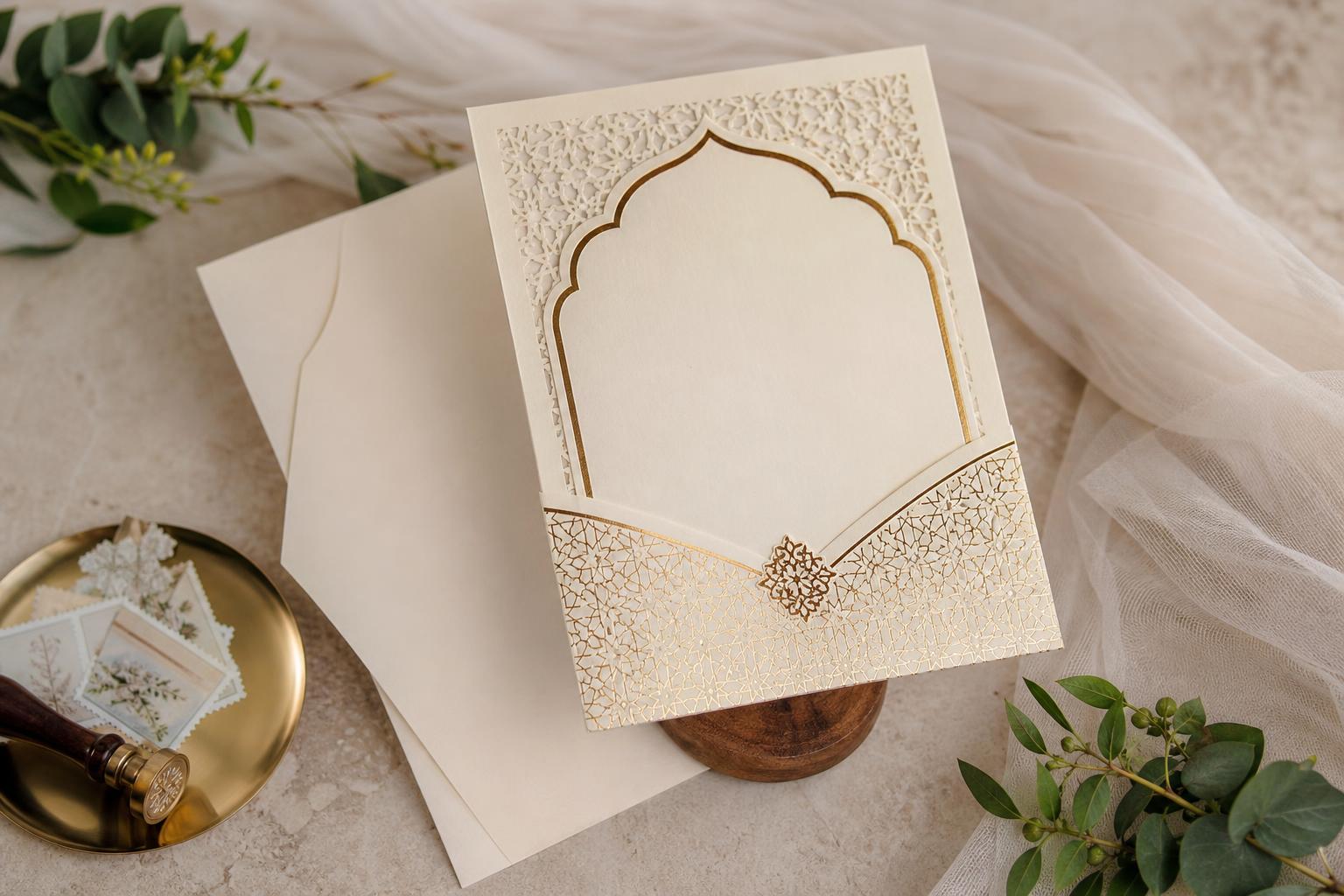
Foil works well when you want to highlight names, sacred openings, borders, or motifs without relying on too many colors. It suits evening receptions, formal venues, and weddings where the invitation should feel celebratory from the moment it is opened. Boxed invitations create a strong luxury impression, but they also raise production and shipping considerations.
Best for: larger budgets, formal walimas, and weddings where the invitation is part of the luxury experience.
Why it works: premium finishes can make even a simple layout feel special and considered.
Common mistake to avoid: adding foil, embossing, complex borders, and multiple inserts all at once. Too many premium elements can make the suite feel heavy and visually crowded.
Eco-conscious options that still feel wedding-worthy
ShadiCards’ coverage of seed paper points to a growing interest in sustainability. For couples who want a lighter environmental footprint, eco-friendly invitations can still feel elevated if the design is intentional. A simpler layout often complements these materials better than dense ornament. Sustainability also pairs naturally with digital or hybrid formats.
Best for: couples with a modern planning style, smaller weddings, or celebrations where sustainability is part of the overall wedding vision.
How to make it work: let texture and thoughtful typography carry the design instead of trying to mimic a heavily embellished luxury card on an eco-focused material.
Budget tip: if premium sustainable stock is costly, reserve printed pieces for close family and use digital invitations for the wider guest list.
Real-life styling tip: always request a sample if you are considering unusual material. What looks refined online may feel too casual or too textured for the formality of your event.
Templates, bespoke design, and catalog shopping each solve a different problem
Couples shopping for muslim wedding invitations are usually choosing between three broad routes: templates, bespoke design, and catalog-based ordering. Scarlet Veils focuses on template options, Sakinah Studios emphasizes bespoke and self-editable models, and IslamicWeddingCards presents a catalog structure with collections and formats already built out. Each approach can work well, but only when it matches your planning style.
Templates are helpful when you like a clear style direction and need efficiency. Bespoke design is better when you want a highly personal result or need to combine specific wording, event structures, and visual references. Catalog shopping works best when you want to compare finishes, formats, and price levels quickly.
How to decide which route fits your planning season
- Choose a template if your timeline is short and your wording is fairly standard.
- Choose bespoke design if your wedding includes multiple events, bilingual details, or a very specific visual vision.
- Choose a catalog collection if you want to compare digital, foil, acrylic, or printed options in one place.
Best for: template users on tighter timelines, bespoke clients with strong design preferences, and catalog shoppers who want fast decision-making.
Why it works: matching the purchase path to your real planning style prevents delays and unnecessary revisions.
Common mistake to avoid: starting with a template, then trying to force extensive custom changes that would have been easier in a bespoke process from the beginning.
Budget tip: spend more on custom work only if the invitation truly needs it. If your wording, layout, and event structure are straightforward, a polished template can look just as considered.
Trend-forward does not have to mean disconnected from tradition
Current trends in Muslim wedding invitations point toward customization, digital convenience, sustainability, luxury materials, and stronger personalization. ShadiCards places these ideas at the center of its trend forecasting, and the broader invitation market supports the same direction. But trends only work when they support the wedding itself.
A customized invitation can be as simple as adapting wording and color to your event. A luxury invitation may rely on one premium finish instead of several. A digital invitation can still open with Bismillah or include a faith-centered message. The strongest trend choices are the ones that serve your guest experience, not just current aesthetics.
Best for: couples who want their stationery to feel current without losing the religious or cultural tone of the wedding.
Why it works: it keeps the invitation relevant to how modern couples actually plan while preserving the distinct identity of Muslim celebrations.
Common mistake to avoid: treating “modern” as if it requires stripping away all traditional elements. Often the most memorable invitation is one that combines clean design with meaningful Islamic wording or motifs.
The practical timeline: what to finalize before you send anything
Many invitation problems begin long before the first proof. Couples often start shopping before the event structure, host names, wording preferences, or RSVP system are settled. That creates expensive revision cycles and unnecessary stress. A better approach is to finalize the invitation logic before choosing the invitation style.
Your pre-order checklist
- Confirm whether you are inviting guests to the nikah, the walima, or multiple events.
- Decide whether you want Bismillah, Quran verses, blessings, or English-only wording.
- Choose printed, digital, or hybrid delivery.
- Confirm host names, venue spelling, time, and RSVP destination.
- Know whether your legal or civil ceremony details need to be communicated separately.
Best for: every couple, but especially those planning across families, states, or multiple event dates.
Why it works: you reduce revisions, communicate more clearly, and avoid ordering invitations that no longer reflect the final plan.
Real-life styling tip: finalize wording before you fall in love with a layout. It is much easier to fit a design around your message than to cut meaningful details to fit a pretty template.
A few realistic invitation paths for different wedding styles
Because couples often need decision support more than endless inspiration, it helps to picture how different invitation strategies work in practice.
The formal family-hosted walima
A printed card with foil details, traditional wording, and a clear distinction between nikah and walima works well here. A brand or catalog style similar to what you might find on IslamicWeddingCards is useful when you want a polished, formal presentation. Keep the event details straightforward and avoid overly modern shorthand if the hosting style is traditional.
The modern city wedding with a mixed guest list
A hybrid approach often works best: a refined digital invitation for most guests, with a few printed keepsakes for parents and close relatives. This is where a studio model like Sakinah Studios can be especially practical. Use one faith-centered opening line, then clear English event labeling and digital RSVP handling.
The budget-conscious but design-aware celebration
A self-editable template or streamlined digital suite gives you the most flexibility. Focus your effort on wording and visual consistency rather than expensive finishes. If you want a special touch, print a small number of high-quality copies for photography and family keepsakes rather than mailing them to everyone.
The couple who wants a cultural look without a crowded design
Choose one clear motif, one elegant script treatment, and one restrained color story. A template-led approach like those associated with Scarlet Veils can be a smart fit here. The invitation will still read as Islamic and wedding-specific, but it will feel calm and current rather than overloaded.
Common invitation decisions couples regret later
Most invitation regret comes from preventable mismatches: a very formal card for an informal event, a highly stylized design that guests cannot read, or wording that sounds traditional but fails to explain the schedule. The invitation should not only impress. It should orient.
- Choosing decoration before deciding what the invitation needs to communicate
- Using Arabic or blessings without checking readability and spacing
- Sending only digital invites when key family members expect printed cards
- Printing sacred text without thinking through handling etiquette
- Combining too many premium design elements in one suite
- Relying on borrowed wording that does not fit your actual event structure
If you avoid those pitfalls, the invitation process becomes much simpler. Most successful suites are not the most complex ones. They are the ones where message, format, and style all agree with each other.
Bringing everything together with confidence
The most memorable Muslim wedding invitations do more than announce a celebration. They reflect the values of the couple, the structure of the wedding, and the experience guests are about to step into. Whether you are drawn to a bespoke digital suite from Sakinah Studios, etiquette guidance shaped by Zola, trend-led inspiration from ShadiCards, a premium foil design from IslamicWeddingCards, or wording support from Swayy Invites, Invitation Street, Wedding Invitation Wording Ideas, or Scarlet Veils, the same principle applies: choose with intention.
Let your invitation reflect the real shape of your wedding. If faith-centered wording matters, give it room. If clarity for guests matters, state details plainly. If your budget is tight, simplify the format rather than the meaning. And if your style leans modern, remember that tradition and contemporary design do not compete when they are balanced well. They strengthen each other.
The right invitation feels like an honest beginning. It prepares your guests, supports your planning, and sets the emotional tone for everything that follows.
FAQ
What should be included in muslim wedding invitations?
Most muslim wedding invitations should clearly state whether guests are invited to the nikah, the walima, or both, along with the couple’s names, host names if relevant, date, time, venue, and RSVP details. Many couples also include Bismillah, a blessing, or another faith-centered opening, but the wording should remain easy for guests to understand.
Is it appropriate to include Quran verses on a wedding invitation?
It can be appropriate, especially for a formal or traditional invitation, but it should be a considered choice rather than a decorative one. Couples should think about readability, whether guests will understand the wording, and the practical etiquette around handling or disposing of printed pieces that contain sacred text.
What is the difference between a nikah invitation and a walima invitation?
A nikah invitation is for the marriage ceremony, while a walima invitation is for the celebration or reception that follows. Some weddings combine these in one invitation, but if the events have different guest lists, venues, or schedules, separate wording or separate invitation sections usually works better.
Are digital Muslim wedding invitations acceptable?
Yes, digital Muslim wedding invitations are widely used and can be a practical choice for modern weddings, shorter timelines, and guest lists spread across different locations. They are especially useful when couples need easy updates or a simpler RSVP process, though some families still prefer printed invitations for formal events.
How do I make the invitation clear for non-Muslim guests?
Use clear event labeling, complete English details, and simple explanations where needed. You do not need to remove Islamic wording or terms like nikah and walima, but it helps to pair them with enough context that every guest understands what they are attending and when.
What invitation style works best for a formal Muslim wedding?
For a formal Muslim wedding, printed invitations with premium finishes such as foil often work well, especially when paired with balanced calligraphy and traditional wording. The design should still remain readable, with enough spacing for names, event details, and any faith-centered opening text.
Should I choose a template or a bespoke invitation design?
A template is usually best when your timeline is short and your wording needs are straightforward, while a bespoke design makes more sense when your wedding includes multiple events, bilingual details, or a very specific visual direction. The right choice depends less on trend and more on how customized your invitation actually needs to be.
Can I mix traditional wording with a modern invitation design?
Yes, and that combination often works especially well. A modern layout can still include Bismillah, blessings, or traditional host language, as long as the overall composition stays clean and the key event information remains easy to read.
What are the most popular trends in Muslim wedding invitations right now?
Current trends include stronger personalization, digital invitation formats, premium finishes such as foil, boxed invitation styles, and eco-conscious materials like seed paper. The most effective trend choices are the ones that support your wedding logistics and reflect your event style rather than simply following what is popular.