Why Caricature Wedding Invitations Feel Chic Right Now
Some wedding invitations quietly do their job, and some become the first true expression of a couple’s personality. caricature wedding invitations sit in that second category, which is exactly why they can feel both exciting and unexpectedly difficult. Couples often love the idea of something playful, personal, and story-led, but then hesitate: will it still feel elegant, will relatives understand the tone, will it print well, and will it fit the rest of the wedding stationery?
The stress usually begins when aesthetics and practicality start pulling in different directions. A funny caricature can feel too casual if the rest of the event is formal. A beautiful illustration can lose impact if the file is not prepared properly for printing. An AI-generated design may be fast, but it may not capture the emotional details a couple wants. A hand-drawn commission may feel more meaningful, but timelines, revisions, and rights can quickly become confusing.
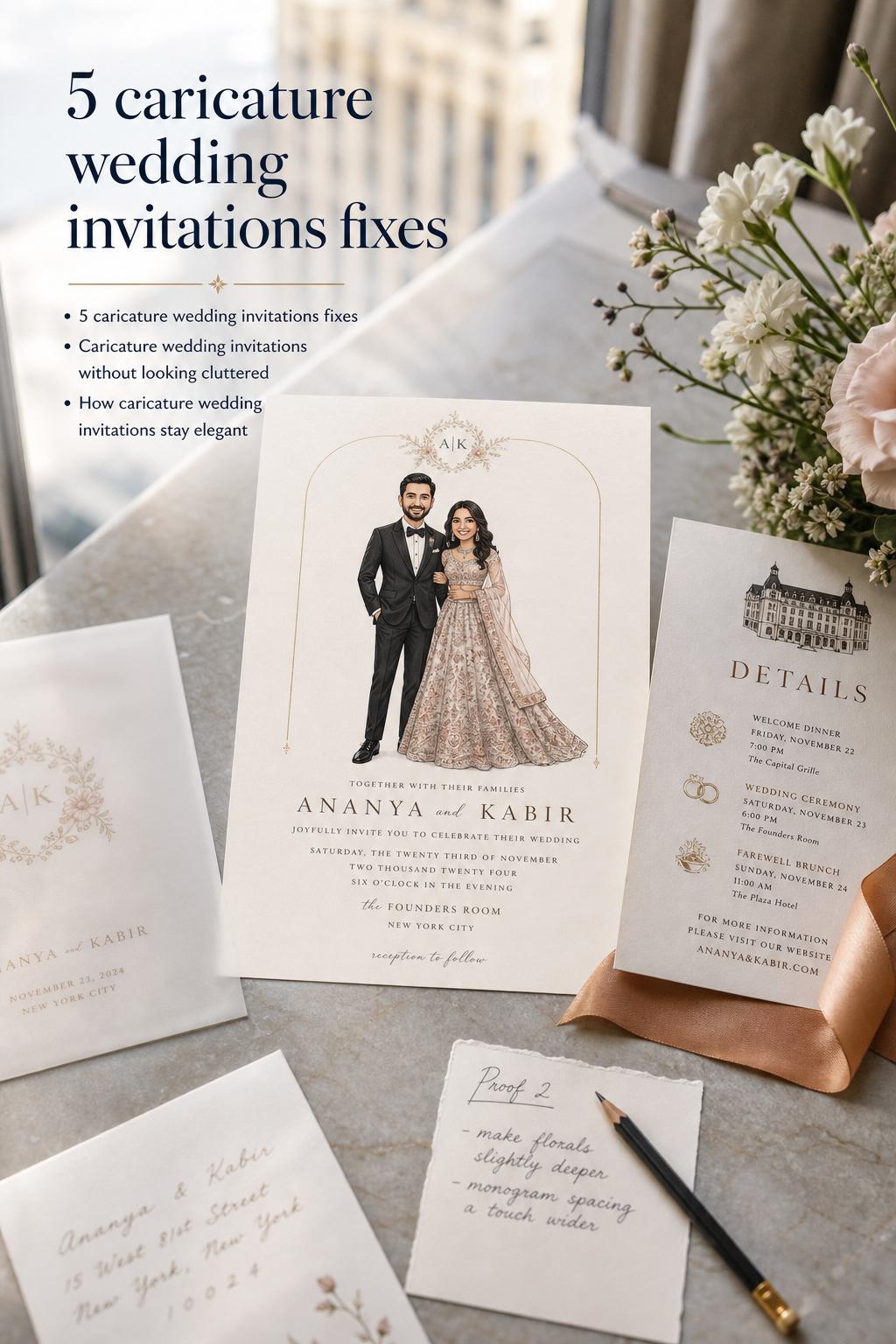
This guide is designed to solve that tension. Whether you are exploring a from-photo cartoon invite, comparing Pixelcut AI with an artist-led service like Photolamus, considering an Indian wedding caricature invite from InviteKaro, or simply trying to make your wedding invitation design feel personal without becoming visually chaotic, the goal is the same: create an invitation that feels joyful, cohesive, and realistic to use in the real world.
Why this wedding challenge happens
Caricature invitations ask one design to do many jobs at once. It has to introduce the event, reflect the couple, set the tone, and still function as readable wedding stationery. That is harder than it looks. A caricature is naturally expressive, but invitations also need structure, clarity, and polish. When those elements are not balanced, the result can feel more like a novelty illustration than a well-composed invitation suite.
Turn wedding inspiration into a plan you can actually follow.
Zarellea brings your guest list, budget, vendors, and day-of details into one shared space — so no beautiful idea gets lost in the shuffle.
Another reason this becomes complicated is that couples are often choosing between very different creation paths. AI-based tools such as Pixelcut AI and Caricature Maker promise speed and accessibility. Artist-led platforms such as Photolamus, Your Personal Cartoonist, Sangme Caricature, Caricature King, Caricature24, and MyBeautifulMemory emphasize custom work and personality. Neither path is automatically better for every wedding. The right choice depends on timing, expectations, style preference, and how much control you want over revisions and final details.
Cultural context also matters more than many couples expect. An invitation for a modern New York celebration may call for a different visual tone than a multi-event Indian wedding, where the caricature may need to reference more than one function or tradition. Some vendors, including InviteKaro, clearly lean into that broader event storytelling. This is where many couples feel overwhelmed: they are not just picking a drawing style, they are deciding how much personality, humor, tradition, and formality should appear in the first impression guests receive.
The styling principles that make caricature invitations work
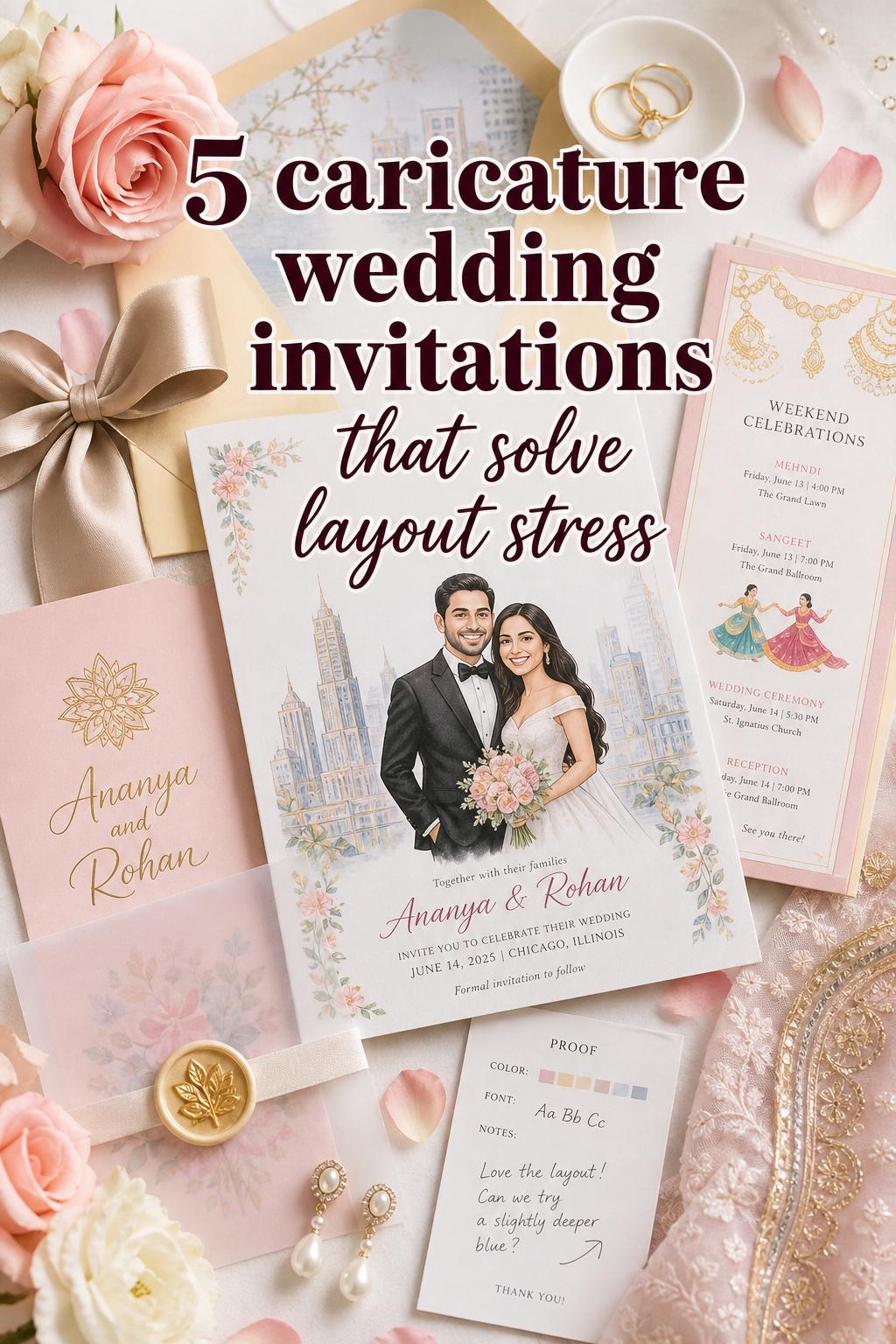
The strongest caricature wedding invitations are not successful simply because the illustration is good. They work because the invitation is built around a few clear principles: personality without clutter, humor without confusion, and visual charm without sacrificing function. Once couples understand these principles, decisions become easier and the invitation starts to feel intentional rather than risky.
- Match the caricature tone to the wedding tone. A playful cartoon can still feel elegant if the typography, spacing, and palette are refined.
- Use the caricature as a focal point, not the entire design. This prevents the layout from becoming crowded.
- Keep the couple recognizable, especially when using a from-photo process or an AI caricature invite.
- Plan for print from the beginning, including CMYK, DPI, and bleed requirements if the artwork will be professionally printed.
- Think beyond the invitation card. If the illustration will also appear on a wedding website, RSVP page, or favors, usage consistency matters.
These principles matter because guests experience invitations quickly. They glance at the artwork, absorb the mood, and search for the practical details. If the caricature overwhelms the information, the design becomes tiring. If the information overwhelms the caricature, the artwork feels wasted. The best invitations create a calm hierarchy: personality first, clarity immediately after.
Choosing the right style: playful, refined, or culturally specific
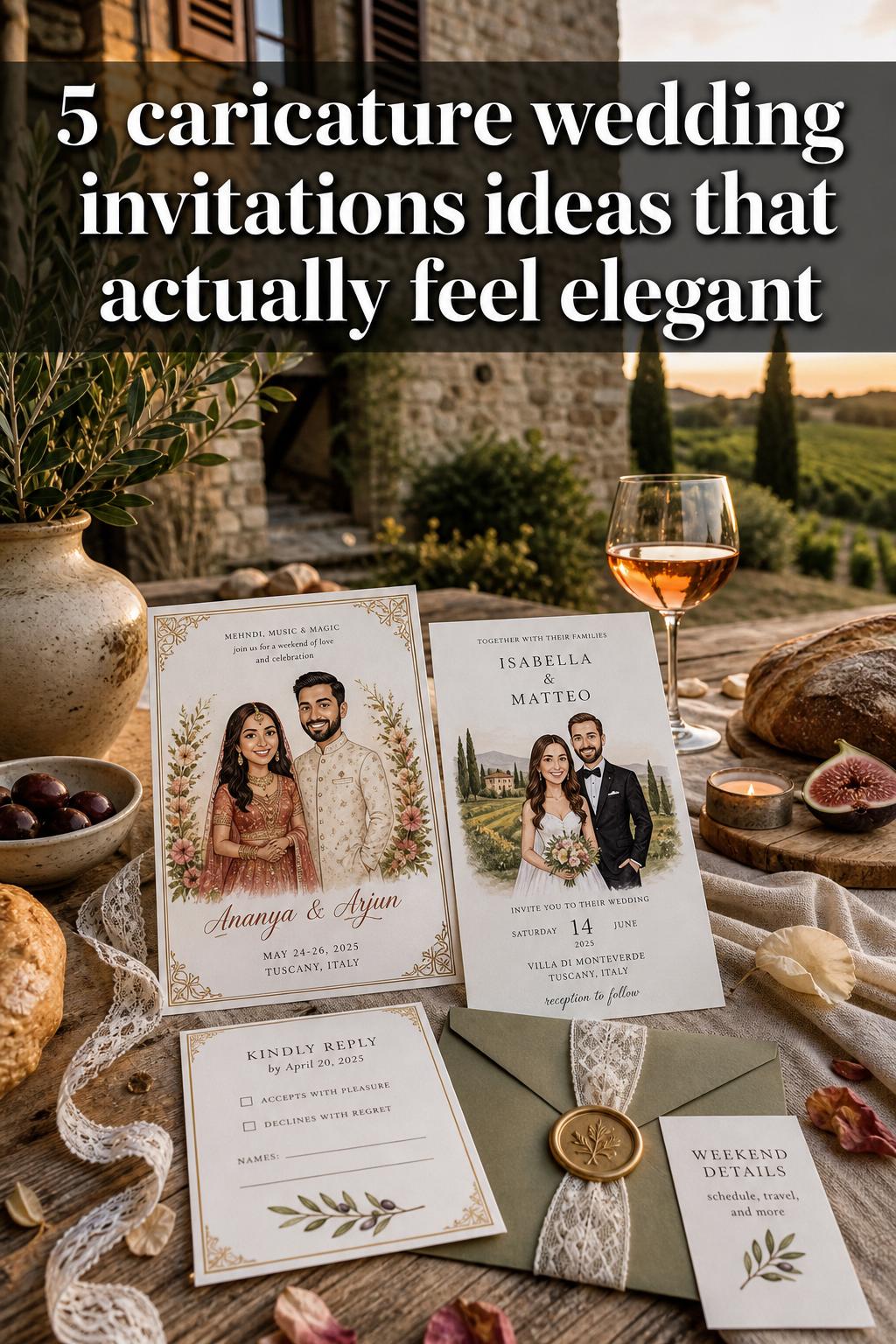
Playful caricatures for couples who want warmth and humor
The most common reason couples choose caricature wedding cards is emotional. They want guests to smile before the celebration even begins. A playful style works especially well when the wedding itself is relaxed, modern, or guest-focused. It can show the couple’s hobbies, proposal story, venue mood, or a lighthearted scene that feels unmistakably personal.
The practical key is restraint. A playful caricature does not need every inside joke added to the page. Too many props, exaggerated expressions, or competing background details can make the invitation harder to read and harder to print attractively. If you want a lively design, keep the scene focused and let the text layout do the work of keeping the invitation polished.
When this style is handled well, the result feels inviting rather than silly. Guests understand that the celebration will be personal and joyful, and the couple gets an invitation that feels memorable without losing control of the overall aesthetic.
Refined caricatures for formal or design-conscious weddings
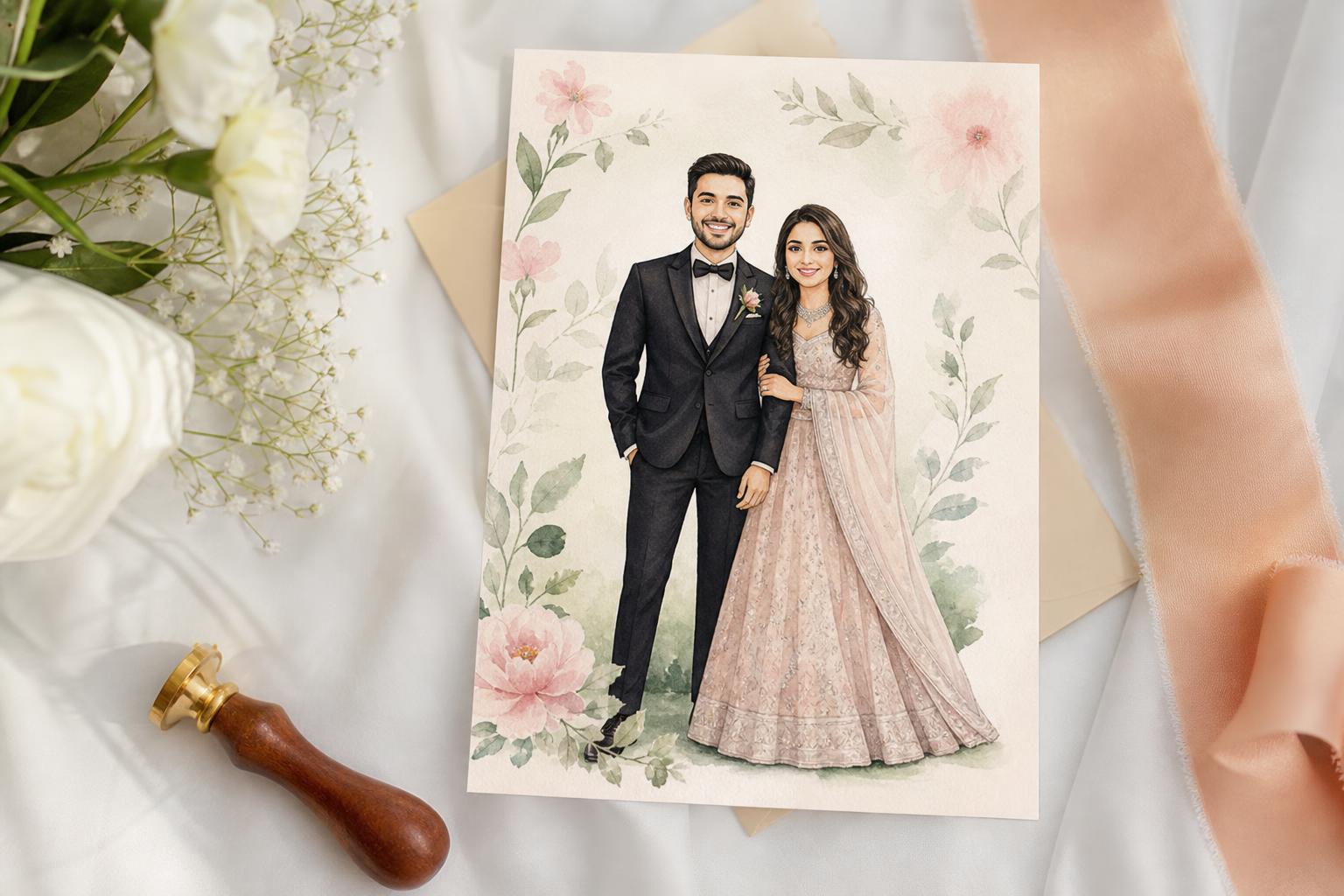
Many couples assume caricatures have to be loud or comic, which is one reason they dismiss the idea too quickly. In reality, a refined caricature can feel surprisingly elegant. The difference is usually in the drawing style, color palette, and how the invitation uses negative space. Softer expressions, cleaner lines, and a composed scene can shift the artwork from novelty to stylized portrait.
This is often the better route for black-tie celebrations, city weddings, or couples who want personality but still care deeply about a timeless stationery look. Artist-led services such as Your Personal Cartoonist, Sangme Caricature, Caricature24, and Photolamus are especially relevant here because the promise is not just caricature, but customization and illustration quality.
The emotional effect is important. A refined caricature keeps the invitation personal without making formal guests feel unsure about the dress code or atmosphere. It says, “this wedding has personality,” not “this wedding is casual.” That distinction can shape expectations in a helpful way.
Cultural and themed caricatures that tell a broader story
For multicultural weddings and especially Indian wedding events, the caricature often has to carry more narrative weight. It may reference multiple celebrations, traditional clothing, symbolic details, or family expectations around presentation. InviteKaro’s focus on Indian wedding caricature invites reflects a real need: not every couple wants a single generic card when the celebration itself spans different moments.
The challenge here is cohesion. If the invitation tries to represent every ritual, outfit, and event in one crowded scene, the result can feel visually exhausting. A better approach is to choose one unifying illustration style and then decide which details truly matter. That might mean emphasizing attire, the couple’s pose, or one key event setting rather than trying to include everything.
This kind of invitation often feels especially meaningful because it communicates identity, not just decoration. Guests immediately see that the wedding is rooted in personal and cultural story, and that gives the stationery emotional depth beyond simple visual novelty.
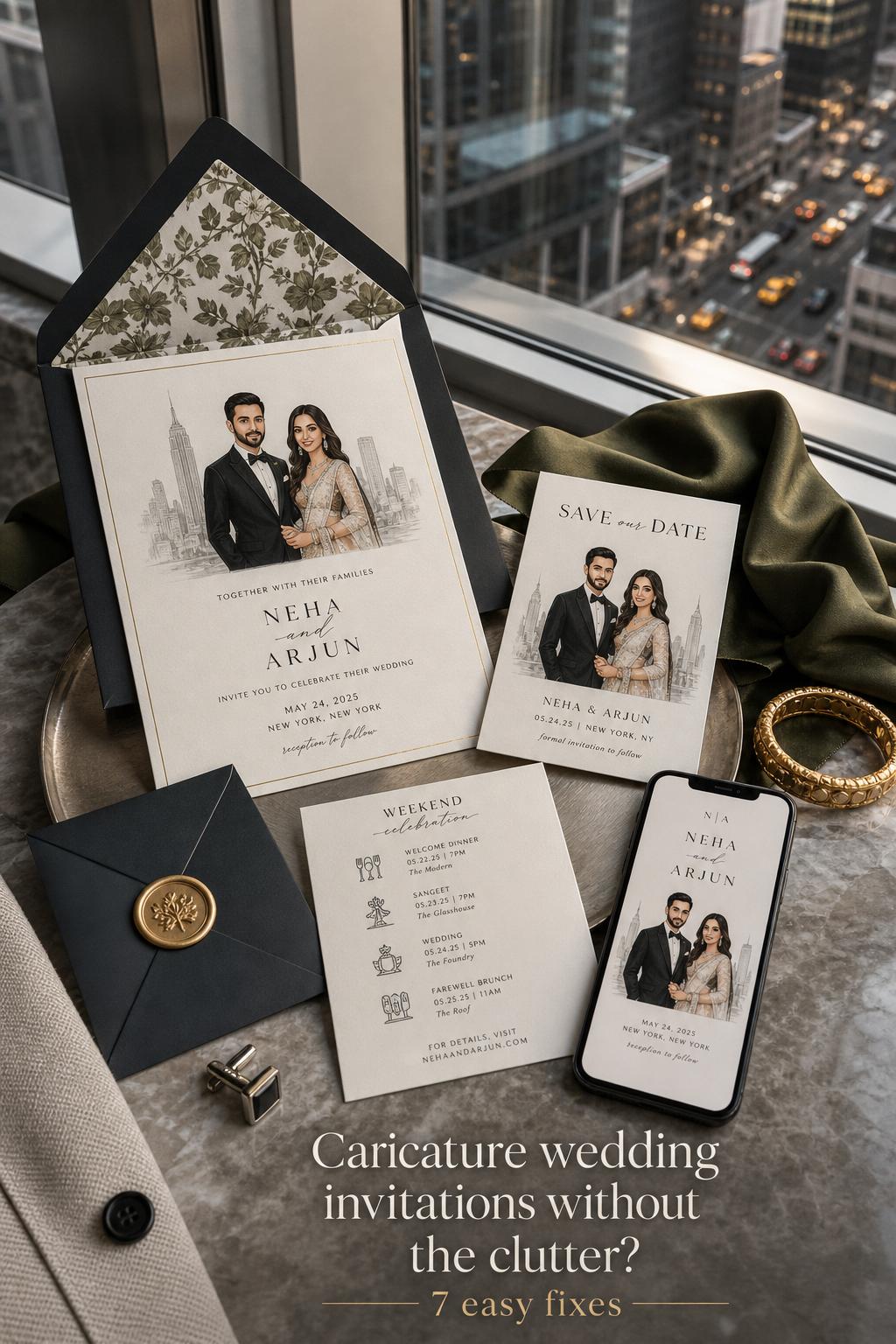
From photo to invitation: the process that keeps the result polished
Start with the right photo
One of the most common problems with personalized caricature wedding invitations from photo is that couples assume any favorite picture will work. In practice, the source image affects almost everything: facial recognition, body language, outfit reference, and whether the final caricature feels flattering. A charming memory is not always the clearest reference image.
Choose a photo where both faces are visible, proportions are clear, and expressions feel natural. If the invitation needs to show specific clothing, hair, or accessories, make sure those details are easy to see. This helps both AI caricature wedding invitation generator tools and human artists interpret the couple accurately. It also reduces unnecessary revisions later.
The right photo saves time and protects the mood of the design. When the caricature looks recognizably like the couple, the invitation feels intimate and affectionate instead of generic.
Build the scene intentionally
Once the likeness is established, the next question is setting. Caricature Maker highlights choices such as venue, flowers, palette, and export-ready artwork, and that reflects a useful planning truth: the background is not filler. It tells guests how to read the invitation. A city skyline, floral setting, ceremonial stage, or minimal backdrop each creates a very different mood.
Think in layers. First choose the couple’s pose. Then decide whether the scene needs a venue cue, symbolic props, or color accents. Keep only the details that support the wedding story. If every element competes for attention, the invitation loses elegance. If the scene is too empty, it may feel unfinished. Balance is what makes the design look editorial rather than accidental.
When the scene is chosen carefully, the invitation starts doing emotional work. It gives guests a visual doorway into the celebration, and it helps the couple feel that the card belongs to their wedding rather than just borrowing a trend.
Understand the trade-off between AI-assisted and hand-drawn work
This is often the biggest planning decision. AI-assisted options like Pixelcut AI and Caricature Maker can be appealing for couples who need speed, want to test ideas, or prefer a digital-first workflow. They are especially helpful when you want to experiment with prompting, style direction, or scene concepts before committing to a final format.
Hand-drawn or artist-led services such as Photolamus, Caricature King, Sangme Caricature, Your Personal Cartoonist, and MyBeautifulMemory typically appeal to couples who want a more bespoke result, stronger interpretation of facial details, or a more curated invitation feel. They may also be more suitable when the caricature needs to balance humor with sophistication.
Neither option should be chosen out of pressure. AI can be efficient, but it may require careful prompting and additional editing to feel truly personal. Artist-led work can feel richer, but the process may involve longer timelines and more structured revision stages. The best choice is the one that matches your timeline, budget comfort, and emotional expectations for the finished artwork.
Do not leave print specifications until the end
A beautiful digital caricature can become disappointing very quickly if it is not prepared for print. This is one of the most overlooked parts of wedding invitation design. Couples often focus on style first and assume production details can be solved later, but file format and print readiness influence the final look more than many expect.
- Confirm whether the final file is intended for digital-only use or professional printing.
- Ask for print-ready specifications such as CMYK color mode, sufficient DPI, and bleed allowances.
- Clarify whether the art is being delivered for a single card or an entire invitation suite.
- Check how text will be placed so readability is preserved after printing.
These details may sound technical, but they are really design protection. They help preserve color, sharpness, and layout integrity so the invitation you approved on screen still feels beautiful in hand.
Working with vendors without creating extra stress
One reason couples feel stuck with caricature invites is that the market is fragmented. Some providers are clearly product-based, some are artist portfolios, and some are tool-driven platforms. Caricature Online, MyBeautifulMemory, Caricature King, Photolamus, Caricature24, and Your Personal Cartoonist all sit slightly differently within that landscape. That means your buying process will not be the same everywhere.
Before ordering, define what you actually need. Are you looking for a complete wedding invitation caricature card, an illustration only, or artwork that can be adapted across invitations, websites, and favors? A service that is excellent for producing a single card may not be the best fit if you need broader wedding stationery coordination.
What couples usually overlook
The most common oversight is revision policy. Couples often assume “custom” means unlimited changes, but vendor processes differ. Some services are structured around product options, while others behave more like commissions. Booking timeline matters too. A rushed invitation order can force compromises on likeness, scene complexity, or print testing.
A calmer approach is to ask a few focused questions early: what is included, how many revisions are available, what the artwork can be used for, and whether the final file is suitable for print and digital assets. This protects both style and logistics. It also helps you compare U.S.-focused needs with international options, especially if you are considering a vendor whose audience is broader than the U.S. wedding market.
Good vendor communication does more than prevent mistakes. It gives couples confidence, which matters during wedding planning. When expectations are clear, the invitation process feels creative instead of fragile.
Production choices that shape the final impression
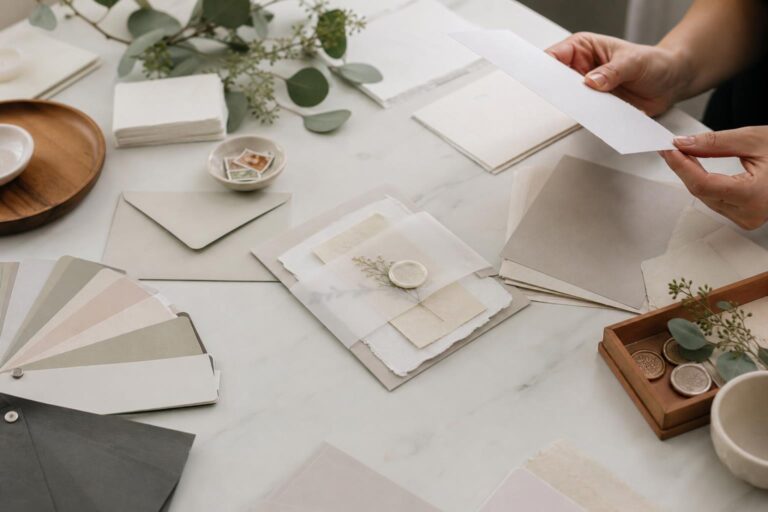
Even the best caricature can feel underwhelming if production choices are treated as an afterthought. Paper stock, finish, and proofing affect whether the invitation feels polished, playful, luxurious, or slightly off-balance. This is where many couples unintentionally lose the sophistication they were hoping to preserve.
Paper, finish, and print method
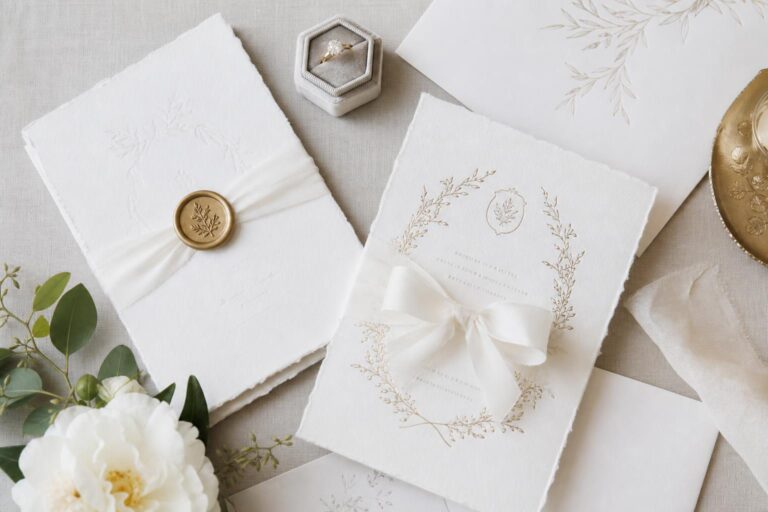
If the caricature style is highly detailed, the print surface should support clarity rather than muddy it. Textured card stock can add tactile romance, but too much texture may soften fine illustration lines. If the invitation is minimal and refined, foil or letterpress accents can elevate the suite without competing with the caricature itself. The key is choosing one or two finishing ideas that support the artwork rather than turning the card into a collection of disconnected effects.
This is also where visual hierarchy matters. If the caricature is already expressive, the surrounding stationery should often be quieter. A calm envelope, measured typography, and controlled finish can make the illustration feel more intentional. Excess finishing on an already lively design can tip into clutter very quickly.
When production is handled well, the invitation feels complete in hand. Guests notice that it is not just cute or unusual, but thoughtfully made.
Color management and proofing
Caricature invitations are especially sensitive to color shifts because skin tones, clothing, and decorative accents all contribute to recognizability. What feels bright and balanced on screen can look flatter in print if proofing is skipped. This is why color management matters even for couples who are not especially design-oriented.
Whenever possible, review a proof before full production. Pay attention to skin tone warmth, text contrast, and whether any fine details are getting lost. If the invitation is intended to coordinate with a wedding website or RSVP page, check that the digital and printed versions still feel like part of the same visual family.
This extra pause reduces disappointment. It is a small logistical step that protects the emotional payoff of receiving the finished stationery.
How to make the invitation feel personal without becoming busy
Personalization is the entire point of caricature wedding invitations, but personalization is also where couples often overdesign. Once they realize the illustration can include outfits, flowers, venues, pets, hobbies, and event references, it becomes tempting to add everything. The result can feel sincere but visually scattered.
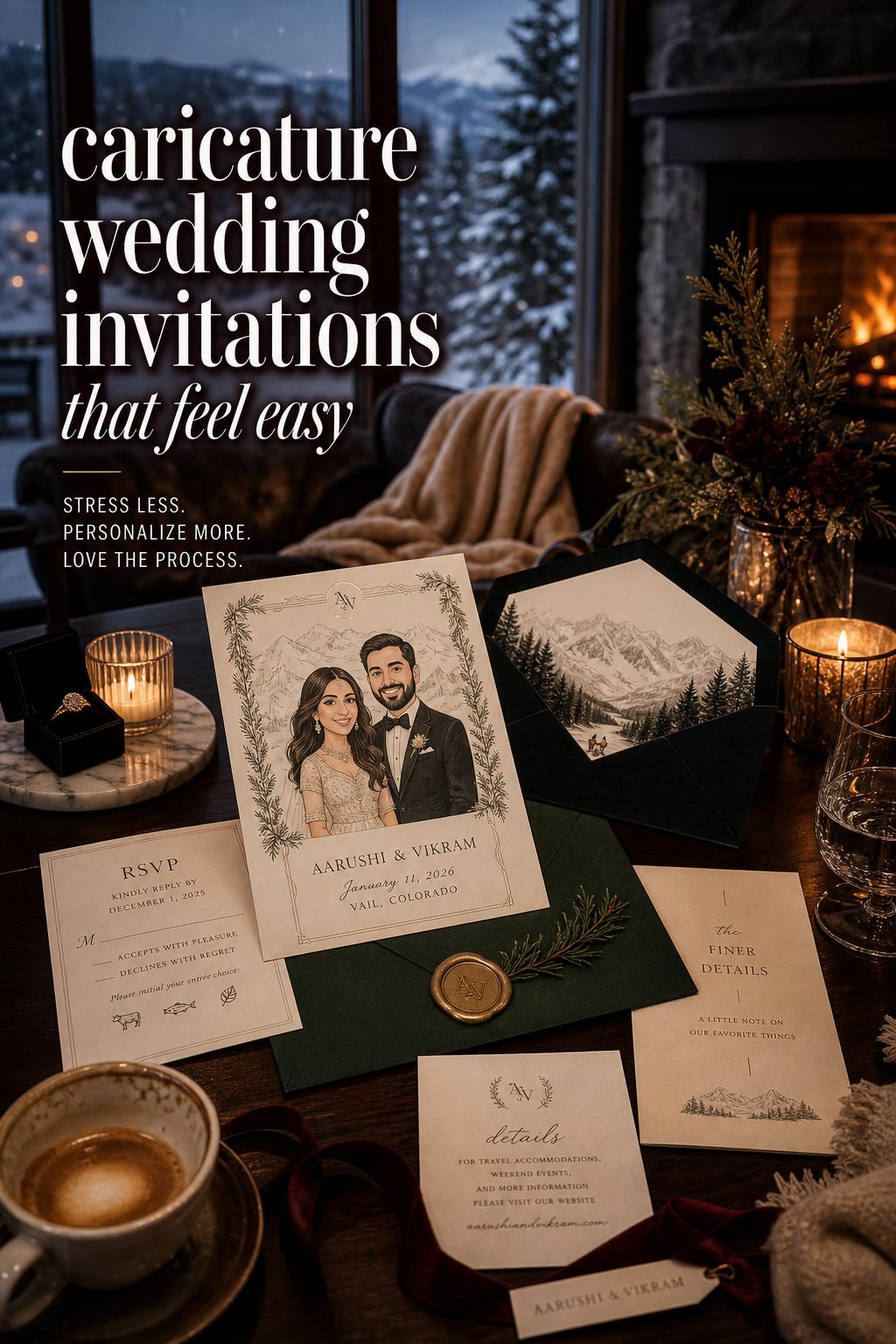
The simplest way to elevate the look is to choose one primary story and one secondary detail. For example, the primary story might be “the couple in wedding attire,” and the secondary detail might be “a venue-inspired background” or “a nod to a shared interest.” That gives the invitation character without overwhelming the page. This approach works for both playful and elegant caricatures, and it is especially useful when adapting the same art across a broader invitation suite.
Guests rarely need every reference explained. What they notice is whether the design feels cohesive. A focused invitation reads as more luxurious because it looks intentional, and intentionality is often what people mean when they describe wedding design as sophisticated.
Photography perspective: what reads beautifully in real life
Invitations are photographed more often than couples realize. They appear in detail shots, wedding websites, flat lays, and keepsake albums. That means the design needs to work not just in a hand-held moment, but also under photography conditions where texture, contrast, and composition become much more visible.
- Clear focal-point illustrations photograph better than crowded scenes.
- Readable text placement matters in close-up detail photography.
- Balanced color palettes tend to feel more cohesive across both digital and print imagery.
- Invitation suites with coordinated envelopes or supporting cards create stronger detail-shot storytelling.
This does not mean the design should be created only for photos. It means a well-composed invitation naturally performs better in photography because it already has clarity, hierarchy, and finish. Couples do not need excess embellishment for a beautiful result. Thoughtful spacing and a well-resolved caricature are often enough.
Budget-conscious paths that still feel special
Not every couple wants to invest in a fully bespoke artist commission, and that is completely reasonable. The invitation can still feel memorable without becoming financially disproportionate. The mistake is assuming there are only two options: very cheap and generic, or highly custom and expensive. In reality, there are middle paths.
A practical approach is to use an AI-assisted concept through a tool like Pixelcut AI or Caricature Maker to establish direction, then keep the surrounding invitation suite simple and polished. Another option is to commission one strong artwork piece from a service like Photolamus or Caricature King and use that single illustration across multiple assets instead of commissioning separate designs for every item.
What makes this feel special is not quantity. It is consistency. A single well-used caricature can create a personal wedding identity across invitations, RSVP materials, and digital touchpoints without requiring endless design complexity.
Common mistakes that make caricature invitations harder than they need to be
Most invitation problems are not caused by choosing caricature as a concept. They happen because the process is rushed or the design is not grounded in how wedding stationery actually functions. That is reassuring, because it means most issues can be prevented with clearer decisions early on.
- Choosing a style before deciding the overall wedding tone.
- Submitting unclear photos and expecting a highly accurate likeness.
- Adding too many personal references into one illustration.
- Ignoring print-ready requirements until after approving the design.
- Assuming all vendors offer the same revision process and usage rights.
- Treating the caricature as separate from the rest of the wedding stationery.
The better alternative is to think of the invitation as part of the entire guest experience. When style, clarity, and production are considered together, the process becomes much more manageable. Couples usually need less than they think, not more.
Tips for keeping the look timeless
The fear many couples carry is that caricatures may date quickly. That concern is understandable, especially if the wedding itself leans classic. The solution is not avoiding personality; it is shaping personality carefully so it feels rooted in the couple rather than in a passing visual gimmick.
- Use a controlled color palette even if the illustration style is lively.
- Keep typography calm and legible.
- Let one strong caricature carry the design rather than layering multiple visual ideas.
- Reference the wedding setting or culture with intention, not overload.
- Choose details that reflect the couple’s real story, not random trend cues.
Timelessness in wedding design usually comes from restraint and sincerity. If the invitation feels genuinely connected to the couple and thoughtfully composed, it is far less likely to feel dated later.
Where these invitations fit best in today’s wedding landscape
Caricature wedding invitations are no longer limited to one type of celebration. They appear in modern city weddings, artist-led stationery suites, digital-first events, multicultural celebrations, and highly personal gatherings where storytelling matters more than convention. That range is part of their appeal. They can be adapted to different tones if the process is handled thoughtfully.
In the U.S. market, that flexibility matters. Couples in places such as New York, Los Angeles, Chicago, and Dallas often want invitations that stand out without feeling disconnected from the rest of their wedding design. A caricature can absolutely do that, but only when it is approached as a design system rather than a single cute idea. The invitation should belong to the wedding’s architecture, tone, and guest experience.
That is ultimately the strength of this style. It invites personality into a space that can otherwise feel formal or predictable, while still allowing room for elegance, cultural meaning, and practical function.
Conclusion
The best caricature wedding invitations are not the most exaggerated or the most elaborate. They are the ones that translate a couple’s personality into a clear, well-made invitation that guests immediately understand and enjoy. When tone, likeness, print quality, and overall stationery cohesion are considered together, the result feels personal in a polished way.
If you are deciding between AI-assisted tools, artist-led commissions, playful cartoon wedding invitations, or a more refined wedding invitation caricature card, the guiding principle stays the same: choose the version that supports your real wedding, not just the idea of one. Practical choices can still feel romantic, and simplicity often creates the strongest impression.
You do not need a perfect invitation. You need one that feels recognizably yours, works beautifully in print and in digital spaces, and sets the emotional tone for the celebration ahead. That kind of intention is what guests remember.
FAQ
Are caricature wedding invitations too casual for a formal wedding?
Not necessarily. A caricature can feel formal if the illustration style is refined, the layout is clean, and the surrounding stationery choices such as typography, spacing, and finish remain elegant. The tone of the artwork matters more than the concept alone.
Is an AI caricature wedding invitation generator a good option?
It can be a good option for couples who want speed, flexibility, and an easy way to test ideas. Tools like Pixelcut AI and Caricature Maker are useful for concepting and digital workflows, but couples should still review likeness, customization quality, and print readiness before treating the result as final.
How do I choose the best photo for a from-photo caricature?
Use a photo where both faces are clearly visible, expressions are natural, and important visual details such as hair, clothing references, or accessories can be seen easily. Clear source images help both AI systems and artists create a more accurate and flattering result.
What should I ask a vendor before ordering a custom caricature invite?
Ask what is included in the order, how revisions are handled, what file formats you will receive, whether the file is print-ready, and how the artwork may be used across invitations, RSVP pages, websites, or favors. These details help prevent misunderstandings later.
Can caricature artwork be used beyond the invitation itself?
Often yes, but it depends on the vendor’s usage terms and the file you receive. Many couples want the same artwork adapted for wedding websites, RSVP materials, and favors, so it is important to clarify rights and intended uses before commissioning the piece.
What print details matter most for caricature wedding invitations?
Print-ready specifications such as CMYK color mode, sufficient DPI, and proper bleed setup are especially important. Caricatures rely on line quality, facial detail, and color accuracy, so proofing and file preparation can make a major difference in the final result.
Are there vendors that specialize in cultural or Indian wedding caricature invites?
Yes. InviteKaro is one example with a clear Indian wedding focus, including multi-event invitation needs. This can be especially useful for couples who want the caricature to reflect traditional attire, multiple celebrations, or a more culturally specific story.
What is the difference between artist-led services like Photolamus and product-style platforms?
Artist-led services generally emphasize bespoke illustration, interpretation, and a commission-style process, while product-style platforms may focus more on standardized ordering and simpler customization. The better fit depends on how personalized and hands-on you want the process to be.
How can I keep a caricature invitation from looking cluttered?
Choose one main story for the artwork, limit extra props or references, and let the caricature act as the focal point. A calmer text layout and restrained color palette will help the invitation feel polished rather than crowded.