Winter Wedding Flowers: A Seasonal Style Guide
There is a particular kind of quiet in a winter wedding room. Candlelight settles on white linen, coats are gathered near the entrance, and the flowers do not have to compete with a garden in full bloom. They can be more deliberate: one amaryllis standing tall in a bouquet, an anemone showing its dark center, or a loose line of evergreen making a long table feel connected. The best winter wedding flowers do not pretend it is June. They make the season part of the story.
That does not mean you have to choose a Christmas palette or limit yourself to a short list. Roses, ranunculus, tulips, orchids, hydrangeas, and other imported flowers can work beautifully in a winter design. The useful question is how to combine them with winter texture, the right amount of greenery, and a palette that suits your venue. This guide will help you choose a floral direction, build a realistic recipe, carry it through the ceremony and reception, and spend your budget where guests will actually feel the effect.
Start with the winter story you want to tell
Before naming a flower, name the atmosphere. A snowy white wedding, an intimate candlelit dinner, a black-tie ballroom, and a forest-inspired lodge celebration may all happen between December and February, but they need different floral decisions. This is also the easiest way to avoid collecting a dozen unrelated inspiration images. If every saved bouquet suggests a different mood, choose the feeling first and let the flowers follow.
Snow-white and textural
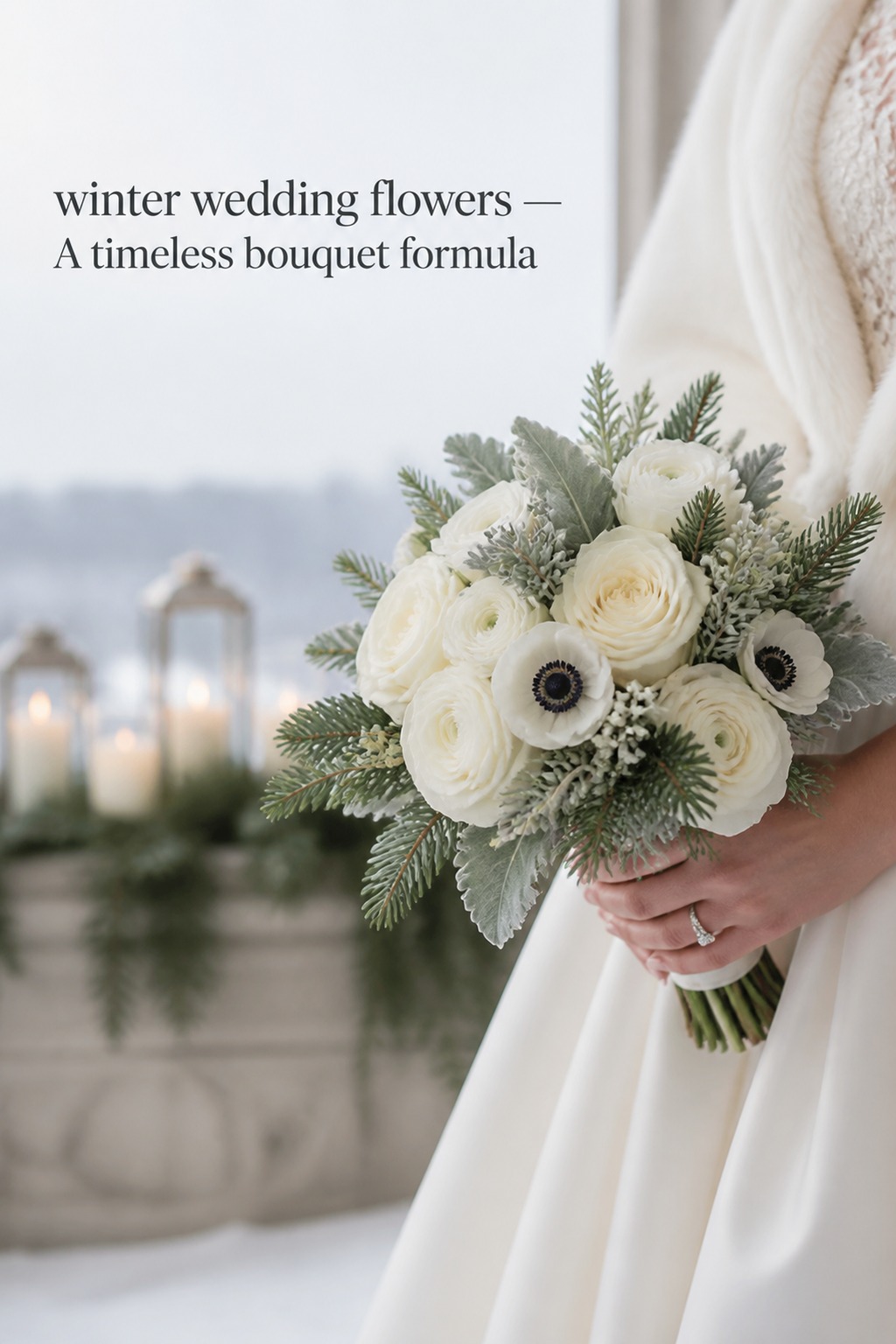
For a clean winter look, combine ivory, soft white, and a small amount of silver-green rather than using pure white flowers everywhere. White garden roses can provide a rounded focal shape, while anemones add a graphic center and ranunculus bring smaller layers. Dusty miller, lamb’s ear, silvery brunia, or pale eucalyptus create the frosted feeling without needing glitter or artificial snow. A few bare branches can add height, especially in a ceremony installation or a tall entry arrangement.
Turn wedding inspiration into a plan you can actually follow.
Zarellea brings your guest list, budget, vendors, and day-of details into one shared space — so no beautiful idea gets lost in the shuffle.
Candlelit jewel tones
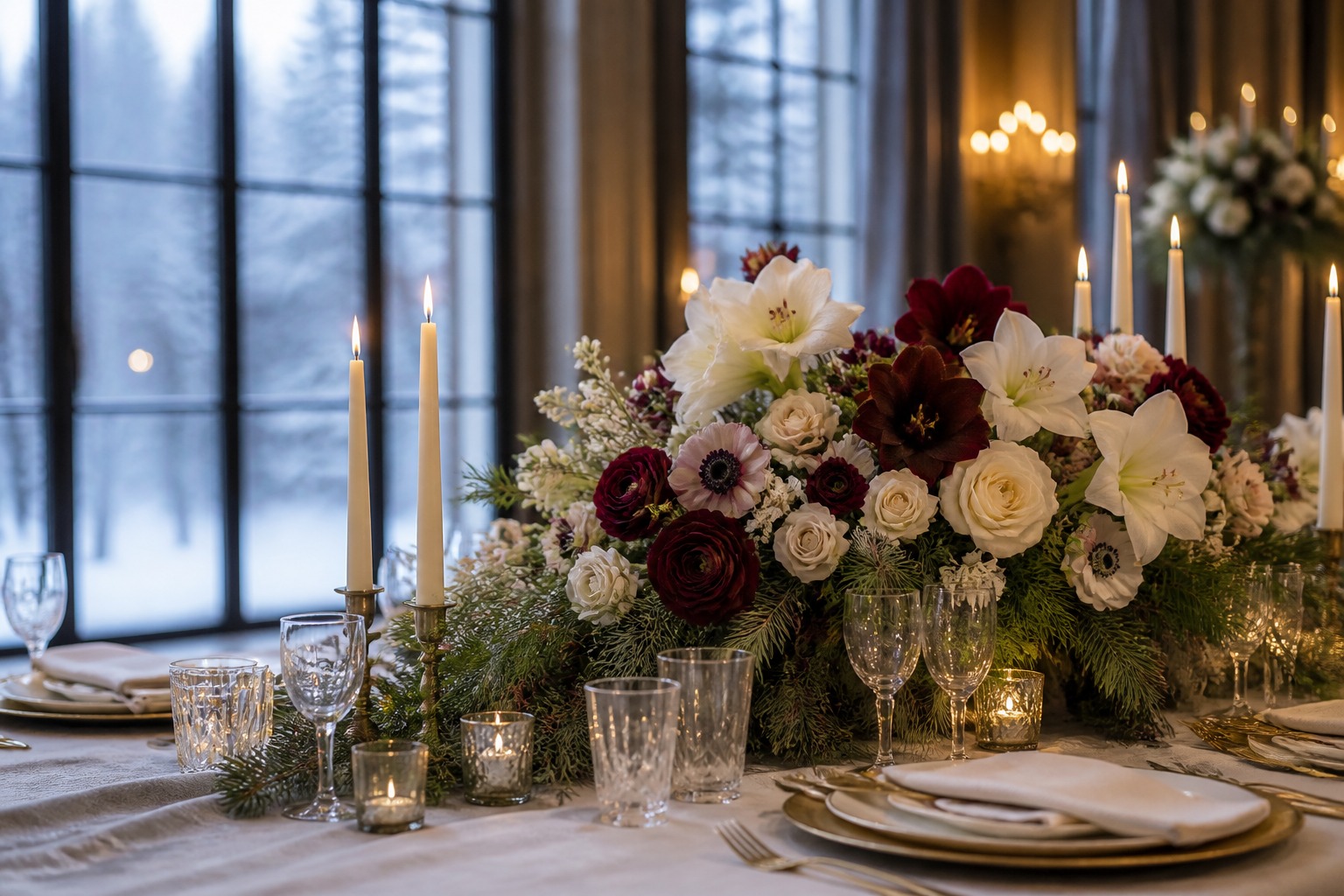
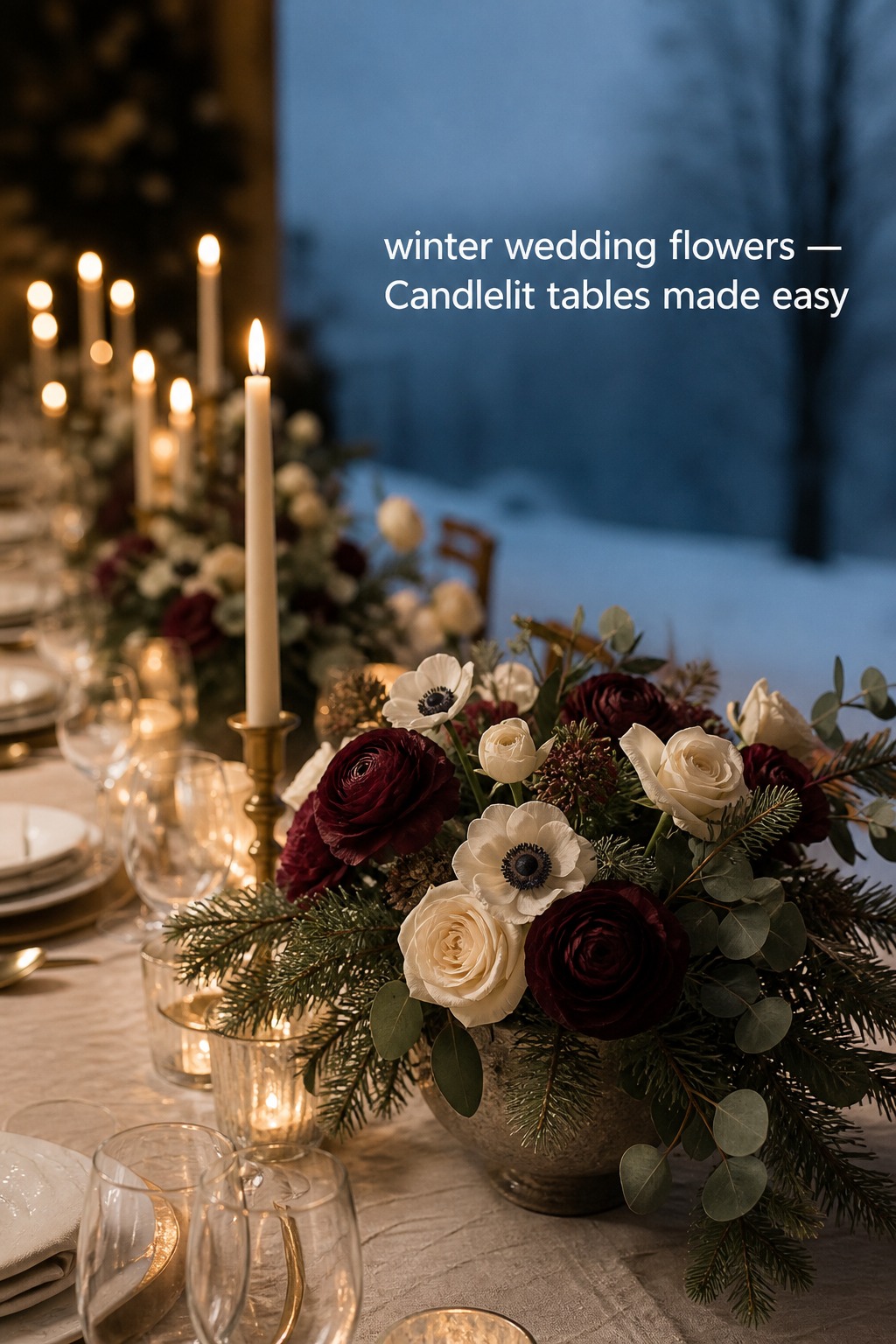
Deep burgundy, plum, wine, and inky blue become especially rich beside warm candlelight. Use them as accents instead of making every arrangement dark. A burgundy amaryllis in the bar display, a few dark ranunculus in the bridal bouquet, or plum ribbon on otherwise ivory flowers is enough to establish the story. Add foliage in muted green so the palette feels sophisticated rather than holiday-themed. This direction works particularly well in restaurants, historic buildings, and evening receptions with warm wood or brass details.
Evergreen forest
Evergreen-forward designs rely on shape and scent as much as bloom color. Cedar, pine, fir, juniper, eucalyptus, magnolia leaves, and winterberry can create a generous base for a smaller number of flowers. Add white roses, paperwhites, hellebores, or anemones so the flowers appear discovered inside the foliage. This is a strong choice for a lodge, barn, mountain venue, or outdoor ceremony, but it can also be refined for an urban space when the greenery is kept loose and the vessels are simple.
Modern and sculptural
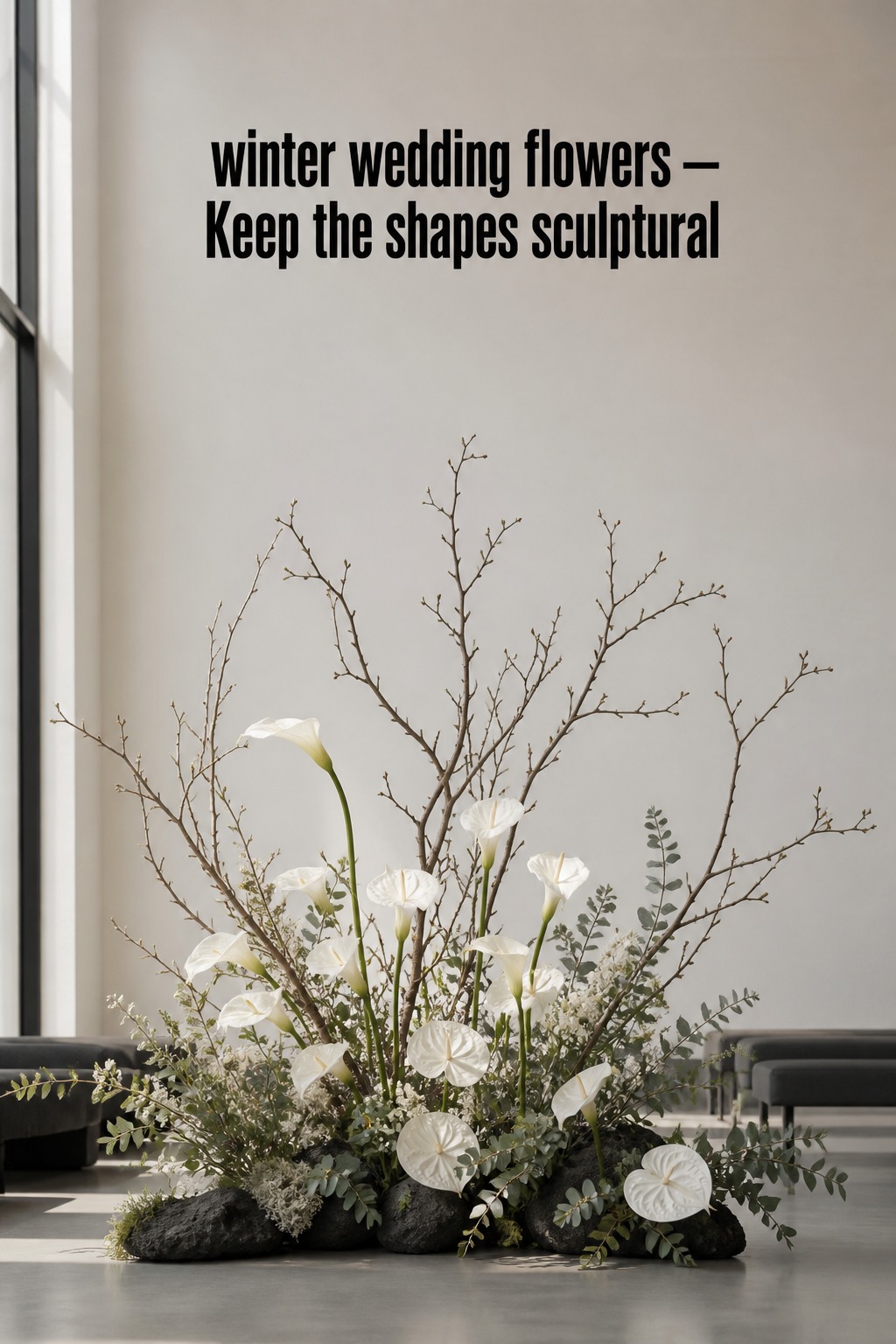
A modern winter wedding does not need a dense arrangement. Try a small group of amaryllis, calla lilies, anthurium, or tulips in a low vessel, with their stems visible. Forced branches, tall taper candles, and negative space can do more than a crowded mix of blooms. This approach is useful when your venue has strong architecture or when you would rather invest in a few memorable installations than cover every surface. Let one unusual shape lead; supporting flowers should make it easier to see, not compete with it.
Once you choose the story, write it in three words for your florist. “Ivory, candlelit, textural” gives a clearer design brief than “winter but not too Christmas.” So does “forest, airy, quietly romantic” or “plum, sculptural, formal.” Your three words can guide the flowers, containers, ribbon, candles, and even the way arrangements are spaced around the room.
Build a winter flower palette that feels intentional
Seasonal availability varies by region, wholesaler, and wedding month, so treat a flower list as a starting point rather than a promise. In the United States, florists commonly work with winter-friendly ingredients such as amaryllis, anemones, camellias, hellebores, paperwhites, tulips, ranunculus, sweet peas, roses, orchids, and evergreen branches. Some are grown or forced during winter; others are available year-round through imports. Your florist can confirm what is realistic for your date and offer a similar substitute when needed.
Use one focal bloom, one supporting bloom, and one structure
A simple formula keeps a winter arrangement from looking either sparse or overworked. Start with a focal bloom that establishes scale: an amaryllis, garden rose, orchid, anthurium, or a larger ranunculus. Add a supporting bloom with a different shape, such as anemones, tulips, hellebores, or spray roses. Finish with structure: evergreen, eucalyptus, bare branches, berries, pods, cotton stems, or a textural leaf. You can repeat this formula in different proportions throughout the wedding and still give each arrangement its own purpose.
Think in color relationships, not a rigid color code
Winter palettes often look strongest when one color is allowed to breathe. Ivory with mossy green feels softer than white with five competing greens. Burgundy beside blush becomes romantic; burgundy beside black and plum becomes dramatic. Lavender, dusty blue, and silver-green can feel icy without becoming childish. If you love red, decide whether you want a bright berry red, a wine red, or a brown-red, then use that choice consistently in flowers, stationery, or small accents.
Let foliage do more of the visual work
Winter is an excellent season for foliage because branches and evergreen textures feel purposeful rather than like filler. Cedar can create movement, pine gives a recognizable seasonal note, eucalyptus adds a blue-gray cast, and magnolia leaves provide a polished, glossy surface. Mix only two or three foliage types in one design. Too many can make an arrangement look like a holiday wreath when your intention is an elegant wedding centerpiece.
Plan by month
December often supports amaryllis, paperwhites, evergreen, holly, winterberry, hellebores, and anemones. January can be a good time for anemones, early ranunculus, tulips, camellias, jasmine, and citrus branches, depending on your market. February may bring stronger ranunculus, sweet peas, mimosa, early daffodils, and forced flowering branches. Roses and other imported flowers can bridge the months. Ask your florist for a primary list and a backup list so the design remains recognizable even if one variety is unavailable.
- Primary flower: the bloom you would most like to see, such as anemone or amaryllis.
- Visual substitute: a flower with a similar shape or color, not necessarily the same name.
- Seasonal texture: one branch, leaf, berry, or dried element that makes the design feel like winter.
- Palette anchor: an ivory, burgundy, green, plum, or metallic detail repeated in more than one place.
This flexibility is especially helpful if you have a specific flower in mind. Peonies, for example, may be possible through imports but can be expensive and less reliable in winter. Your florist might suggest garden roses, ranunculus, or a layered combination that gives a similar rounded, romantic effect. The goal is not to win a botanical vocabulary test; it is to create the shape, mood, and scale you love.
Carry the flowers through the wedding day
A cohesive floral plan does not mean every arrangement should match. It means the same visual language should appear in different roles. The bouquet can be the most detailed piece, the ceremony can be the most architectural, and the reception can be the most repeatable. Choose one or two elements to travel through the day—perhaps the same anemone, the same evergreen, or the same ribbon—then vary the proportions and containers.
Make the bouquet personal and portable
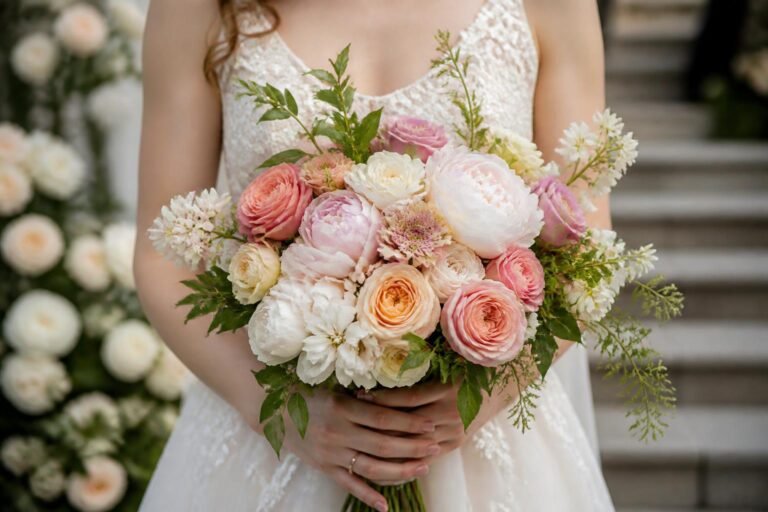
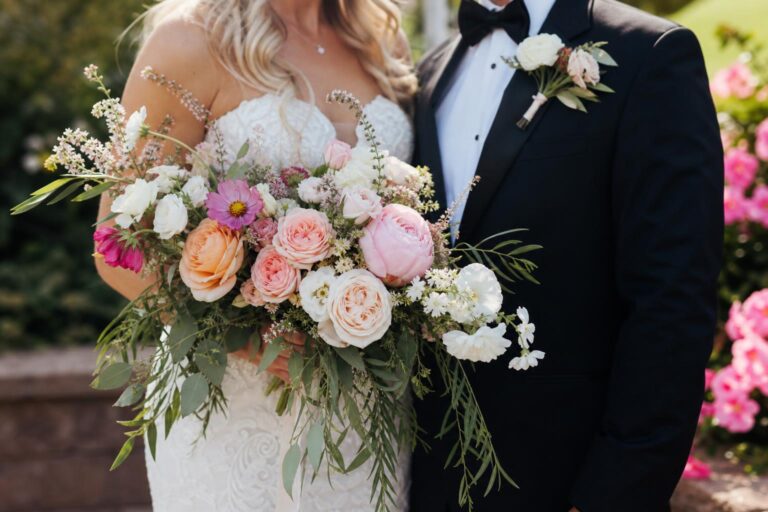
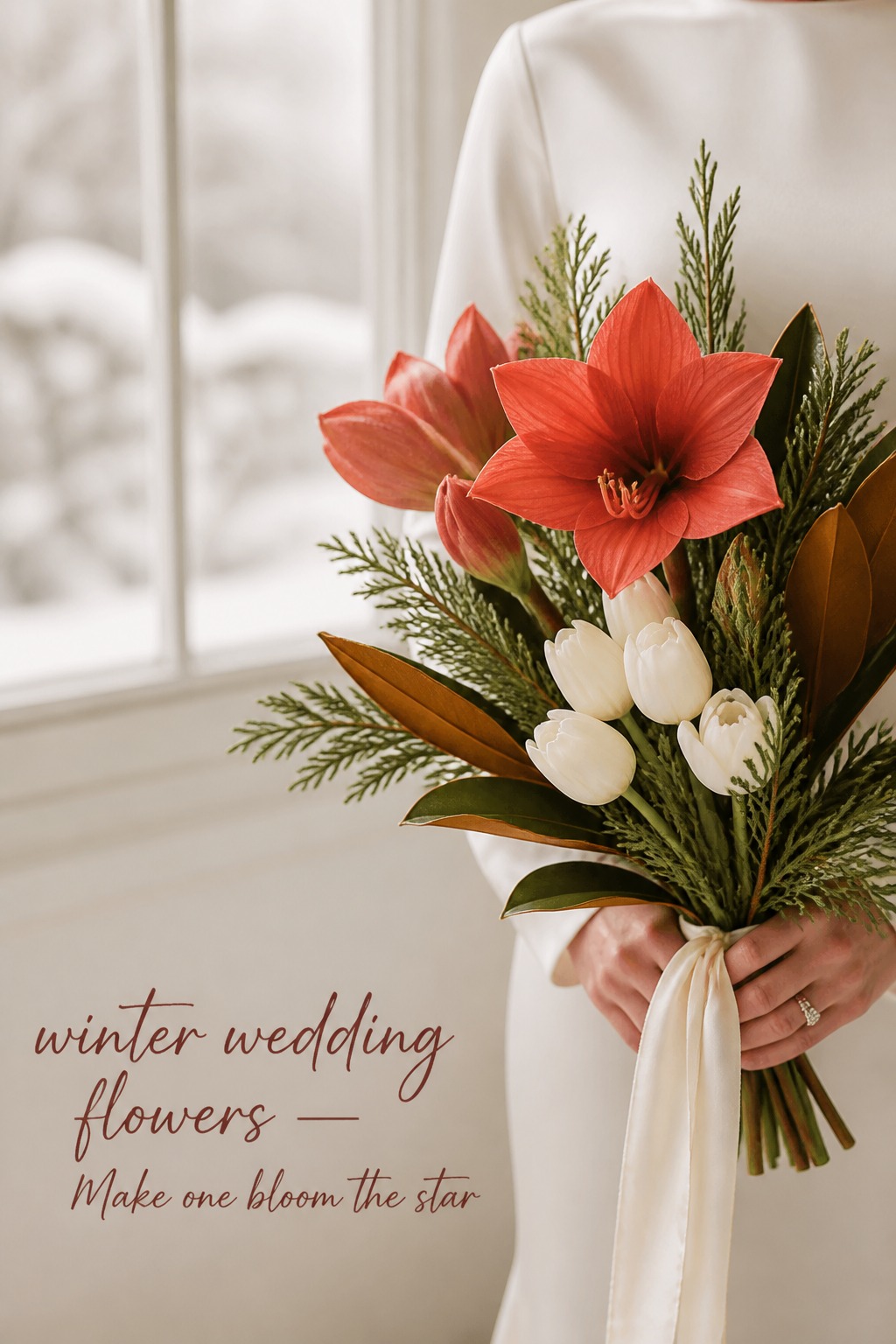
Your bouquet will be photographed close to your face, dress, rings, and hands, so it should be comfortable as well as beautiful. A compact bouquet of white roses, anemones, and dusty miller can feel crisp and timeless. A loose bouquet with ranunculus, jasmine, and evergreen can feel more natural. If you love a large shape, ask how its weight will feel during portraits and the ceremony. Winter texture is wonderful, but stiff branches, prickly evergreens, and heavy accessories need to be secured thoughtfully.
Give the ceremony one strong floral moment
Rather than placing small arrangements everywhere, choose one ceremony feature that frames the vows or improves the guest view. An asymmetrical ground arrangement can follow an arch without hiding it. A low meadow of white flowers and evergreen can soften a wooden arbor. Two tall arrangements at the end of the aisle can create a clear entrance. If the ceremony and reception happen in the same room, design the feature so it can be moved behind the sweetheart table, bar, or dance floor afterward.
Use centerpieces to manage the room’s rhythm
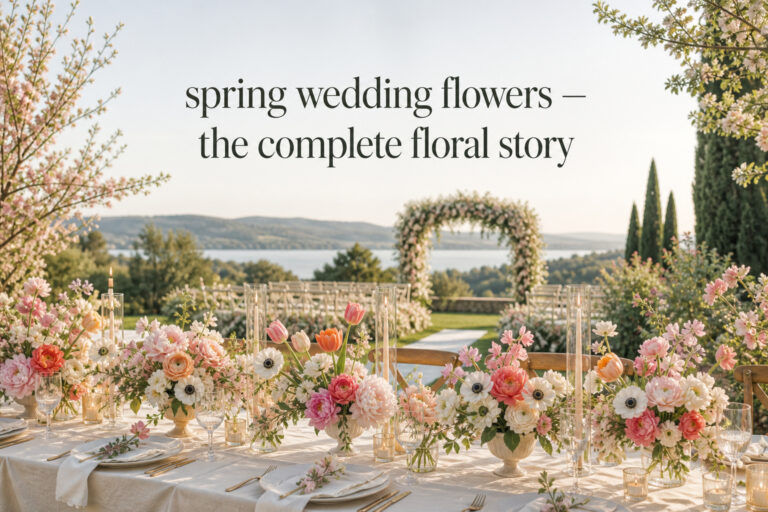
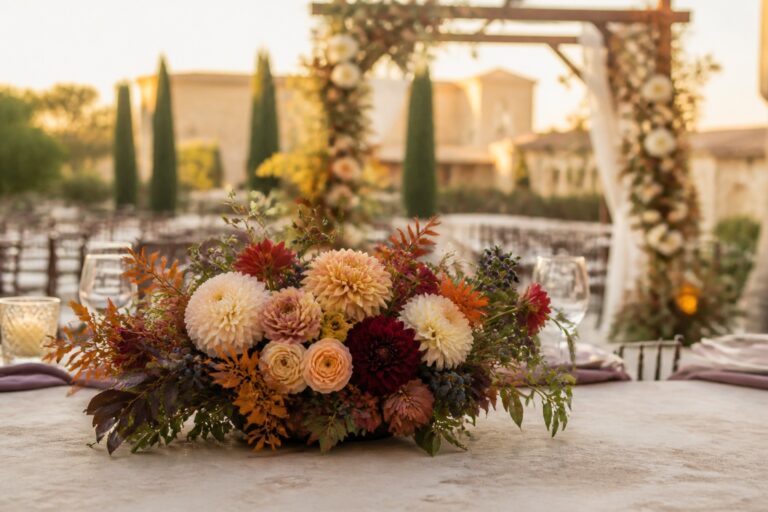
Winter wedding centerpieces can be low and candlelit, tall and architectural, or a mixture of both. Low arrangements make conversation easier and suit long tables with a continuous garland. Tall branches help a large ballroom feel intimate but require careful sightline planning. Bud vases can distribute a few premium flowers across many tables, while one statement arrangement near the entrance gives guests a visual welcome. Keep the vessels consistent if the flowers are varied; keep the flowers consistent if the vessels are eclectic.
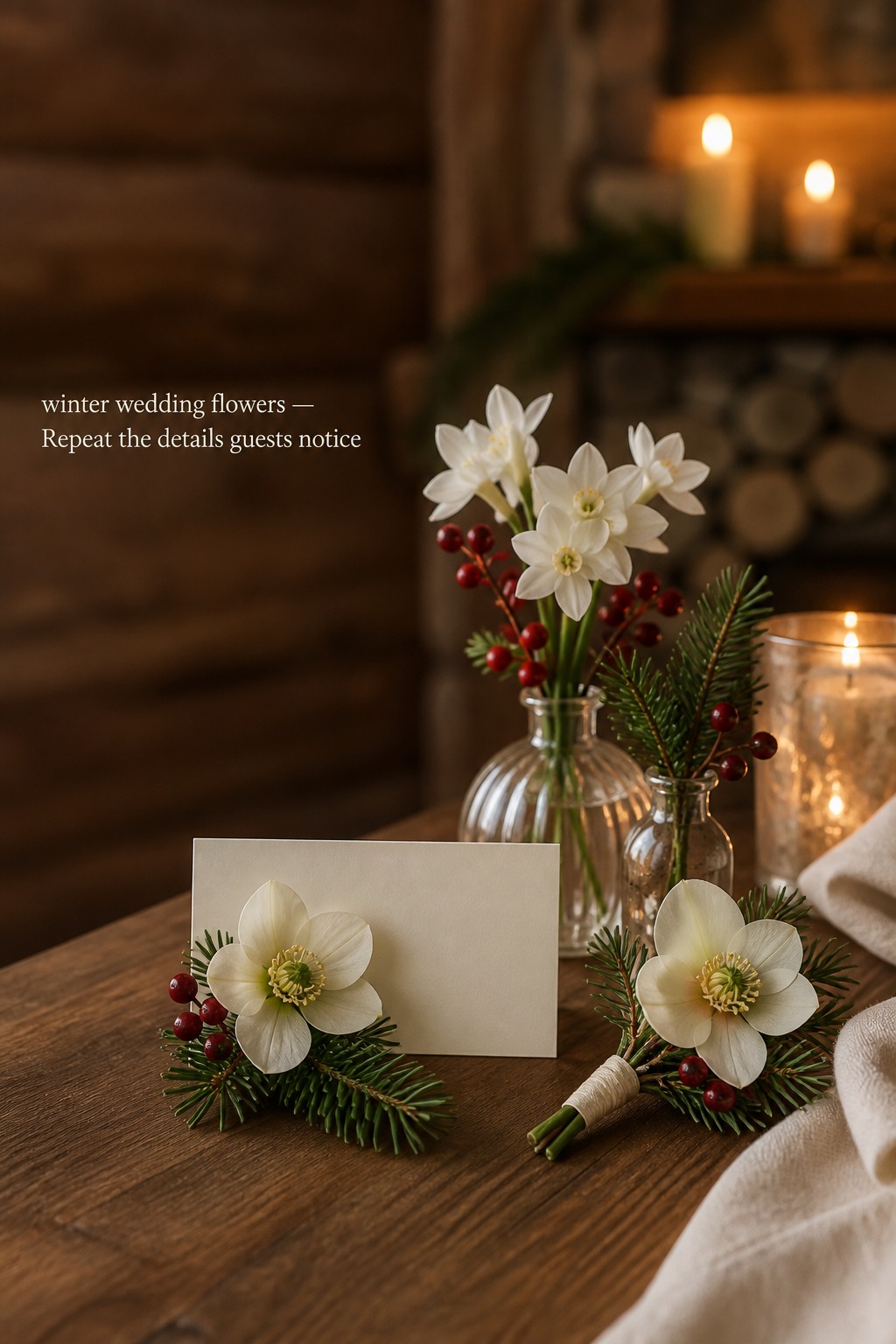
Save small flowers for the details guests notice
Personal flowers, the cake table, escort-card display, bar, welcome sign, and restrooms are opportunities for small, memorable repeats. A single paperwhite or hellebore in a place card arrangement can feel more special than an oversized centerpiece guests cannot see. Add a boutonniere detail that echoes the bouquet without copying it exactly. For a winter palette, a sprig of evergreen, a berry, a small anemone, or a velvet ribbon may be all the design needs.
Ask your florist to create a reuse plan. Ceremony arrangements can move to the reception, bridesmaid bouquets can become head-table flowers, and bud vases can gather around the cake or lounge area later. The safest reuse plan considers transport, water, timing, and who will move each piece. If an arrangement is too delicate or too heavy to relocate, it is better to treat it as a dedicated ceremony investment than to assume it can do two jobs.
Make winter wedding flowers practical
The most convincing winter floral plans are not only pretty; they understand logistics. Cold weather can be kind to flowers, but freezing temperatures, heated indoor air, long transportation, and limited daylight still matter. A florist should know the venue’s loading rules, the distance between ceremony and reception, the time arrangements will wait before guests arrive, and whether flowers will be placed outdoors. These details affect flower choices just as much as your color palette.
Spend on what changes the room
If your budget is limited, protect the bouquet, one ceremony focal point, and the areas where guests spend time. A well-designed bar, escort-card table, or head table can carry the seasonal story farther than identical flowers on every guest table. Use candles, textured linens, fruit, branches, or colored glass to add atmosphere without requiring more premium blooms. A florist can often make a room feel fuller by changing scale and placement rather than simply adding stems.
Ask for substitutions before you sign off
Include a substitution clause or at least a shared understanding of how changes will be handled. Ask which flowers are non-negotiable, which can be replaced, and what visual quality must stay the same. “White flower” is too broad; “a white focal bloom with a rounded garden-rose shape” is more useful. If your design depends on black-centered anemones, ask what the florist would use if the available crop has weak stems or arrives damaged. Good substitutions protect the design instead of making it feel random.
Protect flowers from extreme temperatures
Do not leave finished arrangements in a freezing vehicle or place delicate flowers beside a heater. Outdoor portraits can be brief, with a warm holding location nearby. Bouquets should be carried outside only when needed, and stems should remain hydrated as long as possible. Your florist or planner can advise on the specific varieties you choose, because a hardy evergreen branch and a fragile tropical bloom do not have the same tolerance.
Bring a useful consultation brief
Take your three mood words, wedding date, venue photos, dress photo, ceremony layout, guest count, table shapes, and a realistic budget range. Mark inspiration images with what you actually like: the flower, the color, the shape, the negative space, or the candlelight. Tell the florist what you do not want, too. A clear brief helps them distinguish “I like the cozy feeling” from “I need these exact five flowers,” which usually leads to better seasonal decisions.
- Which flowers are most reliable in my region during my wedding month?
- What are the closest substitutes for my must-have blooms?
- Which arrangement can be reused after the ceremony?
- How will the flowers be protected during transport and outdoor portraits?
- Where will one larger installation create more impact than many small pieces?
- Which ingredients are imported, and are there local alternatives with a similar look?
Finally, remember that winter does not have to be announced in every arrangement. A few seasonal clues can be enough: a gray-green leaf, an elegant branch, a dark berry, a line of candlelight, or the confident silhouette of an amaryllis. When the flowers support the couple, the venue, and the experience of the guests, the result feels intentional rather than themed.
FAQ
What flowers are in season for a winter wedding?
Common winter wedding flowers include amaryllis, anemones, hellebores, paperwhites, tulips, ranunculus, camellias, sweet peas, roses, orchids, and seasonal greenery such as cedar, pine, fir, juniper, eucalyptus, and holly. Availability varies by month and region, so confirm the list with your florist.
What are the best winter wedding flower colors?
Popular directions include ivory with evergreen, white with silver-green, burgundy with blush, plum with candlelight neutrals, and dusty blue with gray foliage. You can also use brighter colors; winter flowers do not have to be red, green, or white. Choose one dominant color and one or two supporting tones for a polished result.
Are peonies available for winter weddings?
Peonies can sometimes be sourced through imports, but they may be expensive and less predictable in winter. Ask your florist about garden roses, ranunculus, or a layered mix that recreates the rounded, full shape you want. Decide whether the priority is the exact flower or the overall color, silhouette, and softness.
How can I make winter wedding flowers look less like Christmas?
Limit overt holiday details such as red-and-green pairings, ornaments, and heavy pinecones unless they are part of your vision. Try ivory, dusty blue, plum, taupe, or muted green, and use winter texture sparingly. A few branches, berries, or evergreen accents will communicate the season without turning the wedding into a holiday party.
Are winter wedding flowers less expensive?
They can be, especially when you choose flowers and greenery available through your local market, but winter pricing is not automatically lower. Imported out-of-season blooms, holiday demand, labor, and large installations can increase the total. The best way to control cost is to choose a flexible palette, use seasonal structure, and invest in a few high-impact locations.
Can winter wedding flowers be used for an outdoor ceremony?
Yes, but the plan should account for freezing temperatures, wind, direct sun, and the time flowers will wait outside. Use hardy ingredients where possible, keep the ceremony feature simple to move, and arrange a protected holding area. Ask your florist how long the specific bouquet and installations can safely remain outdoors.
When should I book a florist for winter wedding flowers?
Book as early as your venue and budget allow, particularly for December dates, holiday weekends, or a florist known for installations. A detailed floral proposal can be refined later as seasonal availability becomes clearer. Bring your date, venue, guest count, mood words, priorities, and a substitution plan to the first serious consultation.