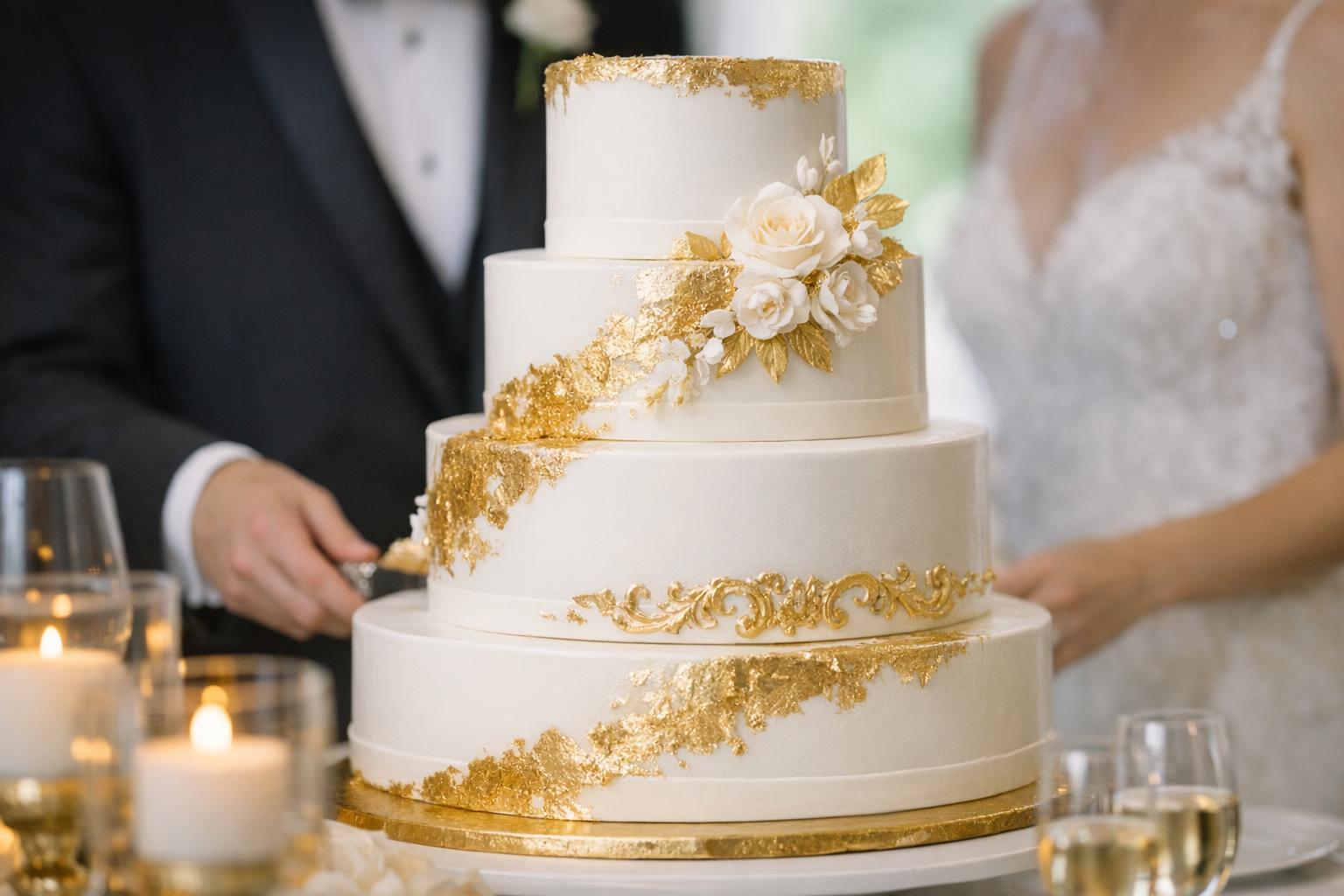
The room quiets for a beat as the cake is wheeled in—tiers glowing under reception lighting, a soft shimmer catching every turn of the stand. A gold wedding cake doesn’t just end a meal; it punctuates the entire day with a sense of celebration and intention. Whether you’re dreaming of gilded edges, delicate flecks of edible gold leaf, or a white and gold wedding cake elegant enough to anchor a ballroom, gold has a way of turning dessert into a moment.
What makes gold wedding cakes so compelling is their range. Gold can be modern and minimal (a few scattered sheets of gold leaf), classically luxurious (full gilded tiers), or romantic and botanical (gold leaf paired with sugar flowers). And because couples shop for cakes in different ways—tutorials, galleries, real weddings, or bakery product pages—this guide brings those paths together: inspiration, technique, planning, and the practical details that help you communicate your vision clearly.
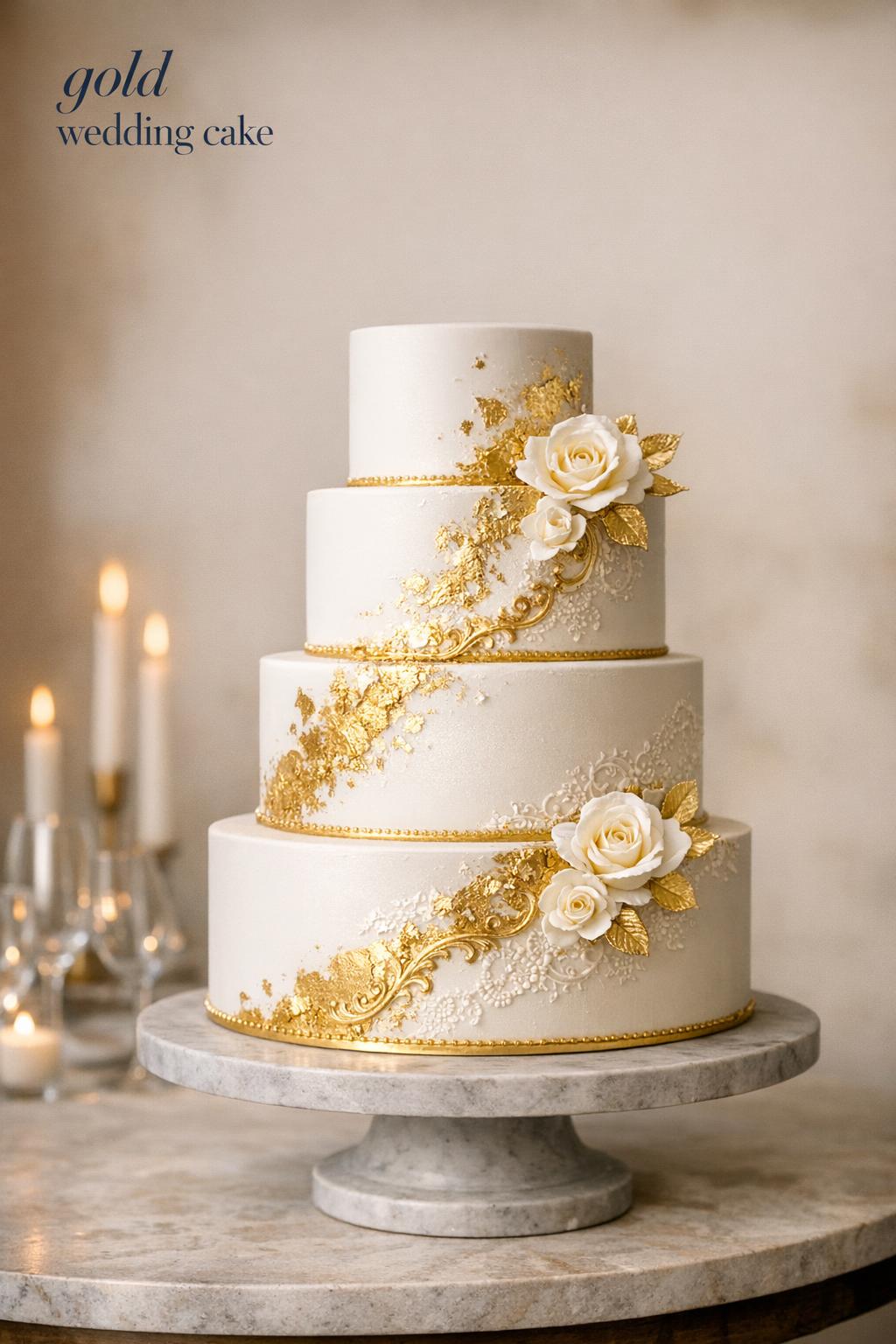
Why gold reads as “wedding” in the best possible way
Gold is one of the few finishes that can feel meaningful and versatile at the same time. In wedding styling, it signals celebration and prosperity without requiring a loud color palette. On a cake, it becomes a finishing note—like jewelry—because it sits on top of the design rather than replacing it.
That’s why “wedding cakes gold” searches often lead to both how-to tutorials and real wedding galleries: couples want to see how gold behaves in real light, with real florals, and beside actual place settings. Gold can look warm and romantic at a candlelit reception, crisp and editorial in bright daylight, or softly luminous against a neutral palette.
Gold leaf, metallic finishes, and the emotional payoff
Edible gold leaf is the centerpiece concept behind most gold cake inspiration. It creates dimension without adding bulk—thin, fluttery sheets that catch light in uneven, organic ways. That “imperfect-perfect” texture is why gold leaf appears so often in real weddings: it photographs like a dream and looks handcrafted up close.
Gold can also show up as other metallic finishes—like gold paint or luster dust—each with a different vibe. Gold leaf tends to read artisanal and romantic; painted gold can feel more graphic and controlled; gold dusted effects often feel airy and soft. Understanding those emotional cues helps you choose a finish that matches your venue, your dress, and the overall tone of the day.
A quick comparison: gold leaf vs. gold paint vs. luster dust
Most couples don’t need to master every decorating method, but it helps to know what you’re asking for when you send inspiration photos to a baker or scroll a gallery.
- Edible gold leaf: Thin sheets placed on the surface in flakes or larger panels. The look is dimensional, textured, and luxurious—especially on white buttercream or fondant.
- Gold paint: A more controlled metallic finish that can create clean brush strokes, precise patterns, or full-panel metallic areas. It often reads more “designed” than leaf.
- Luster dust / gold-dusted effects: A softer shimmer that can be brushed onto details or florals to highlight texture without heavy shine.
If you’re torn, think about distance: guests see the cake from across the room first. Gold leaf creates visible sparkle from afar, while luster dust tends to be a closer-up delight. Many wedding cake designs elegant gold combine methods—leaf for drama, dust for gentle highlights.
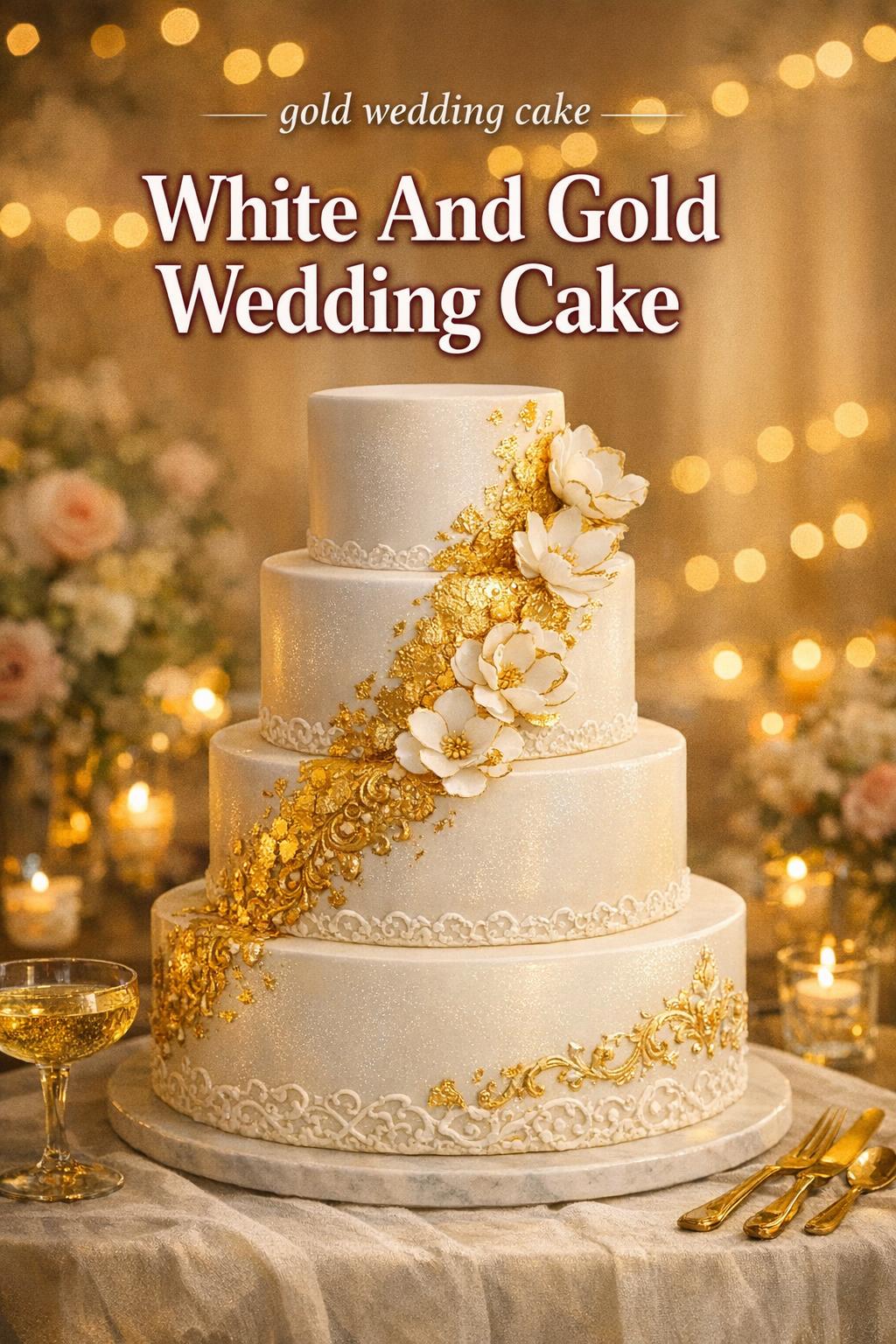
Designing your gold wedding cake around the setting
The most “right” gold wedding cake is the one that belongs in your room. A coastal venue might call for lighter, breezier gold accents; a formal ballroom can hold heavier gilding. Even a small intimate ceremony can feel elevated with a restrained gold detail—one tier, a gilded edge, or scattered leaf.
Classic gilded tiers for black-tie energy
Classic gilded tiers are the architectural version of gold: structured, symmetrical, and undeniably formal. If your reception includes chandeliers, satin linens, or a dramatic aisle moment, a more substantial gold presence can feel perfectly matched. In this style, gold becomes a core visual—often placed in bands, edges, or sweeping areas rather than tiny accents.
A white and gold wedding cake is the natural pairing here. White gives the cake a clean foundation; gold adds ceremony. If you’ve been saving inspiration for a white and gold wedding cake elegant enough to stand on its own, look for examples with gilded edges or defined gold placements that read clearly in photos.
Modern minimal gold accents (quiet luxury, high impact)
Minimal doesn’t mean plain—it means intentional. This is the style for couples who love clean lines, open space, and a curated aesthetic. Think of a smooth white surface with a few delicate sheets of edible gold leaf, placed almost like punctuation marks. The cake looks composed, not crowded, and the gold feels like an accessory rather than the outfit.
This approach is also forgiving when you’re balancing other statement elements, like bold ceremony florals or a detailed gown. The cake adds glamour without competing for attention, which is why “gold leaf cake” inspiration so often leans minimal in editorial galleries.
Baroque piping with gold motifs (ornate, romantic, and dramatic)
Baroque piping is for the couple who wants the cake to feel like an heirloom object—ornate scrollwork, dimensional texture, and a sense of old-world romance. Gold can be used to highlight raised piping motifs, making the details more visible under reception lighting.
In practice, this style rewards close attention to proportion. Too much gold can flatten intricate piping; too little can hide it. A thoughtful balance—gold painted onto select motifs, or a light gold-dusted finish on raised areas—keeps the design readable and elegant.
Gold leaf and sugar flowers (botanical elegance)
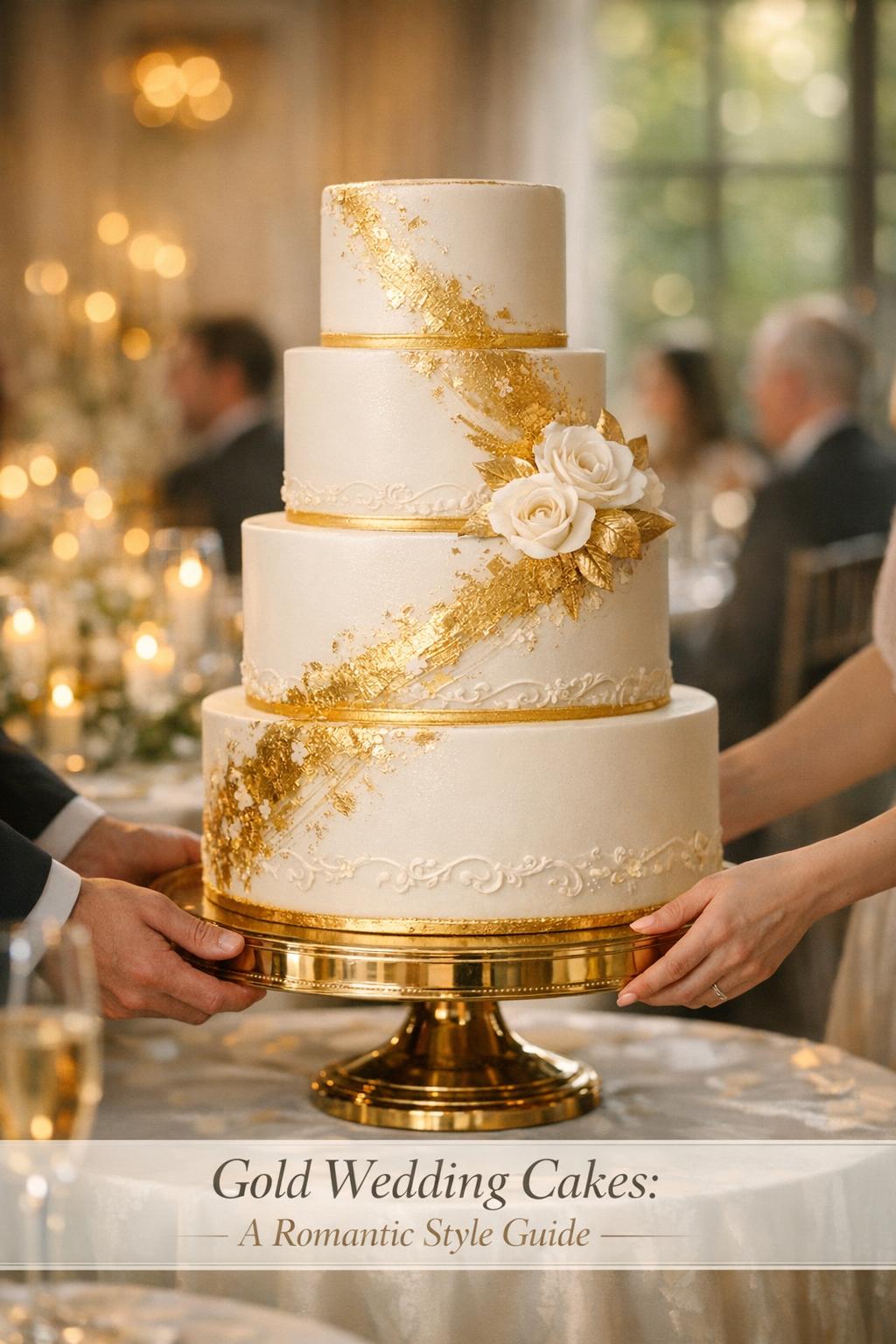
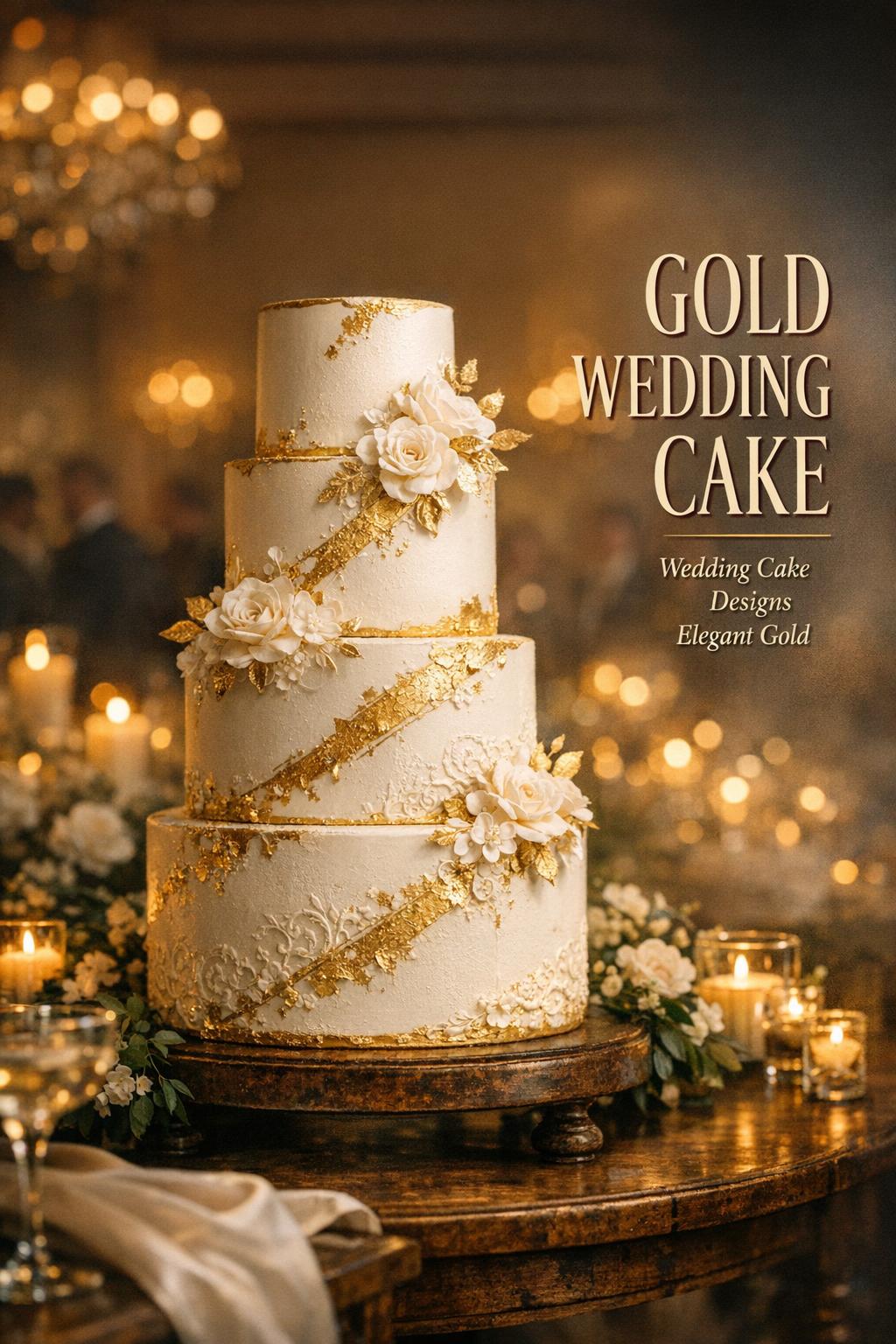
Some of the most romantic real-wedding imagery pairs gold leaf with sugar flowers. The relationship works because the softness of petals contrasts with the crisp shimmer of leaf. In The Knot’s real weddings galleries, this pairing shows up again and again: gold leaf placed near sugar florals to frame them, echo their shape, or create a halo-like glow.
For couples who love garden styling, this is where you can make the cake feel like part of the floral story rather than a separate dessert. You can keep the base simple and let the sugar flowers carry the romance, with gold acting as the light-catching accent that makes everything look intentional in photographs.
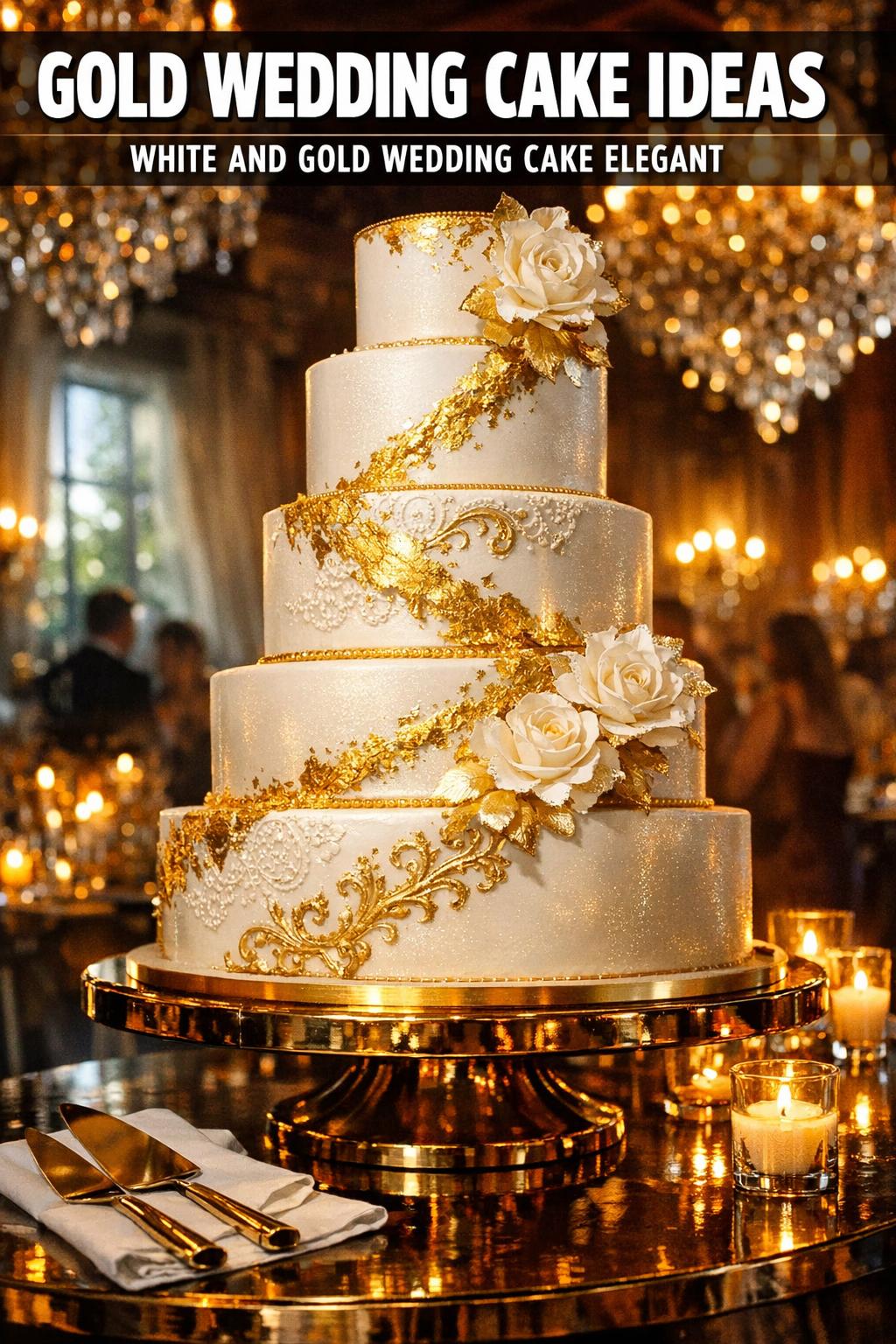
White and gold wedding cake elegant: how to make it feel timeless, not trendy
White and gold is a classic combination, but it can shift dramatically depending on the finish, the placement, and the texture of the white base. If you want a white and gold wedding cake elegant enough to look right in your photos years from now, focus on restraint and clarity.
Choose the “white” first: smooth, textured, or patterned
White can be glass-smooth (a modern canvas), softly textured (romantic and hand-finished), or patterned with motifs like lace. In one popular approach highlighted in tutorial-style content, lace motifs and floral accents can sit beside gold leaf without feeling busy—because lace reads as quiet texture rather than bold color.
Once you decide what kind of white you want, the gold becomes easier to place. Smooth white loves scattered leaf or painted strokes; textured white can handle gilded edges; lace motifs pair well with delicate gold accents that highlight the pattern without overpowering it.
Let gold live in one “role” on the cake
The most polished wedding cake designs elegant gold usually assign gold a single job. That job might be “edge definition” (gilded rims), “movement” (a diagonal sweep of leaf), or “spotlight” (gold around sugar flowers). When gold tries to do everything—edges, splatter, full tiers, florals—it can look like multiple cakes stitched together.
A simple planning test: if you were describing the design to someone without photos, could you say it in one sentence? If yes, it’s likely cohesive.
Techniques couples should understand before asking for edible gold leaf
You don’t need to be a cake decorator to commission a gold leaf wedding cake, but understanding the basics makes vendor conversations smoother. It also helps you evaluate inspiration photos more realistically: gold leaf is delicate, placement is intentional, and technique affects cost.
Materials and safety: what “edible gold leaf” means in practice
When a baker describes a cake as “gold leaf,” they typically mean edible gold leaf sheets applied to the surface as decoration. Because gold leaf is used as an edible decoration, couples often ask about safety and suitability—questions worth bringing up early, especially if your guest list includes dietary restrictions or sensitivities. The key is clarity: confirm with your baker that the leaf used is edible gold leaf and intended for food decoration.
Inspiration pages and product galleries often show dramatic metallic effects, but not every gold-looking finish is the same. If your priority is the true leaf texture, ask specifically for edible gold leaf sheets rather than a generic “gold finish.”
Step-by-step: how gold leaf is typically applied
Gold leaf application is usually a final-stage detail, added after the base finish (such as buttercream or fondant) is complete. Tutorial-style guidance often emphasizes patience and light touch, because leaf can tear or crumple easily—and that fragility is part of why the result feels so special.
- Prepare the surface: the cake is iced smoothly and any key design elements (like lace motifs or florals) are set in place.
- Handle the leaf gently: gold leaf sheets are delicate and can fragment; fragments are often used intentionally for a natural, fluttered look.
- Place strategically: leaf is positioned where it will be seen—around focal areas, along edges, or in an artful cascade.
- Refine the composition: decorators often step back to check balance, ensuring the gold reads evenly across tiers.
This is one reason gold leaf wedding cake ideas vary so widely: the same material can look minimalist, opulent, or organic depending on placement density and pattern.
Troubleshooting: what can go wrong (and how to avoid it)
Gold leaf is forgiving aesthetically—tiny tears can look beautiful—but it’s unforgiving mechanically. The most common disappointments couples experience usually come down to timing, expectations, or unclear design direction.
- Uneven distribution: a few heavy patches can look accidental rather than intentional. Ask for a defined placement plan (edge, cascade, frame).
- Gold disappearing in photos: if gold is too sparse or too finely dusted, it may not read from afar. Consider slightly larger leaf fragments in key viewing zones.
- Competing details: pairing bold piping, heavy sugar florals, and gold leaf can make the cake feel busy. Choose one main texture and let gold highlight it.
A practical fix is to build your design around one hero element—sugar flowers, lace, or a gilded edge—and let gold support that story rather than trying to carry the entire design alone.
Real-world inspiration routes: galleries, product pages, and bakery portfolios
Most couples don’t discover their final cake idea in one place. You might start with a real wedding photo, fall in love with a product page, and then save a few variations from a community gallery. Each source type offers a different kind of confidence.
Real weddings: The Knot’s gold leaf moments
Real wedding galleries are invaluable because they show gold leaf in the context of an entire event—venue lighting, floral styling, and guest perspective. The Knot’s real weddings pages frequently highlight gold leaf cake designs, including pairings like gold leaf and sugar flower wedding cake styling. These examples can help you decide how bold you want the gold to be, and whether you love the look more in daylight or candlelight.
When you see a real-wedding cake you love, pay attention to the relationship between the cake and the room: is the gold echoing flatware, candle holders, or a champagne-toned palette? Those connections are what make the design feel integrated rather than “added on.”
Product pages: white and gold leaf as a defined style
Product pages tend to show a more standardized, repeatable look. Sieve & Stone, for example, features a White & Gold Leaf Cake style that emphasizes a clean white base and a gold leaf gilded edge. That clarity is helpful if you want a crisp, consistent finish and a defined silhouette.
This is also where you’ll often see small but meaningful details—like how a gilded edge is finished around each tier. Those finishing choices can be the difference between a cake that feels polished and one that feels unfinished in close-up photos.
Local bakery portfolios: bespoke options and tier choices
Bakery portfolios can be the bridge between inspiration and execution because they show what a team actually makes. Seatown Sweets, located in Kirkland, highlights a 2 tier gold leaf wedding cake option—an important reminder that gold wedding cakes don’t have to be towering to feel special. Two tiers can still deliver drama when gold leaf is placed intentionally and paired with a clean silhouette.
Other service providers, including UAE Flowers, also showcase gold leaf wedding cake visuals that lean into luxurious wedding décor. Even if you’re planning a U.S. wedding, browsing multiple markets can help you articulate the level of gold, the density of leaf, and the overall “luxury dial” you want to turn.
Community galleries: creative variations and decorator notes
Community platforms like CakeCentral often feature user-submitted gold leaf wedding cake designs with short commentary. These galleries are useful for spotting variations you may not see in polished editorial shoots—unexpected placements, hybrid techniques, or creative ways to combine lace motifs, piping, and metallic finishes.
If you’re a DIY-leaning couple or working with a smaller bakery, these real-world variations can spark solutions that feel achievable without sacrificing elegance.
Gold wedding cake ideas that feel personal (not copy-pasted)
Idea roundups like “20 stunning gold wedding cake ideas” can be a gift when you’re still forming your vision. But the most memorable gold wedding cakes usually have one personal anchor—something that ties the cake back to you: your venue, your florals, your reception mood, or even the way you want guests to feel when the cake arrives.
Idea: a gilded edge that mirrors your reception details
A gold leaf gilded edge is subtle enough to pair with almost any wedding style, yet distinctive enough to look “finished” in photos. It’s especially effective when your tables already include gold accents—flatware, candle holders, or charger plates—because the cake becomes part of the same design language.
This approach works beautifully for couples who want wedding cake designs elegant gold without committing to full metallic tiers. It’s also an excellent choice for a white and gold wedding cake because the edge defines the tier shape and looks crisp from across the room.
Idea: a gold leaf “constellation” on a smooth white tier
Scattered edible gold leaf can look like a constellation—tiny points of light against a clean base. The magic is in negative space: you allow white to remain dominant, and you place leaf fragments in a pattern that feels balanced, not random.
If you love minimalist styling, this is one of the easiest ways to achieve a modern gold wedding cake that still feels romantic. It also pairs well with a single statement element like sugar flowers on one side of the cake.
Idea: sugar flowers framed with gold leaf for a garden reception
For garden-inspired weddings, consider using sugar flowers as the focal point and gold leaf as the “light” around them—placed behind petals, along the base of floral clusters, or lightly scattered nearby. This echoes the real-wedding pairing of gold leaf and sugar flowers you’ll see in editorial galleries, where the cake looks like part of the floral design rather than an afterthought.
This style can be adapted to many venue types, from intimate ceremonies to larger receptions, because you can scale the floral coverage up or down while keeping gold as a consistent accent.
Idea: lace motifs with gold accents for vintage romance
Lace motifs bring softness and nostalgia, especially when paired with a restrained metallic finish. A light gold accent—placed to highlight the edges of lace patterning or to add a few gilded moments near a focal tier—can feel like jewelry on fabric. It’s a beautiful option for couples who want elegance without overt shine.
If you’re drawn to this style, keep the gold placement precise. Lace is already intricate; gold is most effective when it clarifies the pattern rather than adding another competing texture.
Idea: two-tier gold leaf wedding cake for intimate celebrations
A smaller cake can still feel like a centerpiece. A 2-tier gold leaf wedding cake—like those featured in bakery portfolios such as Seatown Sweets in Kirkland—often looks especially intentional because every detail is visible. Gold leaf can be concentrated in one cascade or used as a gilded edge to define the tiers cleanly.
This is a strong choice for couples prioritizing intimacy, budget mindfulness, or a reception where the cake is placed in a prominent spot and photographed up close.
Flavor pairings and finishes: making sure the inside matches the outside
A stunning exterior matters, but the memory guests take home is taste. Many couples pick their cake design first and then rush through flavor decisions. In practice, the most satisfying experience comes from pairing flavor, frosting, and finish so the cake feels cohesive—luxury on the outside, joy on the inside.
Flavors that feel naturally “gold” in mood
Gold aesthetics often align with flavors that feel celebratory or timeless—think warm, classic profiles that match the visual richness. Couples commonly gravitate toward vanilla, champagne, lemon curd, and vanilla bean because they feel wedding-appropriate and pair well with elegant presentation.
If your gold finish is bold and dramatic, a familiar flavor can keep the overall experience grounded. If your design is minimalist, you may feel freer to choose a more distinctive pairing because the cake’s look won’t compete for attention.
Frostings and fillings that complement metallic finishes
Gold leaf and metallic finishes tend to look best on smooth, consistent surfaces—especially when you want the shimmer to read clearly from a distance. Buttercream and ganache-style smoothness (when executed cleanly) can create that canvas, while fillings like lemon curd can add brightness and contrast in flavor.
When you’re reviewing inspiration, notice how the base finish affects the gold: a very textured surface can make leaf look more scattered and organic; a sleek surface makes it look more graphic. Neither is better—just different moods.
Tips from a stylist’s perspective: how to brief your baker so the gold looks intentional
The difference between “gold accents” and a truly polished gold wedding cake often comes down to communication. Bakers and decorators work best when they’re not guessing what you mean by “gold.” A few small planning choices can prevent disappointment and keep your cake aligned with your wedding style.
Tips for turning inspiration into a clear design brief
- Name the finish: say “edible gold leaf sheets,” “gilded edge,” “gold paint,” or “gold-dusted” so there’s no ambiguity.
- Describe placement: edge-only, cascade on one side, scattered flecks, or framing sugar flowers.
- Pick one hero detail: sugar flowers, lace motifs, baroque piping, or a minimalist smooth tier—then let gold support it.
- Share context: mention your venue lighting (daylight vs evening glow) and how close the cake will be to guests.
If you’re commissioning a white and gold wedding cake elegant enough for a formal reception, ask your baker to confirm how the gold will read from across the room. A cake can look perfect in close-up photos yet feel understated on the day if the gold is too delicate for the space.
Tips for photo-ready placement (without overdoing it)
Gold shows best where the eye naturally lands: the front-facing tier, the edge lines that define silhouettes, and areas near sugar flowers or key decorative motifs. In real weddings, the most photographed angle is often the one facing the room—not necessarily the one facing the kitchen—so it’s worth discussing “front” with your baker.
A small but meaningful trick: if you’re using gold leaf in a cascade, ensure it travels across at least two tiers so it looks intentional and integrated rather than like an afterthought added to one level.
Budget, timeline, and vendor outreach for gold wedding cakes
Gold details can affect both price and scheduling because they add labor and require careful handling. Many couples first fall in love with gold leaf cake inspiration and only later realize that “a little gold” can mean different things depending on the method, the tier count, and the intricacy of placement.
What typically drives cost in a gold leaf wedding cake
While exact pricing is vendor-specific, cost usually follows complexity: more tiers, more surface area, and more detailed gold work require more time and materials. A defined style—like a gilded edge—may be simpler to execute consistently than a complex, multi-tier cascade combined with piping and sugar flowers.
If you’re deciding between two design directions, compare them by labor: a minimalist cake with well-placed edible gold leaf can feel luxurious with fewer hours than an ornate baroque piping design that also includes gold detailing.
A realistic planning timeline (from idea to delivery)
Gold wedding cakes benefit from early clarity. You may start with gallery inspiration (Pinterest boards, real wedding photos, or an Adoro Events roundup), then narrow to a single design language you can explain quickly. From there, your baker can advise what’s feasible for your venue, guest count, and schedule.
- Early vision phase: gather gold leaf wedding cake ideas and identify your top two finishes (leaf vs paint vs dust).
- Consultation phase: share a short set of images and describe placement preferences (gilded edge, cascade, minimal flecks).
- Design confirmation: finalize tier count (for example, a 2-tier gold leaf wedding cake for a smaller celebration) and confirm floral elements like sugar flowers.
- Week-of execution: gold leaf is typically a final detail; your baker will plan application so it looks fresh and intentional for your event.
If you’re working with a local bakery that shows gold leaf work in its portfolio—like Seatown Sweets in Kirkland—it’s often easier to trust their process because you’re choosing from proven designs rather than inventing from scratch.
How to evaluate a vendor for wedding cakes gold detailing
Gold is a finish that reveals craftsmanship: clean edges, balanced placement, and thoughtful composition matter. When you’re browsing bakeries, product pages, or galleries, look for consistency—especially in gilded edges and how gold interacts with texture. A cake can be beautiful in one photo but inconsistent across tiers; portfolios help you spot repeatable skill.
It’s also reasonable to ask whether they prefer gold leaf sheets or other metallic finishes for your specific design. The best outcomes happen when your preferred look matches the vendor’s strongest technique.
Sustainability and sourcing: a thoughtful note on luxury finishes
Gold details are associated with luxury, and many couples also want their celebration to feel considered and responsible. Even when your top priority is beauty, it’s fair to ask questions about sourcing and waste—especially because edible gold leaf is a specialty product and often arrives with delicate packaging.
Ethical sourcing and practical waste considerations
Start with transparency: ask what type of edible gold leaf is being used, confirm it’s intended for food decoration, and inquire about how much is typically used for your design style (a minimal accent vs full gilded coverage). Minimal placements can create the same emotional impact as heavier coverage while using less material, which can align with a more mindful approach.
If sustainability is important to you, consider choosing a design that concentrates gold where it matters visually—like a gilded edge or a focused cascade—rather than covering large surfaces. It’s a way to keep the signature look of gold wedding cakes while staying intentional about what you’re adding.
Alternatives when gold leaf isn’t the right fit
Sometimes gold leaf isn’t ideal for a specific vision, timeline, or comfort level—and that’s not a failure. Gold paint or gold-dusted finishes can still deliver a metallic moment with a different texture and often a more controlled look. If you love the idea of “gold” but not the fragility of leaf, ask your baker to show examples of metallic finishes that achieve a similar elegance.
The goal isn’t to force one method—it’s to get the feeling right. Gold wedding cakes succeed when the finish complements the cake’s silhouette, your venue mood, and the way you want the cake to be remembered.
A venue-specific lens: making gold work in daylight, candlelight, and everything between
This is the part couples often overlook: gold behaves differently depending on lighting and distance. A cake that looks richly gilded in a softly lit ballroom can look subtler in bright daylight; a delicate dusted finish that looks poetic up close can disappear in wide shots. Thinking like a stylist means designing for the room you actually have.
Outdoor and daylight ceremonies
In bright natural light, subtle gold can look refined and expensive rather than flashy. Minimal gold accents, a gilded edge, or a small cascade of edible gold leaf often reads beautifully against a white base. If you’re planning a garden-inspired day with sugar flowers, daylight can highlight petal textures while gold adds sparkle without dominating the palette.
Evening receptions and moody lighting
In candlelight and warm reception lighting, gold becomes more dramatic. This is where classic gilded tiers and stronger metallic finishes can feel cinematic. If your room includes reflective details—mirrors, glassware, or metallic décor—a gold wedding cake can look like part of the lighting design itself, catching glints as guests move through the space.
Tips for placement based on how guests will see the cake
- If the cake is a room centerpiece: consider bolder gold placement (a cascade across tiers or defined gilded edges).
- If the cake sits in a corner vignette: increase contrast with a clearer gold pattern so it photographs well in wide shots.
- If guests will be close: intricate placement—like leaf framing sugar flowers—can be especially rewarding.
These small decisions help ensure your gold wedding cake feels as intentional in real life as it did in your saved inspiration photos.
Common mistakes that make gold wedding cakes feel less “elevated”
Most cake disappointments are not about talent—they’re about mismatched expectations. Gold is visually powerful, which means it needs a plan. If you’re investing in wedding cake designs elegant gold, avoid a few common pitfalls that can subtly undermine the look.
Too many statement elements competing at once
Gold leaf, sugar flowers, baroque piping, lace motifs—each is gorgeous. Together, they can become visually noisy. A more elegant approach is to choose one primary detail and let the others support it. For example, sugar flowers plus gold leaf can be the whole story, with a clean white base doing the quiet work in the background.
Asking for “gold” without defining the finish
“Gold” can mean edible gold leaf sheets, gold paint, or gold-dusted shimmer. If you don’t define it, you may receive a finish that looks different from your inspiration. When you’re sending photos—whether from The Knot, Pinterest boards, a Sieve & Stone product page, or a CakeCentral gallery—pair them with one sentence naming what you actually like about the gold.
Forgetting scale: what looks perfect on one tier may not translate to three
Gold leaf placement is about composition across the whole cake. A small scatter that looks gorgeous on a single tier may look too sparse across multiple tiers; a dense patch might feel heavy when repeated. This is where experienced decorators shine: they adjust density and placement so the design reads as one cohesive piece, not repeated fragments.
Resource-inspired planning: where to gather ideas, then narrow them down
Couples often get stuck in the “infinite inspiration” phase. Gold wedding cakes are especially prone to this because there are so many beautiful variations—classic, minimal, floral, ornate, and everything between. A calmer approach is to move from broad inspiration to a tight, personal direction.
- Start with real weddings (The Knot galleries) to understand how gold leaf looks in real venues and lighting.
- Add a product reference (like Sieve & Stone’s white and gold leaf style) if you want a clean, repeatable look with defined finishing details.
- Check a bakery portfolio (such as Seatown Sweets in Kirkland) to see what’s realistically offered locally, including tier options like a 2-tier gold leaf wedding cake.
- Use idea roundups (like Adoro Events) to explore variations—ombré vibes, piping patterns, sugar flower combinations—then select one direction.
- Browse community creativity (CakeCentral) for practical variations and decorator-led approaches.
Once you’ve narrowed down to one core style, your consultation becomes easier—and your final cake is more likely to feel like a deliberate piece of your wedding story.
A closing note: let the gold be the last light of the night
Long after the vows and speeches, couples often remember the small sensory moments: the way the room glowed, the sweetness of dessert, the laughter as friends gathered around the table. Gold wedding cakes have a unique talent for holding that kind of memory. Whether you choose a minimalist leaf constellation, a white and gold wedding cake elegant in its restraint, or a floral design framed with shimmering accents, the best choice is the one that feels like you—celebratory, intentional, and beautifully at home in your day.
FAQ
Is edible gold leaf safe to eat on a gold wedding cake?
Edible gold leaf is used as an edible decoration on cakes, and it’s reasonable to confirm details with your baker—specifically that the product is edible gold leaf intended for food decoration and appropriate for your guest list, especially if you’re managing dietary restrictions or sensitivities.
Will gold leaf change the flavor of the cake?
Gold leaf is applied as a decorative finish, so couples typically choose it for visual impact rather than taste; your cake’s flavor experience will come primarily from the cake layers, fillings (like lemon curd), and frostings rather than the metallic decoration.
What’s the difference between gold leaf, gold paint, and a gold-dusted finish?
Gold leaf uses delicate sheets placed onto the cake for a textured, dimensional look, while gold paint creates a more controlled metallic effect and gold-dusted finishes add a softer shimmer; the best choice depends on whether you want organic texture, crisp design, or gentle highlight.
How long does gold leaf last on a wedding cake?
Gold leaf is delicate and is often treated as a final-stage decorative detail, so it’s best to discuss timing and handling with your baker to ensure the finish looks its best for your event and photographs.
How do I ask for a white and gold wedding cake elegant enough for a formal reception?
Ask for a clean white base and define the gold method and placement—such as a gold leaf gilded edge or a structured cascade—and share a few reference images from real weddings or product pages so your baker can match the finish, balance, and overall level of formality.
Are gold wedding cakes only for large, multi-tier designs?
No—gold can be just as striking on smaller cakes, including a 2-tier gold leaf wedding cake, because the finish reads clearly up close and can be concentrated in one intentional area like an edge, a cascade, or a floral frame.
What pairs best with gold leaf: sugar flowers, piping, or lace motifs?
Gold leaf pairs beautifully with sugar flowers for a romantic botanical feel, can highlight baroque piping when used selectively, and can complement lace motifs when placed with restraint; the most elegant results usually come from choosing one hero texture and letting gold support it.
How can I keep wedding cakes gold detailing from looking too busy?
Give gold one clear role—like defining edges, framing sugar flowers, or creating a single cascade—and keep other details simpler so the overall design reads as cohesive rather than a mix of competing statement elements.
Leave a Reply