Category: Engagement Rings

  • 8 Archetypes to Shop Quirky Engagement Rings in the US

    8 Archetypes to Shop Quirky Engagement Rings in the US

    Quirky Engagement Rings: A Definitive Guide to Unique, Bold, and Personal Rings

    Quirky engagement rings are for couples who want a ring that feels unmistakably personal—something beyond the “classic” blueprint. Whether you’re drawn to sculptural metalwork, unusual engagement ring designs, nontraditional engagement rings with unusual gemstones, or bold engagement rings with chunky bands, the common thread is intention: a ring that reflects your story, your style, and how you want to wear love every day.

    This guide breaks down what makes a ring “quirky,” maps the most popular archetypes (from nature-inspired to geometric to two-stone engagement rings), and walks you through practical decisions—materials, stones, custom design timelines, and care—so you can shop or design with confidence.

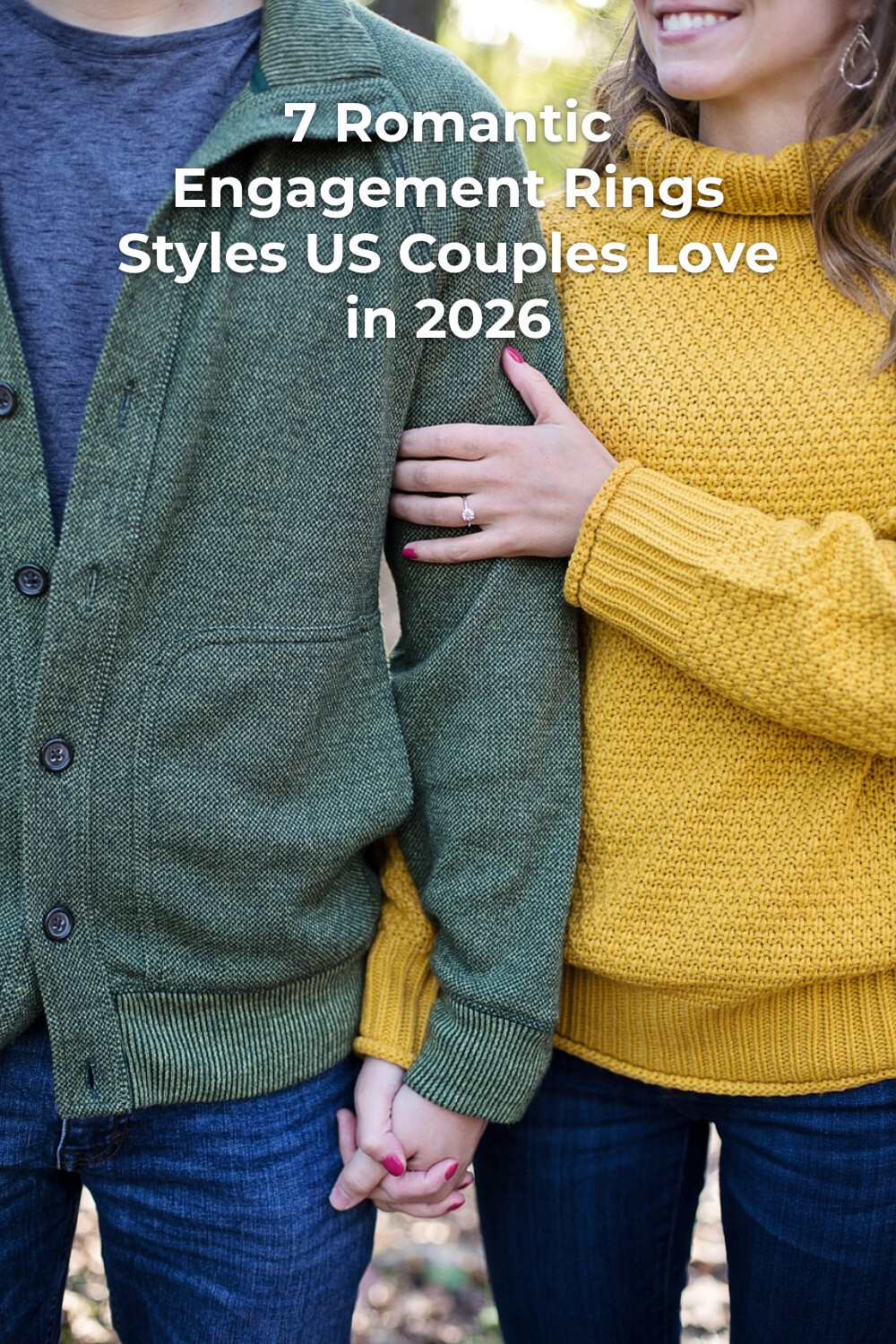
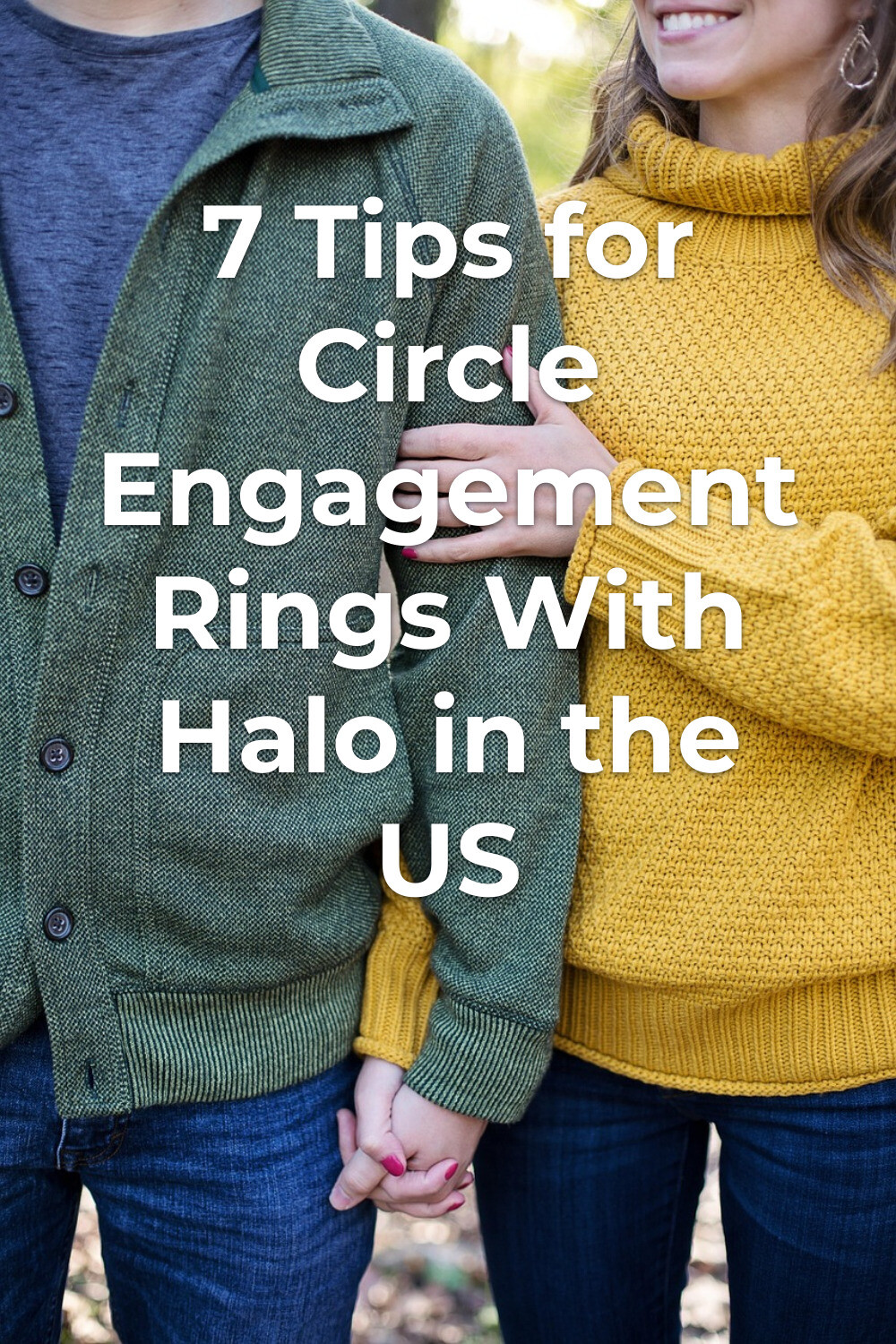
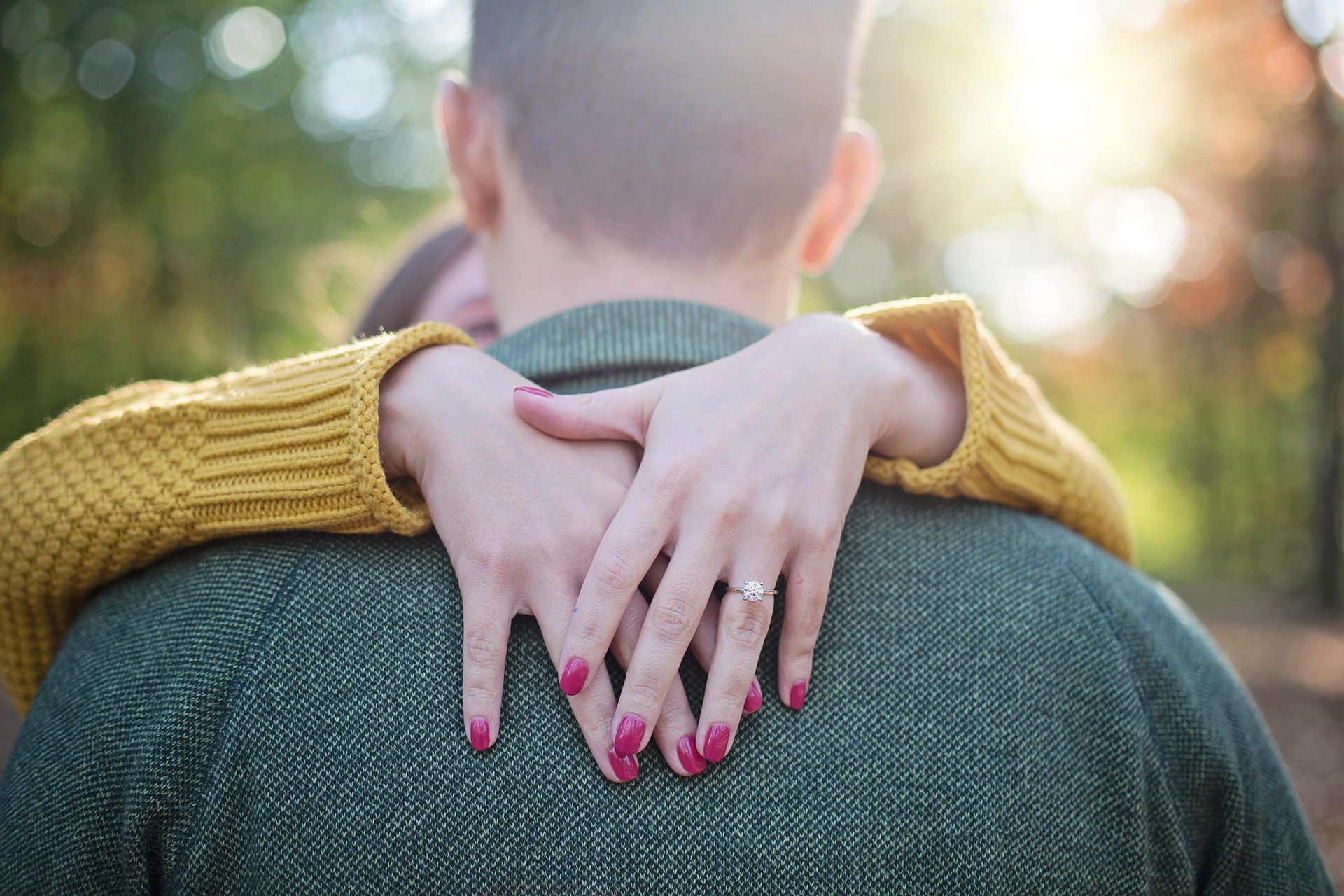
    Couple holding hands in sweaters and jeans, showing quirky engagement rings in a stylish, intimate moment
    In cozy sweaters and denim, the couple share a warm, styleforward moment that highlights their quirky engagement rings.

    What Makes a Ring “Quirky”

    “Quirky” doesn’t mean random. In engagement jewelry, it usually means the ring intentionally departs from traditional proportions, motifs, stones, or settings. Quirky engagement rings can still be timeless; they’re simply built around distinctive choices—like a sculptural silhouette, an art-inspired motif, mixed metals, or a setting that makes the stone feel unexpected.

    Design motifs that signal quirkiness

    Many quirky rings feel instantly recognizable because of their motifs. Some designs lean symbolic (like infinity-inspired forms), others feel narrative (like nature or fantasy cues), and others are architectural (scaffold-like structures and interlocking forms). The “quirk” often comes from a motif you can describe in a single phrase—music-inspired lines, a lotus-like flourish, a Celtic-inspired pattern, or a twist that makes the band feel alive.

    Tip: If you’re not sure what motif fits, start with what you already love—your partner’s favorite design era (vintage or art deco), a shared hobby (music), or a place you feel connected to (nature themes). A clear motif makes customization easier and keeps the ring from feeling trendy for trend’s sake.

    Stones and metals that break the mold

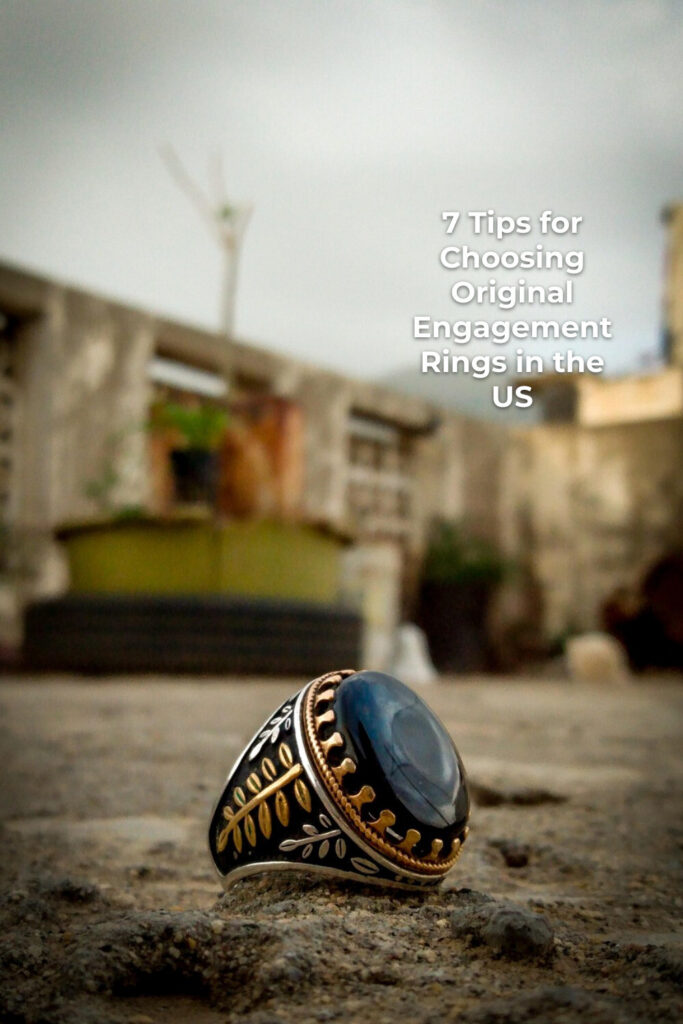
    Quirky engagement rings often feature unusual gemstones, alternative stones, or unexpected diamond looks (including bold diamonds like salt & pepper or black diamonds). Metals can also be part of the statement: mixed metals, nonstandard color pairings, or a finish that emphasizes texture. The overall effect is “personal signature” rather than “default.”

    Setting styles that stand out

    A ring can look unconventional even with a classic center stone if the setting is distinctive. Nontraditional engagement rings often lean into sculptural settings, unusual proportions (like a substantial, domed band), or structural/architectural builds that frame the stone in a more artistic way. Some designs make negative space part of the look; others emphasize texture and depth with handcrafted details.

    Tip: If you want a quirky look that’s still easy to wear daily, focus on a standout setting with a smooth profile, or choose a bold band shape that feels comfortable on the hand. Quirkiness can come from silhouette—not just height or sharp edges.

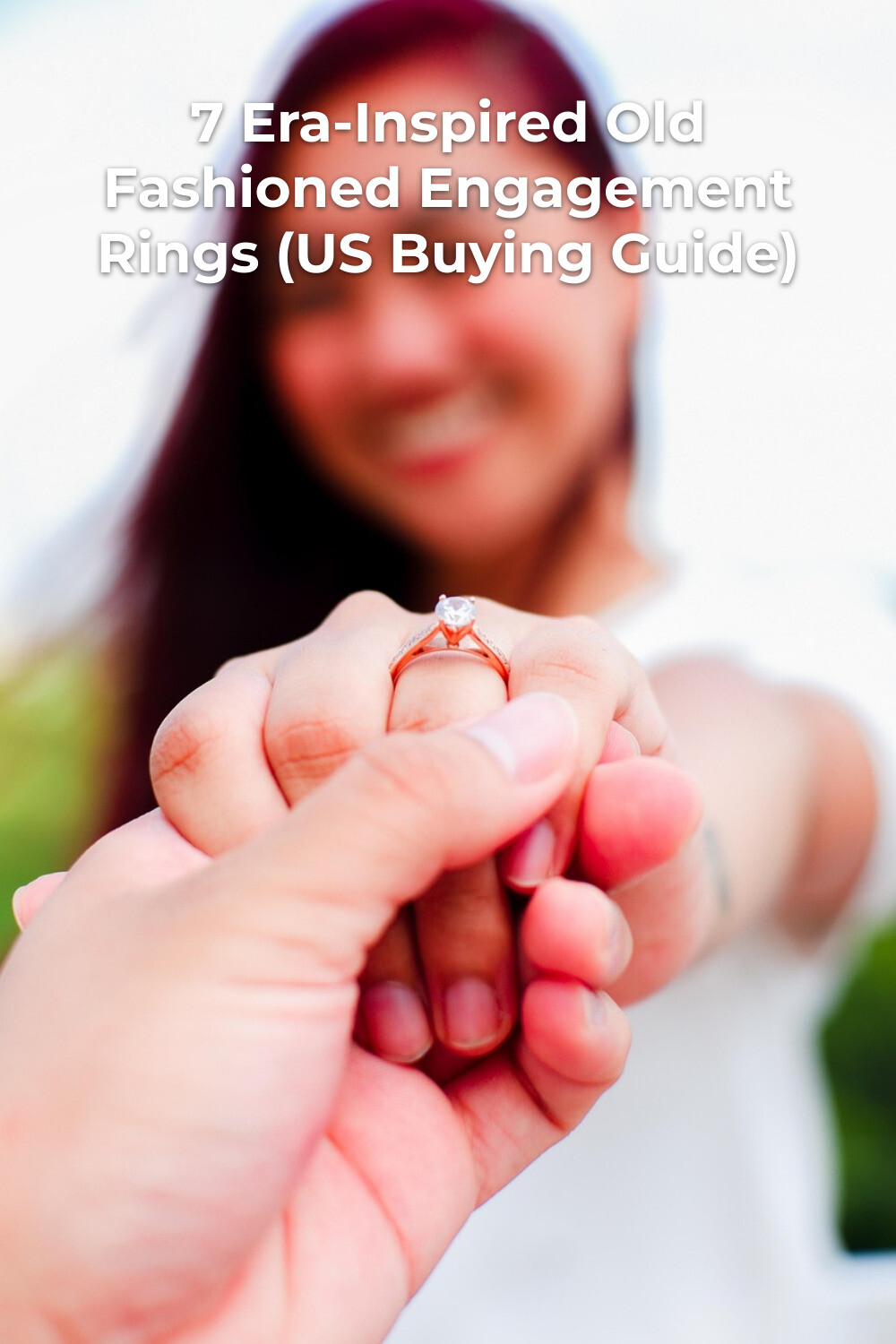
    Quirky engagement rings close-up as one person holds another's hand, ring in focus with blurred white top behind
    A styleforward close-up captures one person holding another’s hand, highlighting a distinctive ring in crisp focus.

    Quick Style Taxonomy: 8 Quirky Ring Archetypes

    Use these eight archetypes as a style map. Many of the most memorable unconventional engagement rings combine two or more of these categories—like a nature-inspired ring with mixed metals, or a geometric ring with a two-stone layout.

    • Sculptural: Artistic, three-dimensional metalwork that looks like wearable sculpture.
    • Geometric: Angular or structured silhouettes (including hex-like shapes and bold, crisp lines).
    • Nature-inspired: Organic lines and motifs rooted in natural forms.
    • Interlocking/Scaffold: Structural, architectural builds that feel engineered and dimensional.
    • Two-stone (Toi et Moi): A pair of stones that share the spotlight, often symbolizing partnership.
    • Vintage-inspired / Art Deco: Old-world cues, graphic symmetry, and era-specific details.
    • Bold colored gemstones (non-diamond): A center stone chosen for color and personality.
    • Mixed metals: Contrasting metal colors to create depth and intentional “rule-breaking.”

    1) Sculptural engagement rings

    Sculptural engagement rings are defined by form: dimensional curves, carved-looking surfaces, and settings that feel like they were designed as art first and jewelry second. This is a natural home for bold individuality and storytelling—especially when handcrafted details and texture are part of the design language.

    Tip: When exploring sculptural styles, ask yourself how you’ll stack (or not stack) a wedding band. Many sculptural rings are intended to stand alone, which can be ideal if you want a single iconic piece.

    2) Geometric and graphic silhouettes

    Geometric rings feel modern and decisive: crisp edges, strong outlines, and silhouettes that look intentional from across the room. They’re a popular direction within nontraditional engagement rings because the shape itself does much of the work—whether the ring leans hex-like, linear, or architectural.

    If you want “quirky” with a clean finish, geometry is often the simplest route: less ornate than nature motifs, but unmistakably different from the typical solitaire profile.

    3) Nature-inspired rings

    Nature-inspired quirky engagement rings often translate organic themes into metal: flowing lines, leaf-like curves, floral or lotus-like elements, and textures that feel hand-formed rather than machine-perfect. The result can be romantic, symbolic, or quietly bold, depending on the proportions.

    Tip: For a nature direction that still feels sophisticated, consider a nature motif paired with a clean, modern band shape. Balancing “organic” with “structured” can make the design feel elevated and wearable.

    4) Interlocking and scaffold-style designs

    Interlocking rings and scaffold-like builds are some of the most visually distinctive unusual engagement ring designs. They feel engineered: layers, frameworks, and structural details that create depth and negative space. These designs can read bold even without an oversized stone because the architecture becomes the statement.

    Tip: If you love the scaffold look, prioritize comfort and practicality in the profile. A ring can be intricate and still feel smooth on the sides that touch neighboring fingers.

    5) Two-stone engagement rings (Toi et Moi)

    Two-stone engagement rings are a hallmark of nonconventional engagement jewelry because they shift the symbolism: instead of a single focal point, the ring celebrates a pair. The look can be symmetrical or intentionally mismatched—two different shapes, two different stone types, or two stones in the same family styled with contrast.

    Tip: Keep the design cohesive by choosing one unifying element—either matching metalwork, a consistent setting style, or a shared color tone across the stones.

    6) Vintage-inspired and Art Deco–leaning designs

    Not all quirky engagement rings are futuristic. Vintage-inspired and Art Deco directions can be “unusual” through detail, silhouette, and era cues. You might be drawn to bold geometry, decorative lines, or a ring that evokes a past decade while still feeling fresh on the hand.

    These designs often appeal to couples who want something distinctive without stepping too far away from traditional associations with engagement jewelry.

    7) Bold colored gemstones and alternative stones

    Choosing a gemstone outside the expected center diamond is one of the clearest ways to create unconventional engagement rings. Some couples gravitate to vivid color, others to moodier stones, and others to diamonds that look intentionally different—like salt & pepper or black diamonds. The stone becomes the personality of the ring.

    Tip: Let the stone lead the design. If the gemstone is the hero, keep the setting lines focused so the ring feels intentional rather than busy.

    8) Mixed metals and deliberate contrast

    Mixed metals can make a ring feel custom even before you change the stone or silhouette. Contrasting metal colors create depth and highlight design features like twists, interlocking bands, or sculptural contours. This “rule-breaking” approach is a cornerstone of many nontraditional engagement rings.

    Tip: When considering mixed metals, think about your everyday jewelry. If you wear both metal colors already, mixed metals can make your engagement ring easier to pair with everything you own.

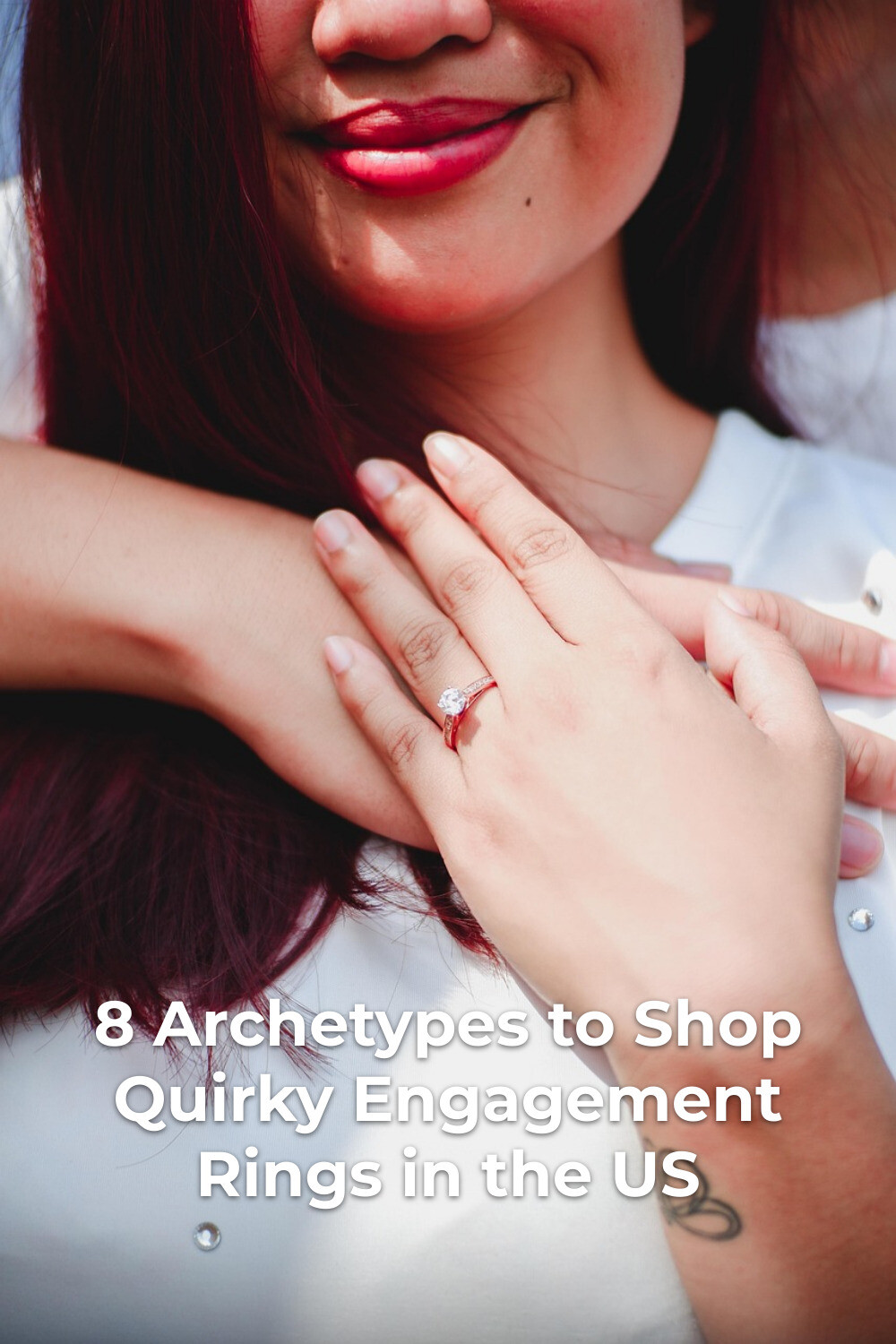
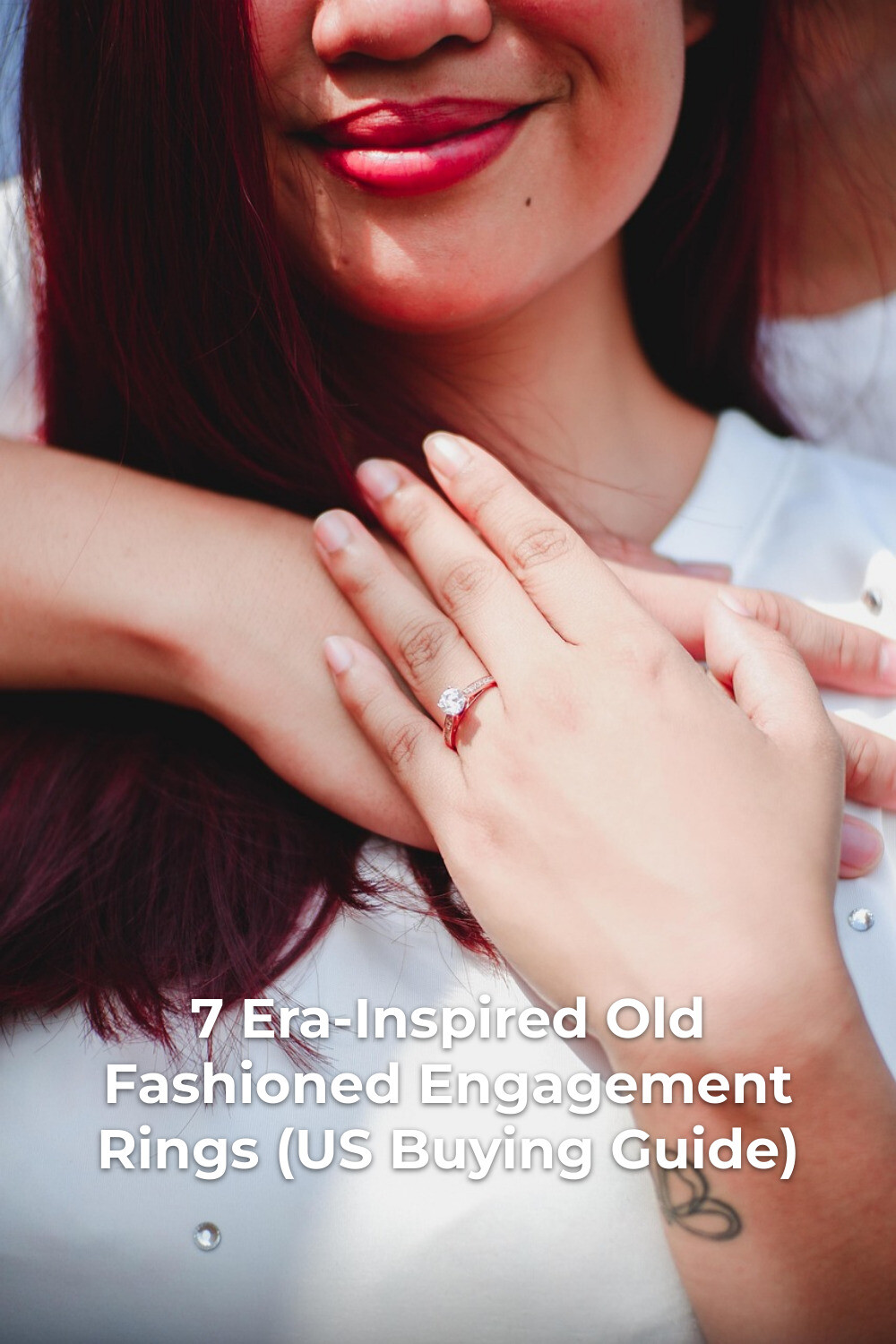
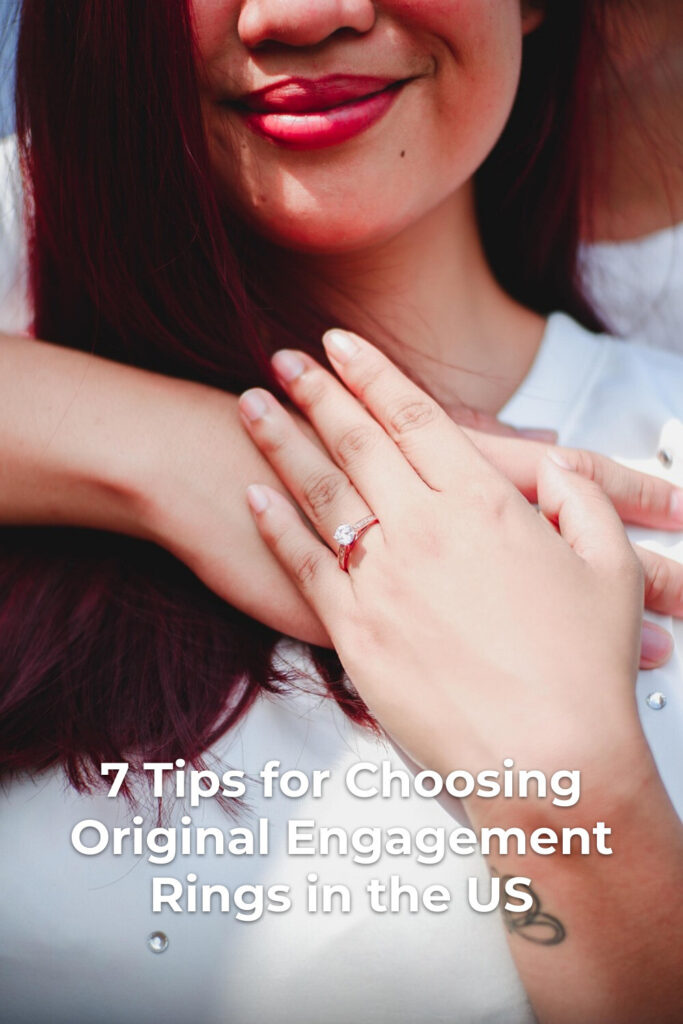
    Woman with red lipstick shows quirky engagement rings in a close-up, hands over chest with small wrist tattoo
    A style-forward close-up captures a woman with red lipstick showcasing a ring, hands held over her chest with a subtle wrist tattoo.

    Materials and Stones for a Quirky Ring

    Materials matter more in quirky designs because shape, texture, and setting choices can be more complex than a standard ring. The right metal and stone combination helps your ring feel both distinctive and wearable for the long term.

    Metals: pros, cons, and care (in real-world terms)

    Most quirky engagement rings are crafted in familiar fine-jewelry metals, with options spanning yellow gold, rose gold, white-toned metals, and platinum, plus the occasional alternative-metal direction. Your choice affects the look (warm vs. cool), how details show up (high polish vs. texture), and how you’ll think about aftercare—especially if your ring is sculptural or heavily detailed.

    • Yellow gold: Often emphasizes vintage-inspired and bold, domed silhouettes; pairs well with warm-toned designs and texture.
    • Rose gold: A strong choice for modern, sculptural, or romantic motifs; can highlight organic lines.
    • White-toned metals: Can make geometric and architectural designs feel crisp and graphic.
    • Platinum: Often chosen for a premium feel in custom engagement rings and intricate settings.
    • Mixed metals: Adds contrast and a customized look, especially effective in twist or interlocking designs.

    Tips for metal decisions: If your ring has a lot of texture, consider how you feel about patina and visible wear—some people love a lived-in look, while others prefer a consistently high-polish finish. If your design is architectural or scaffold-like, prioritize a metal choice that supports crisp lines and durable structure in daily wear.

    Gemstones: classic vs. alternative

    Gemstone choice is one of the most personal decisions in unconventional engagement rings. Some couples still want a diamond but prefer an unusual silhouette or setting. Others want a nontraditional gem, a colored stone, or a diamond look that feels moodier or more distinctive than a classic white center stone.

    When thinking about alternative gemstones, consider the role the stone plays in the overall design: a bold gemstone can be the central statement, while a quieter stone can support a highly sculptural setting. Either route can feel “quirky”—the key is that the stone and the structure speak the same visual language.

    Tip: For unusual gemstone rings, aim for harmony between color, metal tone, and motif. A nature-inspired ring often feels cohesive when the stone’s vibe matches the theme—earthy, luminous, or dramatic—rather than feeling like an unrelated add-on.

    Lab-grown vs. natural: trade-offs for quirky designs

    Many shoppers exploring quirky engagement rings are also thinking about values, transparency, and sustainability angles—especially when considering recycled metals and alternative stones. Lab-grown and natural options can both fit nontraditional designs; the decision often comes down to your priorities and what you want the ring to represent.

    Tip: If sustainability is central to your decision, consider pairing a standout silhouette (like sculptural or geometric) with recycled metals and a stone choice that aligns with your preferences. Quirky design and conscious material choices can complement each other naturally.

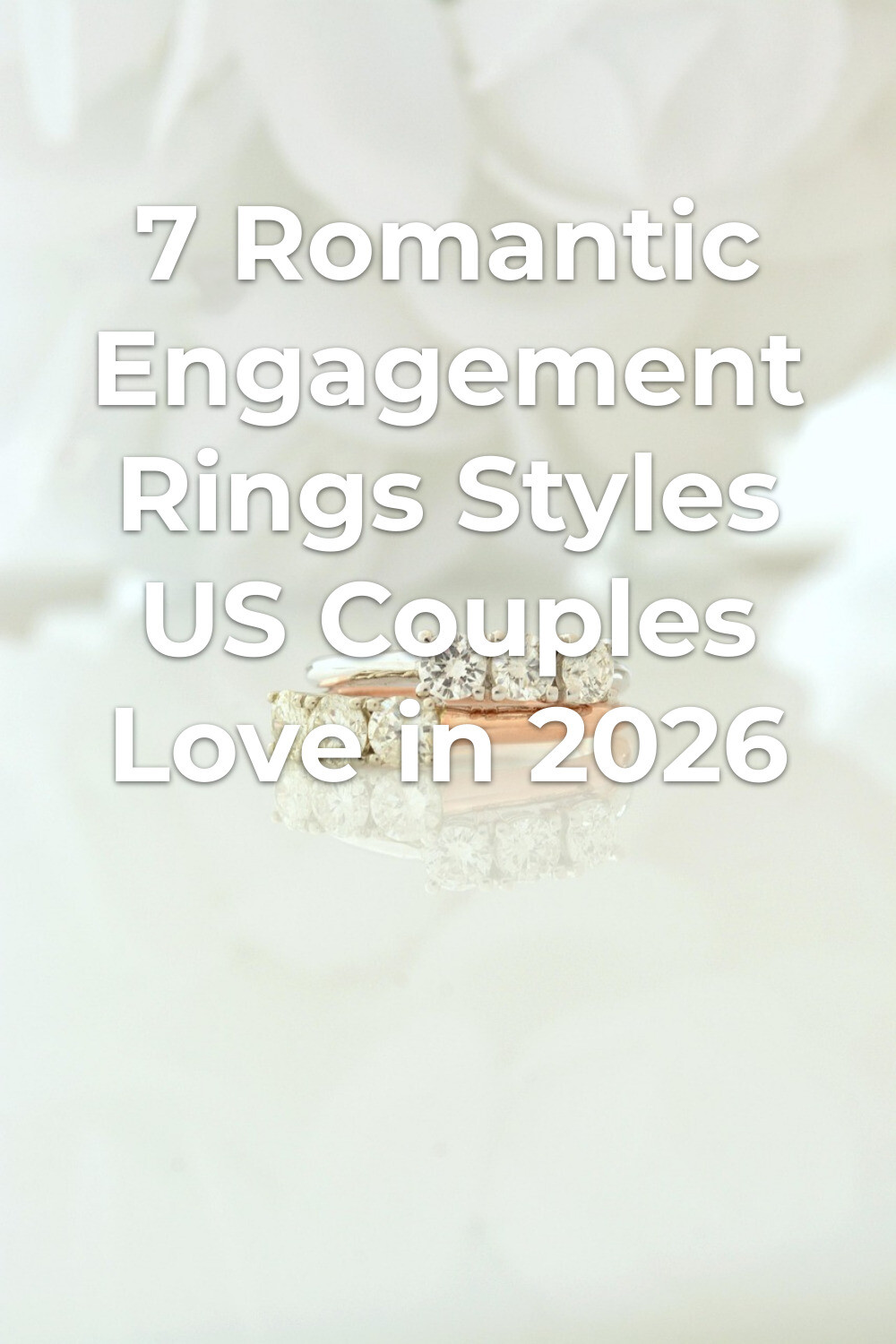
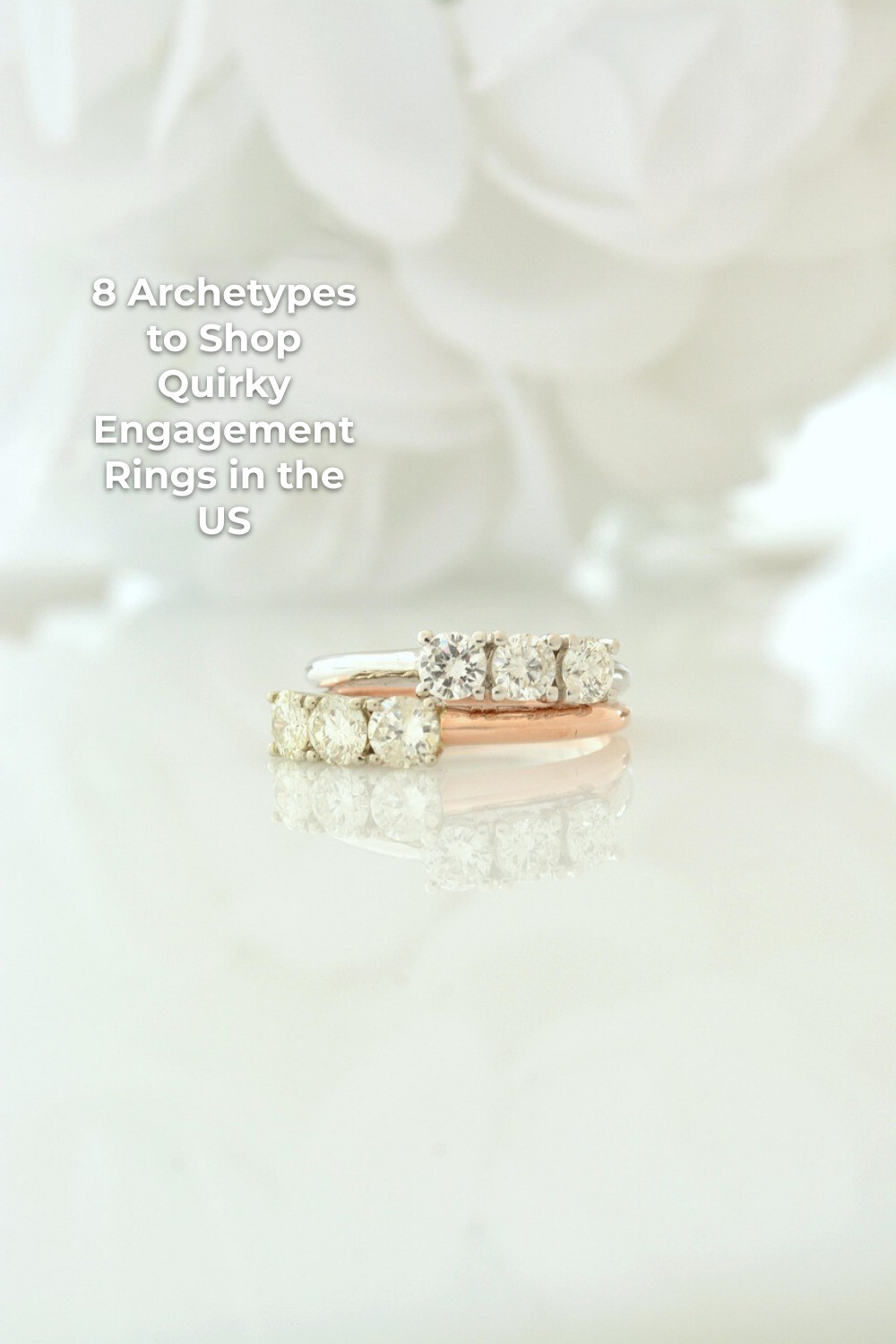
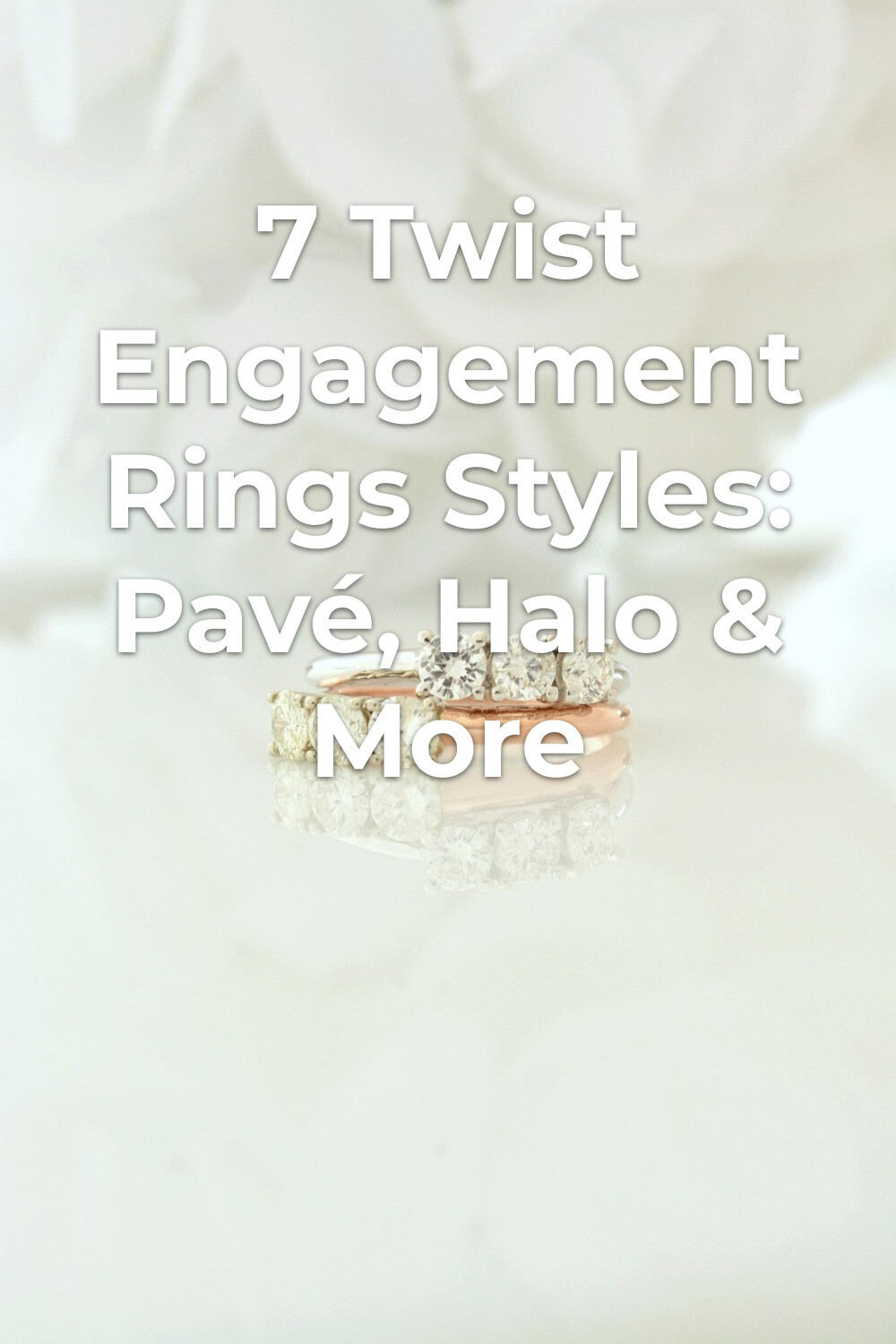
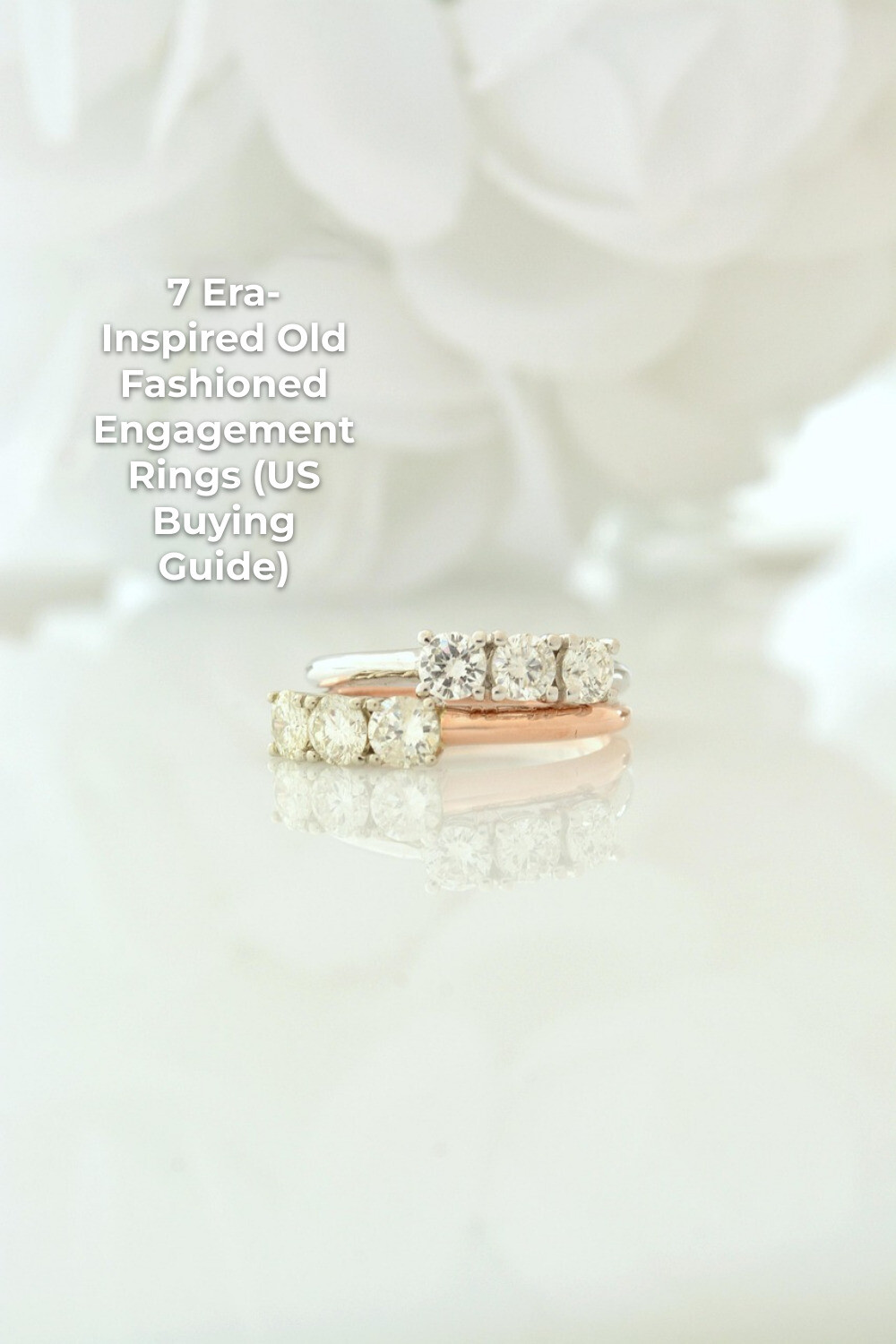
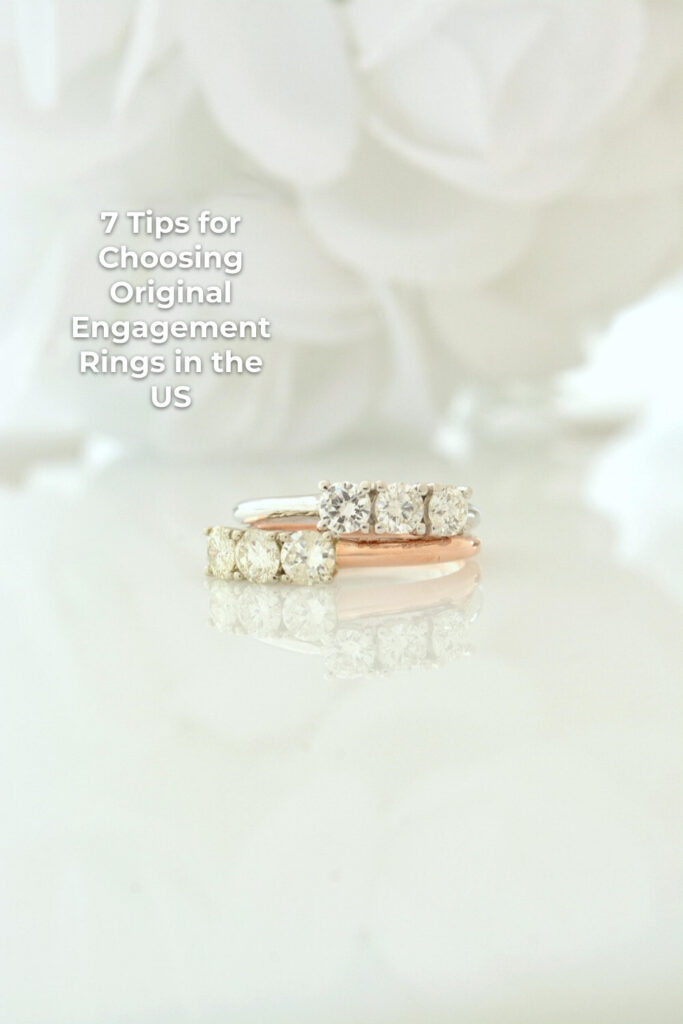
    Quirky engagement rings with gemstone settings in silver and rose gold on a white reflective surface
    Two gemstone rings in silver and rose gold gleam on a white reflective surface, framed by soft white flowers.

    Custom vs. Ready-Made: Designing Your Quirky Ring

    Many quirky engagement rings are purchased as ready-made designs, but custom engagement rings are especially common in this category. That’s because the most “you” ring often comes from personalization: adjusting the silhouette, choosing a nontraditional gemstone, adding texture, or building a motif that holds meaning. If you’ve ever said “I can’t find exactly what I want,” you’re a strong candidate for bespoke engagement ring design.

    When a bespoke ring makes the most sense

    Consider going custom when you want one-of-a-kind details, when you’re combining multiple archetypes (like nature + two-stone + mixed metals), or when the ring needs specific wearability considerations. Custom can also help if you love a concept but want to refine it—making a bold design feel balanced, comfortable, and cohesive.

    • You want a ring that tells a specific story (motif-driven design).
    • You prefer an unusual gemstone or a nonstandard stone layout.
    • You want a particular silhouette (sculptural, domed, interlocking, architectural).
    • You need personalization like engraving or meaningful symbolic shapes.
    • You’re aiming for a true one-of-a-kind ring rather than a variation of a popular style.

    The consultation: what to bring

    A design consultation works best when you bring clarity, not perfection. Most couples don’t need a final sketch; they need direction. Start with a small set of inspiration images, a list of must-haves (stone type, metal color, overall vibe), and a list of “absolutely not” preferences (too tall, too delicate, too ornate, too minimal).

    Tip: Bring examples of jewelry your partner already wears. If they love bold, chunky bands or sculptural earrings, that’s a strong hint they’ll enjoy a statement engagement ring. If they wear mostly minimal pieces, you can still go quirky—just choose a cleaner kind of quirk, like geometry or a subtle twist motif.

    Design timeline and budget ranges (how to plan without guessing)

    Custom engagement ring design typically involves multiple steps—concept, refinement, materials selection, craftsmanship, and final finishing. Because quirky designs can require more intricate metalwork or specialty settings, planning ahead matters. Even if you’re working from an existing concept, small changes (like mixed metals, texture, or a two-stone layout) can add complexity.

    Tip: Create a shared “priority list” before you talk numbers. Decide what matters most—one-of-a-kind sculptural details, an unusual gemstone, a bold band silhouette, or a specific motif. That way, if you need to simplify, you’ll know what to protect and what to edit.

    What to expect during craftsmanship

    Quirky engagement rings are often described as handcrafted and bespoke for a reason: the craftsmanship is part of the value. Expect design check-ins, decisions about finishes (polished vs. textured), and detailed discussions about stone placement and comfort. A well-made unconventional ring should feel intentional from every angle—top view, side profile, and how it sits against the finger.

    Tip: Ask how the ring will sit with a wedding band (if you want one) and whether the design is meant to stack, nest, or stand alone. This is one of the most common “surprise” issues with sculptural and interlocking designs, and it’s easiest to solve during the design stage.

    Real-Life Inspirations: Celebrity, Art, and Pop Culture

    Celebrity engagement rings and pop culture moments often accelerate interest in unconventional engagement rings, especially when a public figure chooses a silhouette that feels bold and wearable at the same time. Recent attention has centered on chunky gold bands and bombé (domed) engagement ring shapes—thick, rounded silhouettes with vintage vibes that read as confident and modern.

    Celebrity-inspired directions you can actually wear

    Celebrity examples vary widely, but the common message is personal expression. Some go for unusual stones and distinctive settings; others go for bold proportions and thick bands. If you’re inspired by a famous ring, focus on the transferable design cues: band thickness, dome shape, a nontraditional silhouette, or a distinctive setting approach.

    Tip: Treat celebrity rings like mood boards, not templates. Pick one or two elements you love (for example, a chunky band plus a clean setting), then tailor everything else—metal color, stone type, and comfort profile—to your life.

    Art-inspired motifs: nature, architecture, and fantasy

    Beyond celebrity influence, many quirky engagement rings draw from broader visual worlds: nature, vintage eras, architecture, and fantasy. This is where motifs like lotus-inspired forms, infinity-like curves, Celtic-inspired patterns, twist designs, and scaffold structures fit naturally. These motifs can be subtle (a gentle twist) or dramatic (a sculptural, story-driven centerpiece).

    Tip: If you love an art-inspired direction, decide whether you want the motif to be recognizable at a glance or more “secretly meaningful.” Both can be quirky; the difference is how loudly the ring speaks.

    Practical Buying Guide: Budgeting, Timelines, and Maintenance

    Quirky engagement rings can be bold, intricate, and highly personal—so practical planning matters. The goal is to match the ring’s design ambition with your real-world needs: how fast you need it, how you’ll maintain it, and how it fits into your financial comfort zone.

    Budgeting for a quirky ring (without losing the plot)

    Budgets for unconventional engagement rings can vary widely depending on materials, stone choice, and whether you go custom. The best approach is to budget around priorities: if the centerpiece is a unique gemstone or a sculptural, handcrafted build, expect the ring’s value to be concentrated there. If you want maximum design impact with a controlled budget, focusing on silhouette (like a bold band or geometric structure) can create a strong statement without requiring the most elaborate stone plan.

    • Decide what matters most: stone, silhouette, or storytelling details.
    • Allocate room for personalization (engraving, mixed metals, texture).
    • If custom, plan for design iterations so you don’t rush decisions.
    • Remember long-term costs like maintenance and insurance planning.

    Tip: If you’re designing together, set a “must-have” list of three items and a “nice-to-have” list of three. This keeps the ring quirky and intentional without becoming overly complicated.

    Sizing, insurance, and aftercare

    Because quirky designs may be wider, thicker, or more sculptural, sizing and comfort deserve extra attention. A chunky band can feel different than a thin band; an interlocking design can fit differently than a simple circle; a ring with a bold profile may catch on clothing if the setting is high or sharply detailed. Aftercare also matters: texture can collect residue, and intricate settings may need periodic checkups.

    Tips for wearability: Think about your lifestyle and your hands-on routines. If you work with your hands frequently, consider a lower-profile setting or a smoother sculptural form. If you love dramatic height, ask how the ring will feel with everyday tasks. If the ring includes detailed texture, plan gentle, regular cleaning habits and periodic professional check-ins to keep the ring looking crisp.

    Ethical considerations and sourcing

    Many shoppers exploring nontraditional engagement rings also care about how materials are sourced and whether the ring aligns with their values. Some brands emphasize recycled metals, and many couples compare lab-grown and natural stones as part of building a ring that feels both personal and responsible. Quirky design doesn’t have to be separate from these choices; it can amplify them by making every element feel deliberate.

    Tip: When discussing sourcing, focus on clarity. Ask what metal options are available (including recycled metals if offered), what stone options fit your design goals, and what choices best align with your priorities. A trustworthy process should feel transparent and collaborative.

    Tips for Choosing a Quirky Ring You’ll Love Long-Term

    A ring can be unconventional without being impractical. The most successful quirky engagement rings balance artistry with comfort and longevity—so you don’t feel like you’re “handling” your ring all day. Use the tips below to keep your choice wearable, personal, and future-proof.

    • Choose one hero element: a bold silhouette, an unusual gemstone, or a defining motif.
    • Keep the profile in mind: dramatic rings can still be low-profile and comfortable.
    • Plan for pairing: decide early if you want stacking, a nesting band, or a stand-alone look.
    • Balance novelty with clarity: if every detail is “loud,” the design can lose focus.
    • Let the ring reflect real style: match the ring’s vibe to the jewelry you actually wear.

    Tip: If you’re torn between two directions—say, geometric versus nature-inspired—consider a hybrid. A clean geometric band can carry a subtle organic detail, or a nature motif can be rendered with Art Deco–like structure. Hybrids often feel the most personal because they don’t fit neatly into a single category.

    Gallery: 40+ Quirky Ring Concepts (Visual Inspiration)

    Use these concepts as prompts for shopping, saving inspiration, or briefing a designer for custom engagement rings. Many can be adapted to your preferred metal, stone type, and comfort profile.

    Sculptural concepts (10)

    A bold, wave-like sculptural band with a flush-set stone for a smooth profile

    • A carved-look band with intentional asymmetry and a clean, centered setting
    • A domed band with a subtle stone detail that feels integrated, not “added on”
    • A thick band with a negative-space window framing the center stone
    • A sculptural twist that wraps toward the stone like a ribbon
    • A textured, handcrafted band that emphasizes depth and shadow
    • A sculptural bezel-like outline with modern, softened edges
    • A statement band that’s meant to be worn alone (no stack), designed as a single icon
    • A band that transitions from smooth to textured as it approaches the setting
    • A sculptural “crown” detail that reads artistic rather than ornate

    Geometric concepts (8)

    • A hex-like silhouette paired with a minimal, crisp setting
    • A strong, straight-line band with a centered stone and graphic shoulders
    • A geometric split-band that meets at a clean, modern head
    • A low-profile geometric bezel with bold edges
    • A band with repeating geometric cutouts for an architectural feel
    • A minimalist setting with a pronounced geometric outline around the stone
    • A stepped, Art Deco–leaning geometry rendered in a modern, simplified way
    • A geometric ring with contrasting metal tones to highlight the structure

    Nature-inspired concepts (8)

    • A lotus-inspired motif integrated into the basket or side profile
    • A band with gentle leaf-like curves that cradle the center stone
    • An organic twist band that feels hand-formed rather than perfectly symmetrical
    • A nature texture that looks like it was drawn from bark or flowing water
    • A floral-inspired detail that’s subtle from the top, more visible from the side
    • An organic contour band designed to nest with a future wedding band
    • A nature-inspired ring paired with a clean stone shape for balance
    • A motif-driven design that tells a specific story (place, memory, shared theme)

    Interlocking/scaffold concepts (6)

    • An interlocking band structure that creates depth without extra height
    • A scaffold-style framework that holds the stone in an architectural “cage”
    • A layered band that looks engineered, with intentional negative space
    • A structured split that wraps around the setting like a bridge
    • A framework design that emphasizes the side view as much as the top view
    • An architectural ring that’s built to be a stand-alone statement piece

    Two-stone / Toi et Moi concepts (5)

    • Two stones with contrasting shapes set in a shared, balanced composition
    • Two stones in similar tones but different sizes for a subtle hierarchy
    • A two-stone design where the band’s twist motif visually connects the pair
    • A Toi et Moi layout that feels modern through clean lines and minimal metalwork
    • A two-stone ring paired with a bold band for extra presence

    Vintage-inspired / Art Deco concepts (5)

    • An Art Deco–leaning geometric silhouette with crisp symmetry
    • A vintage-inspired ring with bold proportions rather than heavy ornament
    • A band with era-inspired detailing paired with a modern, clean setting
    • A vintage vibe achieved through shape and profile (not just surface decoration)
    • A retro-feeling domed band that reads both nostalgic and current

    Mixed-metal concepts (4)

    • A twist band in two metal tones to emphasize movement
    • An architectural ring with contrasting metal colors outlining the structure
    • A two-tone band where one metal frames the setting and the other forms the shank
    • A mixed-metal sculptural band that highlights texture and depth

    Next Steps: How to Start Your Quirky Ring Journey

    If you’re ready to shop or design, the fastest way forward is to turn your preferences into a clear plan. Quirky engagement rings are easier to choose when you can articulate your archetype, your materials comfort zone, and how you want the ring to feel day-to-day.

    • Pick your primary archetype (sculptural, geometric, nature-inspired, scaffold, two-stone, vintage-inspired, bold gemstone, mixed metals).
    • Decide whether you prefer ready-made or a custom engagement ring design process.
    • Choose your non-negotiables (metal tone, stone type, band width vibe, stacking preference).
    • Create a small mood board: 8–12 images max, focused on recurring elements.
    • Set your practical boundaries (timeline expectations, wearability, and aftercare preferences).

    Tip: The most helpful question to answer early is: “Do I want the quirkiness to come from the stone, the structure, or the story?” Once you know that, nearly every design decision becomes simpler.

    Quirky engagement rings moment as groom dips bride kissing beside white columns outdoors
    A style-forward couple shares a romantic dip kiss beside sunlit white columns outdoors.

    FAQ

    What’s the difference between quirky, nontraditional, and unusual engagement rings?

    They overlap, but “quirky engagement rings” usually implies intentional personality—distinctive motifs, proportions, or symbolism—while “nontraditional” often refers to breaking classic norms (alternative stones, mixed metals, unexpected silhouettes), and “unusual” tends to describe standout settings, textures, or structural designs that look different at first glance.

    Are sculptural engagement rings durable enough for everyday wear?

    They can be, but durability depends on how the ring is built and how practical the profile is for your lifestyle; a well-designed sculptural ring should balance artistic form with comfort, smooth contact points, and a setting style that doesn’t snag or feel overly exposed in daily use.

    How do I choose between a ready-made ring and a custom engagement ring?

    Choose ready-made if you already love a design as-is and want a straightforward purchase, and choose custom if you want a one-of-a-kind motif, a specific unusual gemstone, mixed-metal details, or a unique setting and silhouette that you can’t easily find pre-made.

    What are the most popular quirky ring styles right now?

    Popular directions include bold, chunky band silhouettes (including domed or bombé-inspired looks), sculptural settings, geometric shapes, two-stone (Toi et Moi) layouts, and nontraditional engagement rings featuring alternative stones like colored gemstones or distinctive diamond styles.

    Do chunky bands and domed rings feel comfortable?

    They often can, but comfort depends on band width, interior shaping, and how the ring sits between fingers; if you’re considering a bold engagement ring with a chunky band, focus on how it feels across the knuckle and whether the profile is smooth enough for everyday movement.

    Can I still have a “classic” diamond in a quirky engagement ring?

    Yes—many quirky engagement rings use a classic stone but make it feel unconventional through a sculptural silhouette, a distinctive setting, mixed metals, texture, or an unexpected layout like a two-stone design.

    How should I plan a custom ring timeline?

    Plan around a multi-step process that typically includes consultation, design refinement, materials selection, craftsmanship, and final finishing, and give yourself extra breathing room if you’re choosing intricate metalwork, mixed metals, or a more architectural scaffold-style build.

    What should I ask about maintenance for heavily textured or intricate rings?

    Ask how the texture will wear over time, how to clean the design safely, how often the setting should be checked, and whether the ring’s structure (especially interlocking or scaffold details) has any specific care considerations to keep it comfortable and secure long-term.

    Are lab-grown options compatible with quirky and unconventional designs?

    Yes—lab-grown and natural stones can both work well in quirky engagement rings, and many couples pair distinctive silhouettes or handcrafted details with material choices that align with their values, such as recycled metals or lab-grown stones.

  • 9 Chic engagement rings holder ideas for US homes (2026)

    9 Chic engagement rings holder ideas for US homes (2026)

    Engagement Ring Holder Ideas: Dishes, Stands, and Display Tips for 2026

    If you’re searching for engagement rings holder ideas, you’re likely balancing three needs at once: a safe place to put your ring, a beautiful display that fits your home, and something that looks photo-ready for the moments you’ll want to remember. The best ring holder doesn’t just “hold” jewelry—it supports your daily routine, helps protect your ring when you’re not wearing it, and adds a small but meaningful design detail to your space.

    This guide walks through ring dish ideas, ring display stands, personalized keepsake options, room-by-room placement, a practical buying checklist, and DIY ring holder projects. Along the way, you’ll find tips on care and cleaning by material so your holder stays as polished as your engagement moment feels.

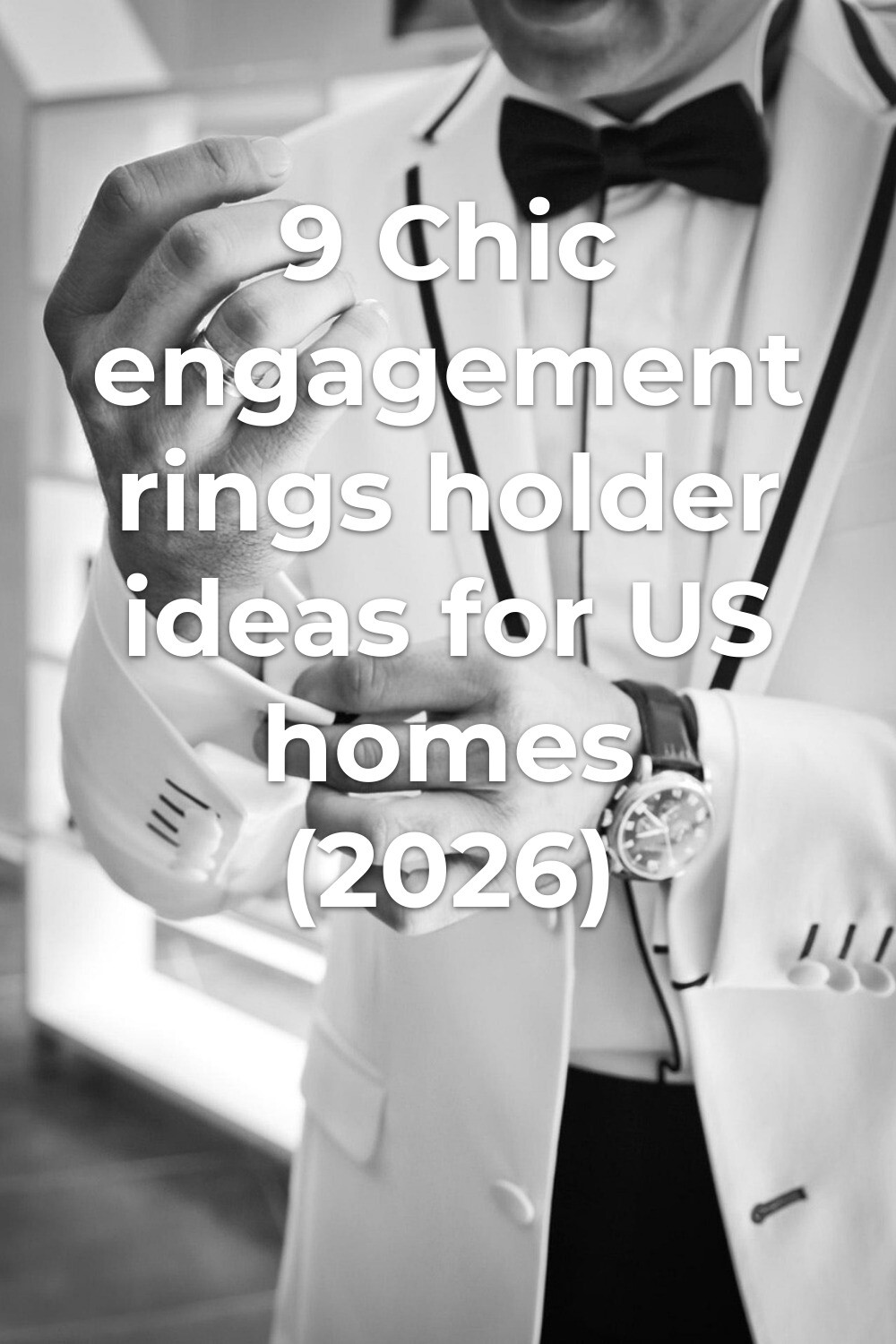
    engagement rings holder ideas: man in white suit jacket adjusts cuff, wearing wristwatch and ring
    A groom in a crisp white jacket adjusts his cuff, showcasing a refined watch and ring.

    Why the Right Ring Holder Elevates Your Engagement Moments

    An engagement ring is one of the most-worn pieces of jewelry for many people, but it’s also one of the most frequently removed—during skincare, cooking, cleaning, workouts, and sleep. Having a dedicated ring holder reduces the chance of misplacing your ring and creates a consistent “home base” that supports daily habits.

    Display aesthetics for photos and flat lays

    Many ring holders double as decor. A clean ceramic ring dish, a minimal metal stand, or a glass terrarium-style holder can turn a simple countertop corner into a photo-friendly vignette. These setups also work well for flat-lay photos—especially when you want to capture your ring alongside small keepsakes or a tidy vanity arrangement.

    Security and ring protection

    A good holder keeps your ring in one predictable place and helps reduce accidental drops, countertop slips, or getting knocked into sinks. Details like a secure basin, a non-slip base, or a stable stand shape can make a noticeable difference in daily use—especially in high-traffic areas like bathrooms and kitchens.

    Gift-ready presentation benefits

    Ring dishes and ring holders are also popular engagement gifts because they are meaningful without being overly personal, and they work across budgets. Personalized engagement ring dishes, engraved stands, and keepsake ring trays feel thoughtful while still being practical.

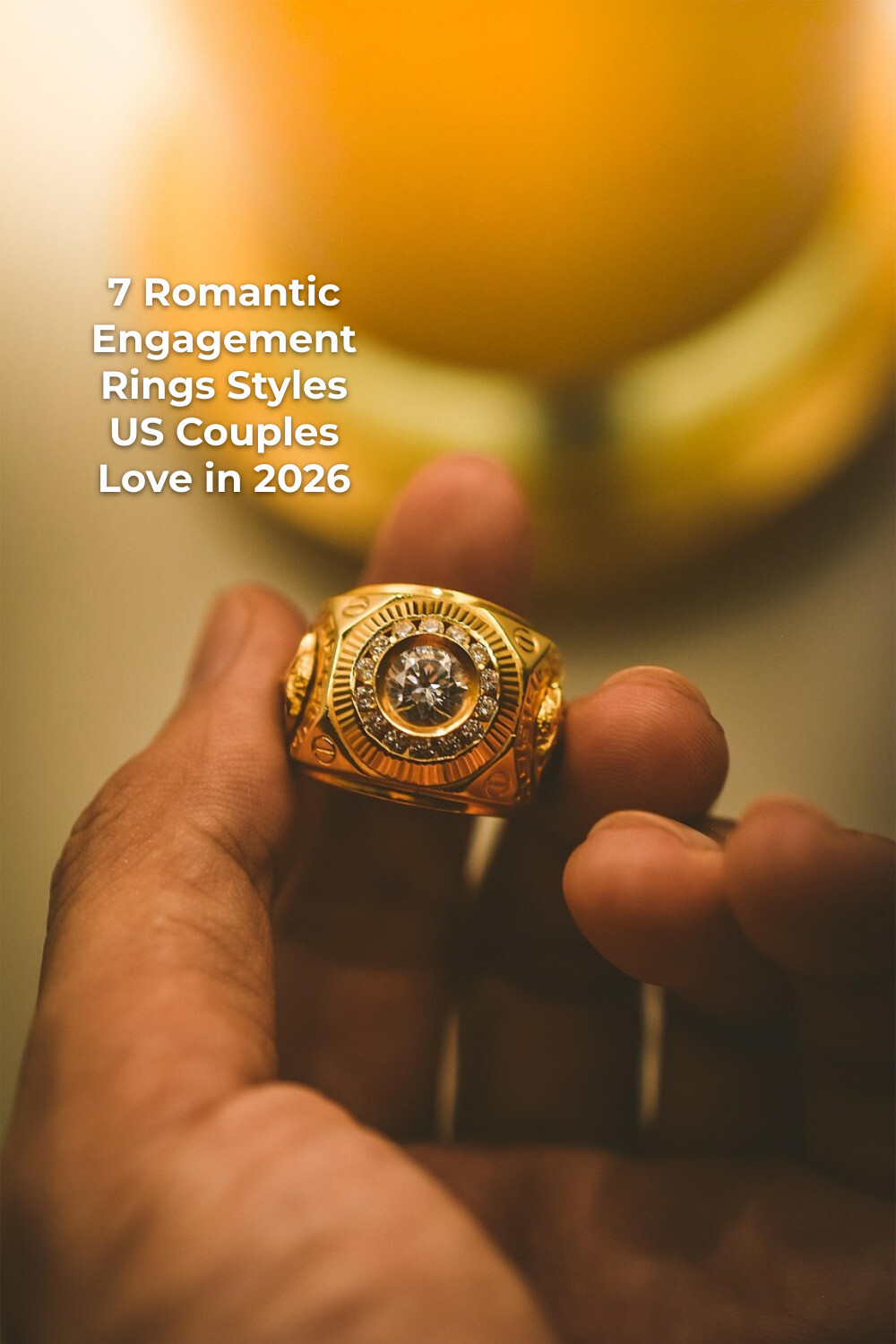
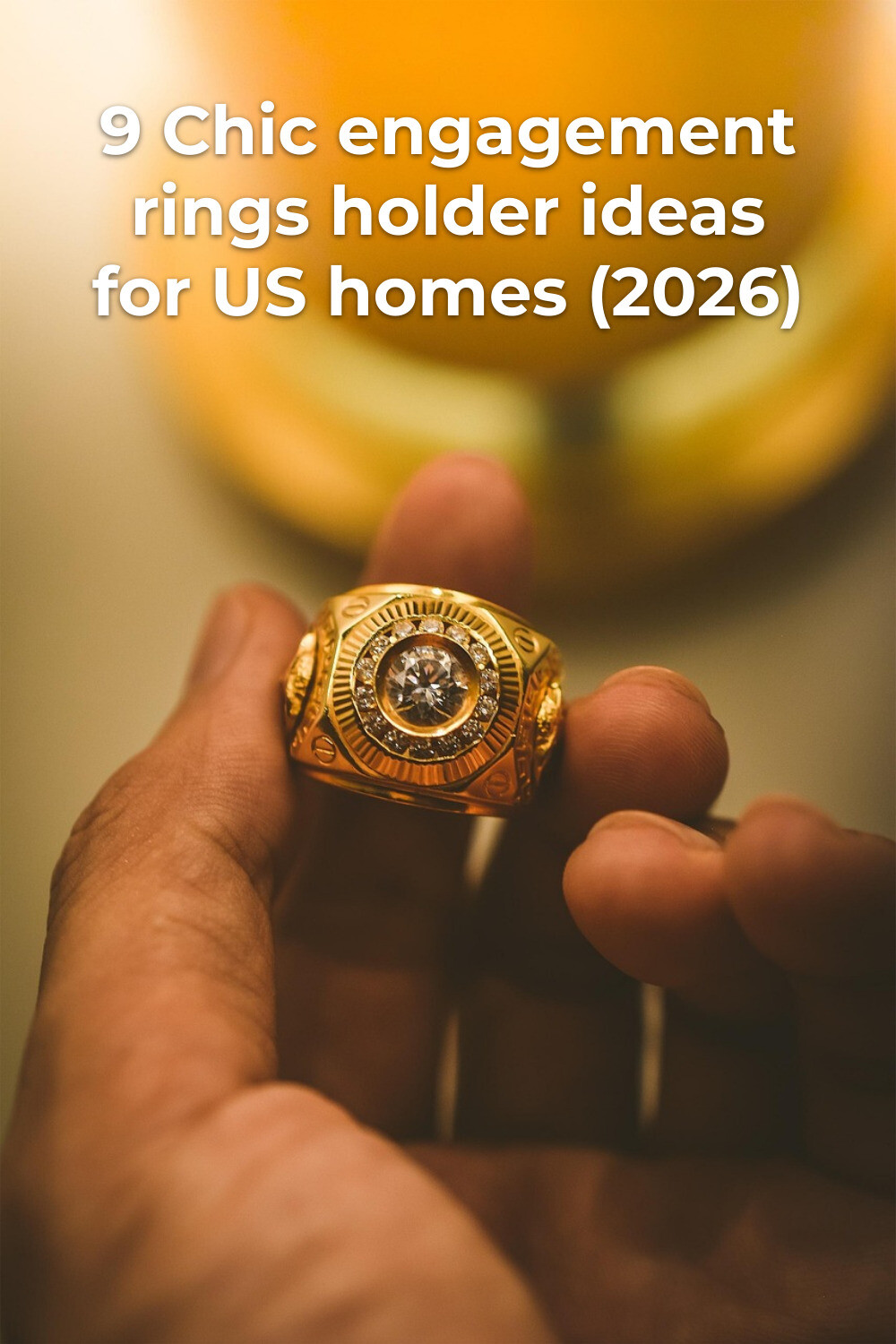
    Hand holding a gold ring with clear stone, decorative engagement rings holder ideas inspiration
    A hand gently presents a gold ring with a clear stone, offering a refined touch of decorative inspiration.

    Ring Holder Ideas by Material

    Material is one of the fastest ways to narrow down ring holder ideas because it affects the look, durability, and maintenance. Below are proven categories seen across popular ring dish roundups and shopping destinations, with practical ways to choose what fits your style and routine.

    Porcelain and ceramic dishes

    Porcelain and ceramic ring dishes are classic for a reason: they look polished, feel giftable, and work in almost any room. These are often the top pick for a nightstand or vanity because they’re low-profile and easy to drop a ring into at the end of the day.

    Engagement ring dish styles you’ll commonly see include clean white ceramics, softly colored glazes, and small sculptural shapes that function as jewelry dishes without looking cluttered. For a more meaningful touch, a personalized ring holder in ceramic—especially monogrammed or dated—adds a keepsake element without sacrificing simplicity.

    Tips: If your routine is fast (take ring off, wash hands, put ring back on), choose a dish with slightly higher sides so the ring can’t slide out when bumped.

    Wood and bamboo stands

    Wooden ring holder ideas tend to lean warm, natural, and decor-forward. A wood ring stand can suit rustic, minimalist, or modern spaces depending on the shape and finish. Bamboo offers a similar vibe and is often favored for an eco-friendly feel within natural decor themes.

    Wood stands are especially useful for people who like “vertical storage” on a vanity or dresser because the ring is easy to grab on the way out the door. They can also pair nicely with a tray to create a complete jewelry landing zone without looking like a storage bin.

    Tips: If you prefer wood, look for a stable base and a smooth finish where the ring rests, so the ring slides on and off easily and the stand remains comfortable to use daily.

    Metal and aluminum racks or stands

    Metal ring stands and minimalist racks offer a modern look and a sturdy feel. Finishes often range from brushed to polished, making it easy to match other hardware in your home. If you’re drawn to clean lines and uncluttered surfaces, a small metal ring display stand can feel like a tiny piece of functional sculpture.

    Metal designs can work well for a “grab-and-go” setup on a dresser or near a sink, but the best options still prioritize stability. A base that stays put on smooth surfaces helps keep daily use effortless.

    Tips: If your holder will live in a bathroom, prioritize a stable, easy-to-wipe metal surface and avoid designs that feel top-heavy or easy to tip when reached for quickly.

    Glass, terrarium, stone, and terracotta holders

    If you want unique engagement ring display ideas, consider materials that add texture and visual interest: glass dishes, terrarium-style ring holders, stone pieces, or terracotta accents. These options often feel curated and styling-driven, which is ideal if you love decorative setups and intentional vignettes.

    Glass can feel airy and photo-ready; stone can look grounded and premium; terracotta offers earthy warmth. Terrarium ring holder styles can be especially decorative and work well in staged photos or styled corners of a vanity table.

    Tips: If you choose glass or other fragile materials, place the holder away from edges and in a low-traffic area where it won’t be easily bumped.

    DIY and customizable options

    DIY ring holder ideas are popular because they allow you to tailor the shape, color, and vibe to your space. Customizable options also include personalized engagement ring dishes, engraved plaques, or made-to-order stands. This category is where you can match a specific decor style—minimalist, rustic, glam, or boho—without hunting endlessly for the perfect “off-the-shelf” piece.

    Customization can be as subtle as a monogram or as meaningful as a date. If you’re gifting, personalization also turns a practical item into a keepsake that feels intentional rather than generic.

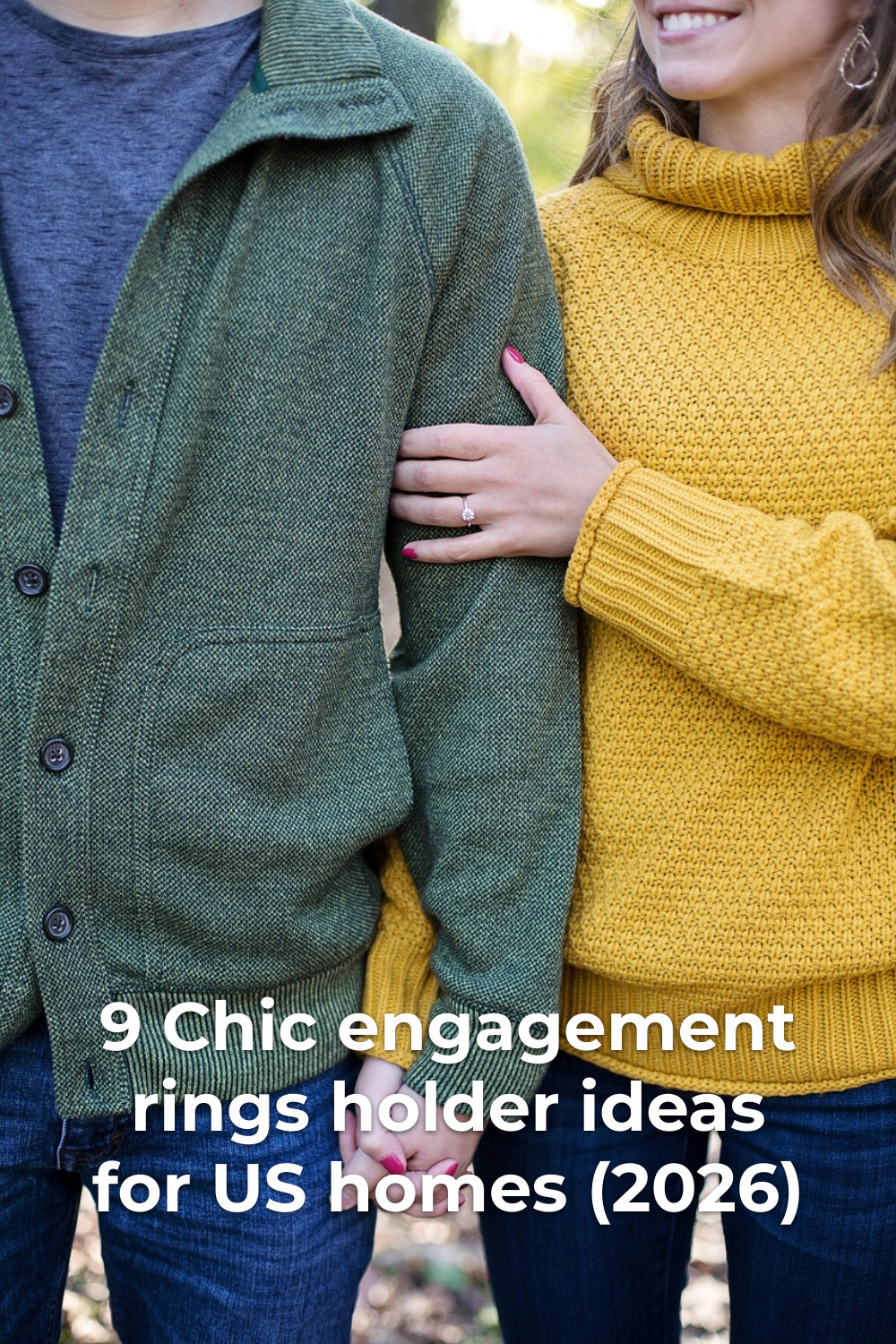
    Decorative engagement rings holder ideas with couple holding hands, woman showing ring while resting on man’s arm
    A cozy couple in sweaters and jeans holds hands as her ringed hand rests gently on his arm.

    Room-by-Room Ring Display Ideas

    Where you place your ring holder matters just as much as which style you choose. The best ring holder ideas support the moments you naturally take your ring off, while still looking like they belong in the room.

    Vanity table setups

    A vanity is one of the most natural homes for an engagement ring dish because you’re often removing your ring for skincare, makeup, or hair routines. A small jewelry dish can also elevate the surface, making the setup feel intentional and clean rather than cluttered.

    For a cohesive vanity ring display, pair your ring holder with a simple tray or ring bowl style that visually corrals small items. The goal is a fast routine: ring off, into the holder, and back on—without searching.

    • Place a ceramic ring dish near where you set down daily jewelry
    • Add a small ring tray to anchor the area and keep it looking tidy
    • Choose a holder shape that’s easy to use with one hand
    • Keep the setup photo-ready by leaving extra counter space around it

    Tips: If you take photos often, keep a neutral-toned dish at your vanity. Clean ceramics and simple forms tend to look timeless in flat lays.

    Nightstand and bedroom displays

    The nightstand ring holder is a classic: you take your ring off at the end of the day and want it within reach in the morning. Here, low-profile ring dishes often outperform tall stands because they’re harder to knock over in the dark.

    If your bedroom decor leans cozy, a wood ring stand can add warmth. If you want an elegant, minimal look, porcelain or ceramic dishes keep the visual footprint small while still feeling special.

    Tips: Choose a holder with a secure basin for the nightstand. A dish with slightly higher sides can help keep a ring from shifting if the table gets bumped.

    Bathroom sink and getting-ready areas

    Many people remove rings near the sink for handwashing and skincare. That makes the bathroom a practical location for a ring dish or a non-slip ring holder. The best choices here are easy to clean and stable on smooth surfaces.

    Decorative engagement rings holder ideas with a woman in yellow sari and jewelry outdoors
    A woman in a yellow sari and black blouse showcases jewelry outdoors against a softly blurred city backdrop.

    If you prefer a sleek look, metal and ceramic work well visually. If you choose a bowl, aim for one that’s not too deep; you want the ring to be visible at a glance so you don’t forget it.

    Tips: Keep a dedicated ring holder near the sink rather than placing rings directly on the counter. The consistent “ring goes here” habit is often the biggest step toward not misplacing it.

    Wedding/event table props and photo moments

    Ring holders aren’t only for home—they can also be part of wedding table styling or photoshoot props. Many wedding resources highlight ring dishes, ring pillows, and ring holders as part of presentation. If you’re styling a moment, focus on a holder that looks intentional in a close-up shot and feels consistent with your theme.

    A clean ceramic ring dish reads timeless. A glass or terrarium ring holder reads styled and decorative. A small engraved stand or plaque adds a sentimental “keepsake” layer that photographs well in detail shots.

    • Minimal ceramic dish for a clean, classic look
    • Terrarium-style holder for a curated, decorative vibe
    • Engraved plaque or stand for a keepsake detail in photos
    • Ring tray for styling multiple rings together in a flat lay

    Tips: For photo-friendly ring display ideas, keep the area around the holder simple. A single focal point typically looks more refined than a crowded surface.

    Travel-friendly ring holders for proposals and honeymoons

    Travel adds a new constraint: you want something protective and compact. The best travel ring holder is easy to pack, keeps the ring contained, and reduces the chance of it being misplaced in a hotel bathroom or on a nightstand you’re unfamiliar with.

    While many home holders are decorative, travel-friendly ring holders prioritize secure storage. If you don’t want to buy something solely for travel, consider a small, sturdy ring dish that can sit safely on a hotel dresser, or choose a compact holder style designed to keep the ring in a stable basin.

    Tips: When traveling, use the same habit every time: ring off, ring into the holder, holder placed in the same spot. Consistency is your best protection against leaving something behind.

    Personalization and Gift-Giving: Keepable, Not Just Cute

    Personalized ring holder ideas are popular for engagements because they combine everyday function with meaning. The personalization can be subtle enough for daily decor but still make the piece feel like it belongs specifically to the couple and the moment.

    Monograms, engravings, and dates

    A monogrammed dish is a classic engagement gift choice: it’s decorative, useful, and personal without needing to know intimate details. Engraved stands and plaques can also commemorate a date, initials, or a short phrase, turning the holder into a keepsake ring dish rather than a generic accessory.

    Personalization also helps in a household where multiple people wear rings—your holder becomes clearly “yours,” which keeps routines simple and reduces mix-ups.

    Bundle ideas (holder + ring dish + care kit)

    One of the most practical engagement gift approaches is bundling: pair a ring holder or ring dish with a small set of complementary items so the gift feels complete and ready to use. A bundle can be simple and still feel elevated.

    • A personalized engagement ring dish paired with a second, simple everyday dish
    • A ring stand paired with a tray for a vanity “landing zone” setup
    • A keepsake dish paired with a small ring-care add-on so it feels thoughtful and functional

    Tips: If you’re gifting and unsure of decor style, choose a neutral ceramic dish or a clean-lined metal stand, then personalize with initials or a date. It keeps the design flexible while still feeling custom.

    Budget-conscious vs. premium custom options

    Ring holders span a wide range of price points—from simple ring bowls to custom, engraved pieces. If you’re shopping on a budget, focus on stable construction and a finish that fits the recipient’s space. If you’re going premium, invest in personalization and a display style that looks intentional as decor, not just storage.

    What matters most is daily usability. A beautiful ring holder that’s awkward to use won’t become the designated “ring home,” which is the point of having one in the first place.

    A Quick Buying Guide: How to Choose the Right Ring Holder

    With so many ring dish ideas and display stands available, the best approach is to match the holder to your habits and your environment. Use the checklist below to quickly narrow your options.

    Size, fit, and compatibility

    A ring holder should comfortably fit your ring without feeling cramped. Dishes should have enough surface area to keep the ring visible and easy to grab. Stands should hold the ring securely without requiring force to slide it on or off.

    If you plan to place multiple rings together—such as an engagement ring and wedding band—consider a ring tray or a slightly wider jewelry dish so everything sits neatly without stacking.

    Non-slip features and secure basins

    For daily use, stability is key. A non-slip ring dish or a holder with a sturdy base can reduce the risk of accidental knocks, especially on smooth bathroom counters or busy dressers. A secure basin—meaning sides that gently contain the ring—helps prevent the ring from sliding out.

    • Stable base that sits flat and doesn’t wobble
    • Basin or dish sides high enough to contain the ring
    • Surface that won’t feel slippery during quick hand movements
    • Easy-to-clean finish for frequent handling

    Tips: Think about when you remove your ring most often. If it’s during handwashing, prioritize stability and a contained dish shape over tall, decorative stands.

    Material-specific care and longevity

    Different materials look and wear differently over time. Ceramic and porcelain are easy to wipe clean, while wood may need gentler handling to preserve the finish. Metals can vary by finish and may show fingerprints more easily. Glass and terrarium-style holders look striking but need careful placement to avoid chips or breakage.

    Before buying, consider where the holder will live and how frequently it will be handled. The best ring holder is one you can maintain easily in your real routine.

    Price ranges and where to buy

    You’ll find ring holders across a wide budget range. Marketplaces and major retailers often offer countless options, while curated wedding and decor blogs highlight themed picks and giftable styles. Handmade and personalized designs are especially common through custom marketplaces, while general retailers often feature broad variety and reviews that help compare everyday practicality.

    Tips: If you’re buying as a gift, prioritize clear product photos and straightforward sizing details so the recipient can use it immediately and confidently.

    Editors’ Style Picks: Engagement Ring Holder Ideas by Look and Function

    If you’re overwhelmed by options, start with a style direction. Many top ring holder roundups group ideas by aesthetic (modern, rustic) or by display type (dish, stand, tray). Below are multiple individual ideas you can mix, match, and adapt to your space.

    Minimalist everyday dish

    A clean, small ceramic ring dish is a go-to for modern and minimalist homes. It’s subtle enough to disappear into your decor, yet intentional enough to feel like a special place for a special item. This is one of the safest choices if you want a neutral, timeless look.

    Modern metal ring stand

    A metal ring display stand suits contemporary spaces and can look especially sharp on a dresser or vanity. It also keeps the ring visible, which can be helpful if you’re prone to forgetting where you set things down. Choose a stand with a stable footprint so it doesn’t tip during quick use.

    Warm wooden ring stand for natural decor

    Wooden ring holder ideas fit naturally into warm, organic interiors and can complement other wood accents in the room. This style works well for a vanity setup, and it can be a subtle nod toward more sustainable, nature-inspired decor preferences when paired with eco-friendly materials like bamboo.

    Ring tray for multiple rings and daily accessories

    A ring tray is ideal if you regularly set down more than one item at a time—an engagement ring, wedding band, or other daily jewelry. This option helps keep your items together in a tidy, contained space and supports a cleaner-looking surface.

    Keepsake ring dish with personalization

    A personalized engagement ring dish is one of the most meaningful options because it turns a daily habit into a small ritual. Monograms, dates, and engravings are especially popular for gifting, anniversaries, and engagement celebrations. It’s a functional piece you’ll actually use—and remember why it was given.

    Glass or terrarium-inspired display for curated styling

    If you love decor styling and photo moments, a glass dish or terrarium ring holder can create a distinctive focal point. These options are often chosen more for the visual story than pure utility, so place them thoughtfully where they can be appreciated and protected from bumps.

    Wedding table ring display idea

    For wedding-day or event styling, ring holders can serve as props that add refinement to detail photos. Ring dishes, ring holders, and other presentation pieces are commonly used for these moments. Choose a style that matches your theme and photographs clearly in close-up—clean shapes and intentional materials tend to read best.

    DIY Ring Holder Projects (Step-by-Step)

    DIY ring holder ideas can be as simple as customizing a basic dish or as hands-on as building a wooden stand. The goal of DIY isn’t complexity; it’s creating a holder that fits your decor, supports your habits, and feels personal.

    Simple DIY dish customization (porcelain/ceramic style)

    If you like the look of porcelain or ceramic ring dishes but want something more personal, a simple customization project can create a keepsake feel. Start with a small dish shape you already like, then add a monogram, date, or minimal design element so it feels tied to your engagement story.

    • Choose a small dish with a stable base and slightly raised sides
    • Decide on a minimal personalization idea (initials, date, short word)
    • Keep the design simple so the ring remains the focal point
    • Place it in a consistent “ring home” location to build the habit

    Tips: For a photo-ready result, choose a light, neutral base color and keep personalization understated. The most versatile designs look intentional in multiple rooms.

    Simple wooden ring stand project

    A basic wood ring stand can be a satisfying DIY if you prefer natural materials and want a vertical holder. The most important features are stability and a smooth area where the ring rests. Keep the silhouette simple so it reads cleanly on a vanity or dresser.

    Even if you’re not creating something elaborate, you can still add a customized element—like a small engraved-style detail—to make it feel like a keepsake rather than a generic stand.

    Upcycling ideas from jars or reclaimed materials

    Upcycled ring holder ideas can bring personality and a sense of story to your display. Consider repurposing a small glass container as a ring bowl or using reclaimed wood elements to create a rustic stand or base. These projects often lean into the “collected” look that works well in boho, rustic, or eclectic rooms.

    Tips: When upcycling, prioritize safety and stability over novelty. Your ring holder should make daily use easier, not introduce new risks like tipping or slipping.

    Care, Cleaning, and Longevity

    A ring holder gets handled frequently, so it’s worth choosing one you can maintain easily. Material-specific care keeps the holder looking good over time and helps ensure your ring is placed on a clean surface every day.

    Care by material (ceramic, wood, metal, glass)

    Ceramic and porcelain ring dishes are typically simple to wipe clean and maintain, which is one reason they’re so popular for everyday use. Wood and bamboo holders benefit from gentle handling to keep the finish looking smooth and consistent. Metal stands may show fingerprints depending on finish, so occasional wiping can keep them looking polished. Glass and terrarium-style holders should be cleaned carefully and placed thoughtfully to reduce accidental knocks.

    Storage tips to prevent damage

    If you rotate ring holders by room (for example, a vanity dish and a nightstand dish), store extras in a safe spot where they won’t chip or scratch. For decorative or fragile pieces, avoid stacking them tightly. The easiest longevity strategy is also the simplest: put each holder in a stable, low-risk location and keep it there.

    Tips: Treat your ring holder like part of your routine, not an accessory you move around daily. Consistent placement reduces accidents and helps you build the habit of always putting your ring in the same safe spot.

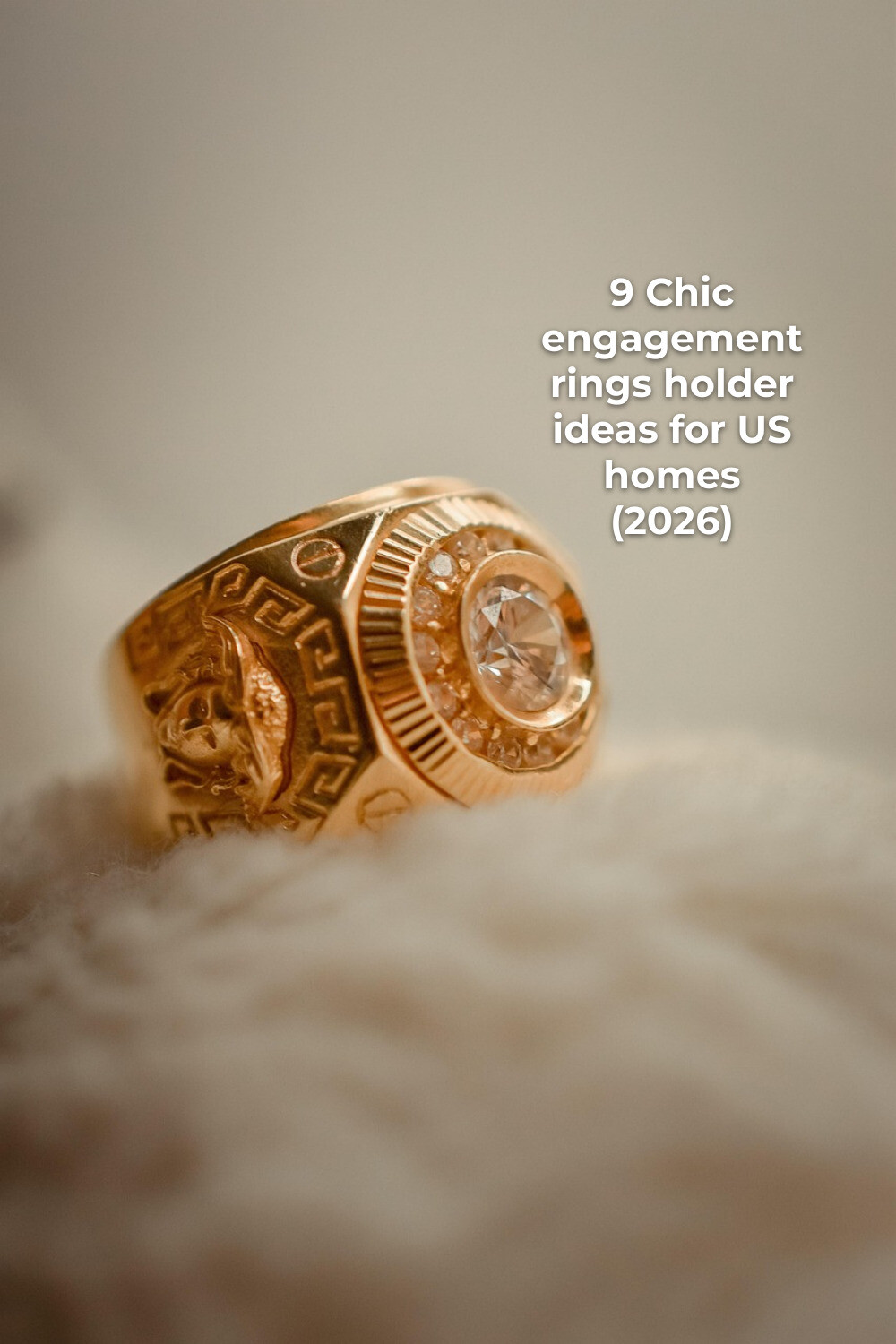
    Engagement rings holder ideas featuring a gold engraved ring with a clear stone on a soft light surface
    A gold engraved ring with a clear stone rests gracefully on a soft, light-colored surface.

    FAQ

    What is the best ring holder for travel?

    The best travel ring holder is compact, protective, and consistent to use, with a secure shape that keeps the ring contained and easy to spot; choose something stable enough for a hotel nightstand or dresser and make a habit of placing it in the same spot each time you take your ring off.

    What’s the difference between a ring dish, ring tray, and ring stand?

    A ring dish is usually a small bowl-like piece for one or two rings, a ring tray is typically wider for multiple rings or daily accessories, and a ring stand holds the ring vertically for visibility and easy grab-and-go storage.

    How do I choose the right size ring holder?

    Choose a holder that fits your ring comfortably without forcing it, keeps the ring visible at a glance, and supports how you wear your jewelry—if you’ll store an engagement ring and band together, a slightly wider dish or a ring tray can help everything sit neatly.

    Which material is easiest to maintain for everyday use?

    Porcelain and ceramic dishes are often the easiest for everyday use because they’re simple to wipe clean and hold up well on vanities and nightstands, while wood, metal, and glass can require a bit more attention depending on finish and placement.

    How can I keep my ring from slipping out of a dish?

    Use a dish with slightly raised sides and a stable base, place it on a flat surface away from edges, and choose a consistent location so the dish isn’t frequently moved or bumped during your routine.

    Are personalized ring holders worth it?

    Personalized ring holders are worth it if you want a keepsake element—like initials or a date—while still getting daily function, and they’re especially strong as engagement gifts because they feel intentional without being difficult to use or style.

    Where should I keep a ring holder in my home?

    The best location is wherever you most often remove your ring—commonly a vanity, nightstand, or near a sink—because the holder is most effective when it supports your natural routine and becomes the default “home base” for your ring.

    How do I make a ring holder look photo-ready for engagement moments?

    Choose a holder with a clean shape and a material that matches your style, keep the surrounding surface uncluttered, and build a small, consistent setup—simple dishes, trays, and minimal decorative choices tend to photograph clearly and keep the ring as the focal point.

  • 7 Tips for Circle Engagement Rings With Halo in the US

    7 Tips for Circle Engagement Rings With Halo in the US

    Circle Engagement Rings with Halo: A Practical, Style-First Guide

    Circle engagement rings with halo combine a round, centered look with a surrounding “halo” of smaller stones that frames the center and intensifies sparkle. This design family spans classic round halo rings, modern hidden halo ring options, and bolder double halo engagement ring styles—each changing how the ring looks, feels, and wears day to day. If you’re comparing settings online or planning a custom design, this guide breaks down the major circle halo designs, center stone choices (including diamond, lab-grown, and moissanite), metal and band decisions, and the practical details that can make a halo ring either effortless or high-maintenance.

    Because many shoppers move between exploration and purchase quickly with halo rings, you’ll also find a clear buying guide, wearability checks, care and maintenance guidance, and tips for pairing a halo setting ring with a wedding band—so you can choose confidently, whether you’re browsing ready-to-ship rings or building a ring with a jeweler.

    Circle engagement rings with halo seen as a couple in sweaters hold hands in a cozy, style-forward moment
    Two people in sweaters and jeans stand close, hands intertwined, in a quietly style-forward moment.

    What Is a Circle Halo Engagement Ring?

    A circle halo engagement ring is a ring containing a halo of stones arranged in a circular outline around the center stone. In practice, many people use “circle halo” to describe either (1) a round center stone surrounded by a halo, or (2) any center shape surrounded by a halo that reads as a circular halo design from the top view. The defining element is the surround halo ring effect: a bright frame that visually emphasizes the center and creates a more dimensional face-up appearance.

    Halo setting rings vary in how the halo is built and where it sits. Some halos are prominent and visible from the top, while others are more subtle and designed to be noticed from side angles. Your final look depends on the halo style, the band (such as pavé), and the relationship between center stone size and halo diameter.

    Single halo vs double halo vs hidden halo

    Most halo engagement rings fall into three popular families: a single halo (one ring of accent stones), a double halo engagement ring (two layers of accent stones for a bolder outline), and the hidden halo ring (a halo tucked under the center that adds sparkle without changing the top view as dramatically). These options aren’t just aesthetic choices—they affect the ring’s profile, how it pairs with wedding bands, and what you may need to consider for cleaning and maintenance.

    “Circle engagement ring” vs “halo ring”: understanding the terms

    “Halo ring” describes the setting feature: the ring contains a halo of stones that surrounds the center. “Circle engagement ring” is often used to describe the overall silhouette, usually anchored by a round halo ring face-up shape. Put simply, a halo is a design technique; “circle” is the visual outcome many buyers want—an even, centered shape that looks balanced on the finger.

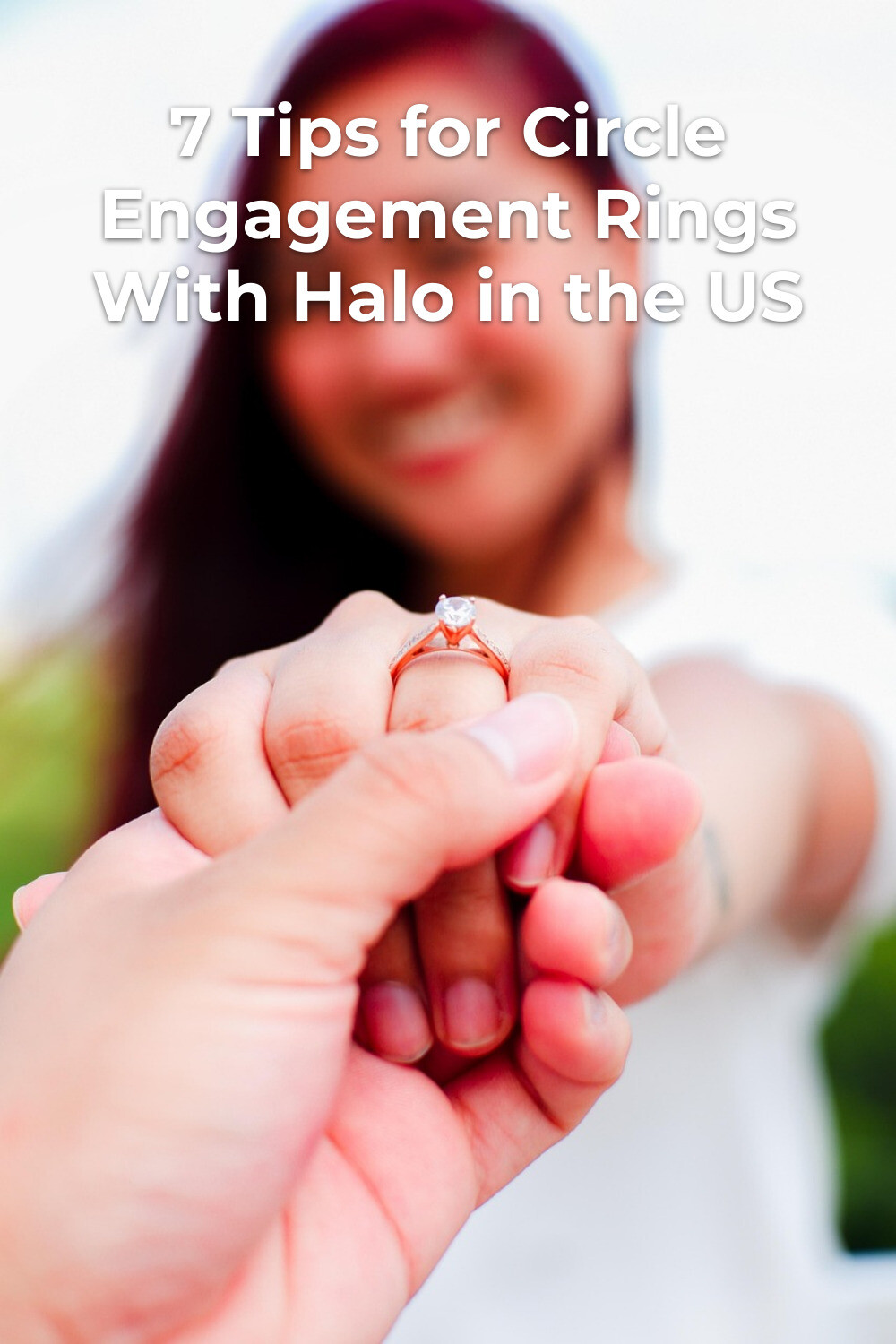
    Circle engagement rings with halo on hand held by partner, bride in white dress blurred in background
    A close-up of hands intertwined highlights a circle engagement ring with halo, with the bride softly blurred behind.

    Circle Halo Styles: Round, Cushion, Oval, and More

    Circle halo designs can look classic, vintage-inspired, or modern depending on the center shape and halo execution. Many shoppers start with round halo engagement ring styles because they feel timeless, then compare against cushion or oval halos for a softer or more elongated personality. The best approach is to choose the center shape that matches your taste, then use the halo to fine-tune presence, sparkle, and scale.

    Round halo rings: classic and brilliant

    A round halo ring is the most straightforward interpretation of circle engagement rings with halo: a round center stone surrounded by a circular halo. This style is popular for its symmetry and for how cleanly it frames the center. Round halos also work well across many band styles—from minimalist shanks to a halo engagement ring with pavé band—without feeling mismatched.

    Tip: If you love the look of a classic circle halo but want a more modern twist, consider a round center with hidden halo. It keeps the top view clean while adding sparkle that shows when the ring moves.

    Cushion and oval halos: vintage vibes with modern sparkle

    Cushion and oval halos often appeal to shoppers who want something slightly different from a pure round outline while still enjoying the benefits of a halo setting. Cushion halos can feel more softly structured, while oval halos lean elegant and streamlined. In both cases, the halo can be shaped to echo the center stone or designed to read more circular overall, depending on the ring’s proportions.

    These are also popular choices when you want the overall presence of a circular halo diamond ring while adding personality through shape. A well-proportioned halo can unify the look, even when the center isn’t perfectly round.

    Emerald-cut and other shapes in a halo

    Emerald-cut and other non-round shapes can also be placed in halo setting rings, creating a more architectural or distinctive look. Some halos closely follow the center stone outline, while others use a softer circular halo design around a more angular center to balance contrast. If you’re choosing a shape that’s less common in circle halo shopping, pay extra attention to alignment, symmetry, and how the halo meets the corners or edges of the center.

    Circle engagement rings with halo on woman's hand, red lipstick, white top, and small wrist tattoo close-up
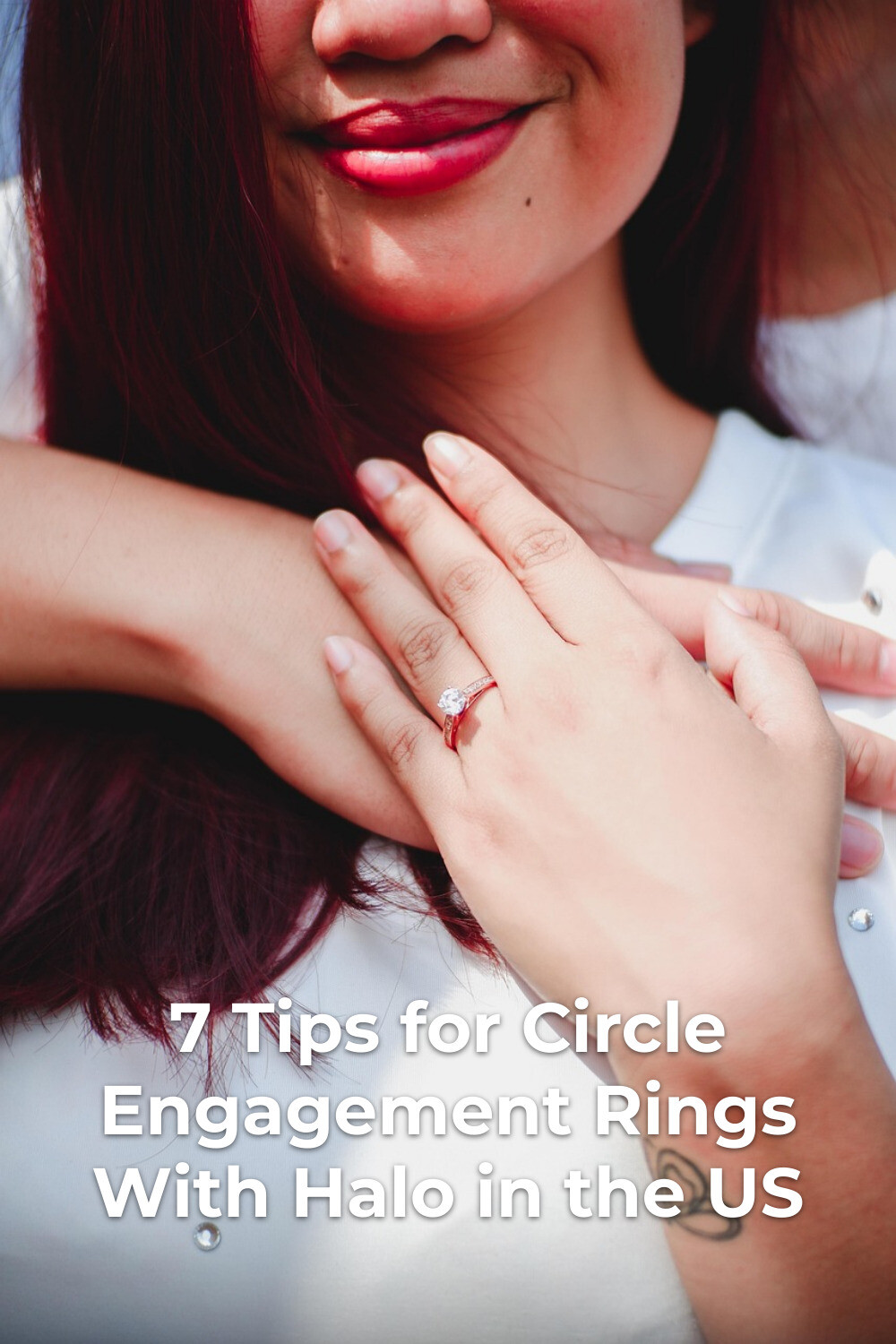
    A close-up captures a woman in a white top with red lipstick, showcasing a circle halo engagement ring and a subtle wrist tattoo.

    Popular Halo Details That Change the Look

    Two rings can both be called “halo engagement rings” and still look completely different. Small construction choices—like whether the halo is pavé, whether it resembles a flower halo, or whether the band has pavé—change sparkle, perceived size, and overall style direction.

    Pavé halo, flower halo, and cluster-like effects

    A pavé halo uses many small stones closely set to create a continuous, bright outline. A flower halo suggests petal-like shaping or a softer, more decorative perimeter. Some circle halo rings can also read like a round halo cluster ring depending on how the accents are arranged and how prominent the halo appears relative to the center.

    • Pavé halo: A crisp, high-sparkle outline that pairs well with both plain and pavé bands.
    • Flower halo: More decorative; can lean romantic and detailed.
    • Cluster-like halo look: A bolder halo presence that can visually compete with the center if proportions aren’t balanced.

    Hidden halo: subtle sparkle from the side

    A hidden halo ring places the accent stones below the center stone, often visible in profile or from angles rather than straight on. This is a popular approach when you want a refined top view but still want extra brilliance and detail. Hidden halos can also complement a wider variety of wedding bands because the top silhouette can remain simpler than a fully framed halo.

    Tip: If you’re torn between a minimal look and a statement halo, a hidden halo is a practical compromise: it adds design interest without making the ring face-up feel significantly larger.

    Double halo: maximum outline and presence

    A double halo engagement ring uses two rows of accent stones, increasing the width of the halo and creating a more dramatic circle halo. This can be ideal if you want a standout look or if you simply love the layered effect. The tradeoff is that the ring face can feel larger on the finger, and cleaning and maintenance become more important because there are more stones and crevices.

    Circle engagement rings with halo in two stacked bands with clear stones on a reflective surface
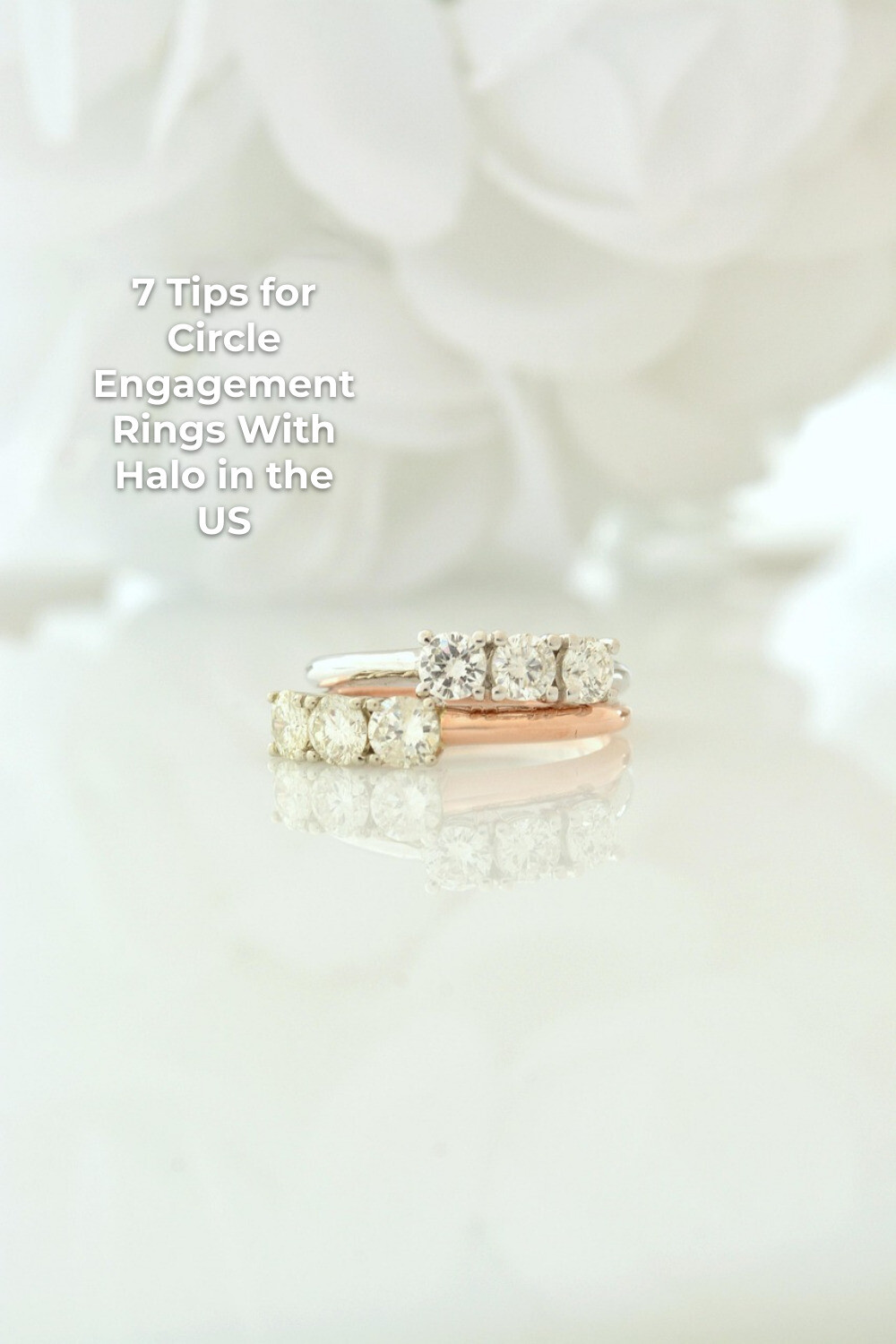
    Two sparkling halo-style rings are stacked together on a reflective surface for a timeless, style-forward look.

    Center Stone Options for Circle Halo Rings

    The center stone drives the character of circle engagement rings with halo, while the halo amplifies it. Many shoppers compare diamond, lab-grown diamonds, and moissanite halo engagement ring options. Your best choice depends on priorities like ethical sourcing preferences, desired look, and how you want to allocate budget between center stone size, halo complexity, and band details.

    Diamond vs lab-grown vs moissanite

    Diamond halo engagement rings are a classic choice and widely available across halo designs. Lab-grown diamond options are frequently positioned as an ethical and sustainable alternative, often paired with messaging around responsible sourcing and customization. Moissanite halo engagement rings are also common in halo collections, often highlighted for strong light performance and for shoppers who want a center stone alternative beyond diamonds.

    Tip: If you’re deciding between materials, compare the full ring look rather than the center stone alone. A halo and band style can influence how bright and “busy” the ring appears, which matters just as much as the center choice for everyday satisfaction.

    Center size vs halo diameter: controlling the “looks bigger” effect

    One of the most common reasons shoppers choose a circular halo design is visual impact. The halo creates a bright border that can make the overall ring face look larger than the center stone alone. This is why understanding the relationship between center stone sizing and halo diameter matters: small differences in proportions can shift the ring from delicate to bold.

    • If you want the center to dominate, choose a halo that reads as a thin, crisp outline.
    • If you want a stronger “frame,” choose a wider halo presence or consider a double halo engagement ring.
    • If you want subtle enhancement without a larger top view, consider a hidden halo ring.

    Coordinating center stone and halo style

    Not every center shape looks best with every halo style. Round centers naturally align with circle halos. Cushion and oval centers can be paired with halos that either mirror their shape or round out the look for a more circular silhouette. When browsing product photos or design previews, focus on symmetry, spacing consistency around the center, and whether the halo looks evenly aligned.

    Metal, Setting, and Band Style Considerations

    Metals and band styles influence durability, contrast, and how the halo reads at a glance. Many halo collections highlight platinum and gold options, including 18K gold, and offer multiple metal variants of the same ring model. Your metal and band decisions also affect long-term wearability—especially for halo settings with many small stones.

    Platinum and gold options

    Platinum and gold are common choices for halo engagement rings, and many brands offer the same circle halo designs across multiple metals. The choice often comes down to desired color tone and how you want the halo and center to stand out. Some shoppers prioritize a classic look; others focus on coordinating with future wedding bands and everyday jewelry.

    Pavé band vs simpler shank

    A halo engagement ring with pavé band increases sparkle and creates a continuous, bright surface across the ring. A simpler shank can feel cleaner and may put more visual emphasis on the circle halo and center stone. When comparing options, think about how much sparkle you want from the side view and whether you prefer a more ornate or more understated profile.

    Tips for choosing a band style: If you already love a bold halo, a simpler band can keep the design balanced. If you want maximum brilliance across the entire ring, pavé on both halo and band can create a cohesive, high-impact look, but it also increases the number of stones that need periodic checking.

    Bezel and other halo-adjacent looks

    While many circle halo rings use prongs and pavé-like detailing, some shoppers compare halo looks against more streamlined settings that emphasize protection and clean lines. If your priority is the halo aesthetic specifically, focus on settings explicitly described as halo setting rings or rings with a surround halo; if your priority is a smooth, simplified profile, you may prefer a less intricate approach while still keeping a circular silhouette.

    How to Choose the Right Circle Halo Ring (Buying Guide)

    Choosing among circle engagement rings with halo is easiest when you treat it like a series of decisions: your preferred silhouette, your center stone plan, your halo type, then the practical details like sizing, wearability, and policies. Many shoppers browse featured halo rings first, then narrow down by ring specs, customization options, and price range.

    Start with your style goal: classic, vintage, modern, or subtle

    Style is more than aesthetics; it’s also how noticeable the halo is from different angles. A classic look often points to a round halo ring with a clean outline. Vintage-leaning options can include cushion halos, flower halo impressions, or more decorative detailing. Modern choices often include hidden halos and sleeker band profiles.
    • Classic: Round center + single halo + balanced band.
    • Vintage-inspired: Cushion/oval with decorative halo character (including flower-like effects).
    • Modern: Round center with hidden halo; minimal top view, detail on the side.
    • Statement: Double halo engagement ring with a bold outline and high sparkle.

    Budget ranges and value levers

    Halo rings appear across a wide price range, and the biggest value levers are typically the center stone choice, halo complexity (single vs double, pavé intensity), and metal selection. If you’re trying to maximize presence, you can focus on a strong circle halo design that gives the visual size effect you want while keeping other elements simple. If craftsmanship details matter most, you may prefer fewer design elements executed at a higher level rather than adding multiple layers of pavé.

    Tip: When comparing rings at similar price points, look at what’s driving the cost—center stone type, customization, and the amount of pavé/halo work—so you’re paying for what matters to you.

    Ring width, halo diameter, clearance, and wearability

    Wearability is where many halo purchases become either a long-term win or a source of frustration. A larger halo diameter or double halo can make the ring face feel more substantial, which some love and others find bulky. Clearance (how high the center sits) and band width affect comfort and how easily the ring catches on clothing.

    • Choose a balanced face size: Make sure the halo and center look proportionate to your hand and finger.
    • Check profile height: Taller profiles can show off detail but may snag more often.
    • Consider daily routine: If you wear your ring constantly, a less delicate halo and a comfortable band profile can matter as much as sparkle.

    Customization and “design your own” options

    Many halo collections emphasize customization, including selecting metal variants, choosing center shapes, and adjusting halo styles (like hidden halo or pavé). If you’re considering a custom halo ring, prioritize clarity on what can be changed and what’s fixed in the design. Customization is especially helpful when you want a specific circle halo motif but need it tailored to a particular center stone plan.

    Tip: When requesting a custom design, ask for clear measurements and visuals that show the top view and profile. Halo rings are all about proportions, and a small change in halo thickness or spacing can change the entire feel.

    Shopping support: showrooms, consultations, and policies

    Halo ring shoppers often want extra guidance because the design involves multiple elements (center, halo, band, height). Many retailers support this with showroom guidance, consultations, and buying guides. Beyond the ring itself, prioritize confidence-building details like sizing support, warranties, and clear return or exchange paths—especially if you’re ordering online.

    Care, Cleaning, and Maintenance for Circle Halo Rings

    Halo settings have many small stones and small spaces where buildup can collect, which can reduce the brightness you expect from a circular halo design. They can also require more frequent check-ins because more stones and prongs create more potential points of loosening over time. Good care is less about complicated routines and more about consistency.

    Cleaning routines for halos

    Because the halo and pavé areas include many tiny surfaces, a gentle, routine approach is important. Keep the ring clean enough that the halo remains crisp and bright, especially around the underside of the center where residue can reduce light return. If your ring includes a hidden halo, remember that the sparkle is often seen from angles—so cleaning the profile area matters too.

    Tip: If you notice the halo looking dull while the center still looks bright, it’s often a sign the tiny stones or the spaces between them need attention. A quick maintenance habit can keep the ring looking like it did in photos.

    Avoiding damage to halo settings

    Halo rings can be durable for daily wear, but they benefit from mindful use. The halo perimeter and pavé sections can be more exposed to bumps than a simpler setting. Being aware of snagging and impact risks is especially important with high-set profiles and very delicate halo detailing.
    • Be cautious with activities where the ring could catch or knock against hard surfaces.
    • Pay attention to prongs and the outer halo edge, where impact is most likely.
    • If the ring starts catching more often than usual, it may be time for a check-in.

    Resizing considerations for halo rings

    Ring sizing and resizing are common questions for halo buyers because the setting can be more intricate than a simple band. The band style (especially pavé) and overall construction can influence how straightforward resizing will be. It’s wise to confirm sizing guidance before purchase and to understand how future resizing is handled, particularly for rings with extensive accent stones.

    Tip: If you’re between sizes or unsure, prioritize getting the sizing right early. A well-fit halo ring is not only more comfortable—it’s also less likely to twist, which helps keep the halo centered on top of the finger.

    Matching Halo Rings with Wedding Bands

    Pairing a halo engagement ring with a wedding band can be simple or tricky depending on the halo’s size, the ring’s profile height, and whether the halo extends beyond the band line. Some circle halo rings sit in a way that allows a band to fit flush, while others may create a gap. Thinking about pairing early helps you avoid surprises later.

    Pairing strategies for different halo types

    Single halos are often easier to pair than double halos because they can be less wide at the perimeter. Hidden halos may pair especially well because they add sparkle without expanding the top outline. Larger halos can still pair beautifully, but you’ll want to confirm how the band sits beside the engagement ring and whether the combination feels comfortable.

    • Single halo: Often versatile with many band styles.
    • Hidden halo: Keeps the top view cleaner; can make pairing simpler.
    • Double halo: Bold look; verify fit and spacing with your intended band.

    Stackable vs non-stackable options

    Some halo setting rings are designed for stacking, while others are more “standalone” due to their profile or halo width. If you love the idea of stacking multiple bands, focus on a circle halo design with a band and profile that support that look. If you prefer a clean two-ring set, prioritize comfortable alignment and a cohesive silhouette rather than maximum sparkle everywhere.

    Tip: When shopping online, look for clear side-view images (or 360° views if available) showing how the halo sits relative to the band. The profile view often tells you more about pairing than the top view.

    The Ethical and Sustainable Halo Options You Should Know

    Ethical and sustainable considerations show up frequently in halo ring shopping, especially in collections emphasizing lab-grown diamonds and responsible sourcing. If these values are important to you, the good news is that halo designs are widely available with lab-grown center stones, and many brands highlight ethical positioning alongside customization.

    Lab-grown vs mined: clarifying your priorities

    Some shoppers choose lab-grown options because they want an ethical halo ring approach, while others prioritize tradition or personal preference. The key is aligning your center stone choice with the rest of the ring plan—metal, halo style, and budget—so the final circle halo ring feels intentional rather than a compromise.

    Certification and sourcing visibility

    When buying a halo engagement ring positioned around ethical sourcing, look for clear sourcing visibility and documentation practices that the seller is willing to explain. This matters because halo designs include multiple stones, not just the center. Transparent communication and clear policies help you feel confident that the ring aligns with your standards.

    Tip: Ask how the brand treats the entire ring—center stone and accent stones—when discussing ethical sourcing. Halo rings use many small stones, and clarity across the full design is part of true transparency.

    Gallery-in-Words: Circle Halo Ring Inspirations

    Even without seeing every ring side by side, you can narrow your favorites by identifying the “personality” of the halo. Below are common inspiration directions you’ll see across featured halo rings and designer-forward collections, including celebrity-inspired styling cues that make halo rings feel current without locking you into a passing trend.

    Classic circle halos

    Classic circle halos focus on a balanced round center and a single, clean halo outline. The look is symmetrical and enduring, and it works across metals and band styles. If you want a circular halo diamond ring aesthetic that always feels appropriate, this is the baseline style to compare everything else against.

    Vintage-leaning halos with decorative character

    Vintage vibes often come through in cushion or oval halos, flower halo impressions, and more pronounced pavé work. These rings can feel more ornate and romantic. They’re a strong choice if you want your ring to read as a “piece” rather than a simple, minimal setting.

    Modern halos with a subtle twist

    Modern circle halo designs often emphasize clean top views and interesting profiles, which is why hidden halo ring styles have become a favorite. The ring looks refined from above, but the side detail adds depth and sparkle when the hand moves. This approach also tends to photograph well from multiple angles.

    Celebrity-inspired halo motifs

    Celebrity coverage and designer callouts frequently highlight halo variations—often emphasizing dramatic sparkle, distinctive profiles, or recognizable halo styling cues. The most wearable way to pull inspiration from these looks is to isolate the feature you love (a bold halo outline, a hidden halo detail, or a particular silhouette) and build the rest of the ring around your day-to-day comfort.

    Top Brands and Where to Buy Circle Halo Rings (What to Compare)

    Circle halo rings are widely sold through brand sites and retailers with dedicated halo collections, “how to buy halo rings” guidance, and in some cases showroom support. While specific offerings vary, the best buying experience usually comes down to how clearly the seller presents ring specs, customization paths, and after-purchase support such as warranties and sizing help.

    Collection depth and style variety

    Some sellers focus on a broad halo ring catalog with many featured halo rings, while others highlight a smaller set of named models in multiple metal variants. If you’re early in the process, a wider collection can help you identify your preferred halo family. If you already know you want a round center with hidden halo or a pavé halo, a curated selection with strong customization tools may feel more efficient.

    Customization workflows and clarity

    Customization is common in halo engagement rings, from choosing a center stone type (including lab-grown) to deciding on hidden halos, pavé halos, and metal options. The key is clarity: you want to understand what changes are possible, what the final ring will look like from multiple angles, and how measurements will be communicated when you shop online.

    Trust signals: warranty, care, sizing support, and policies

    Halo rings benefit from strong aftercare support because there are more stones to maintain. Many sellers emphasize warranty and care guidance, and some highlight discounts or ring specs prominently. Before committing, compare the basics: how sizing is handled, what warranty support looks like, and what the process is if the ring needs adjustment after purchase.

    10 Quick Tips to Spot a Quality Circle Halo Ring

    A halo ring’s beauty depends on precision. The difference between an average halo and an exceptional one is often visible in symmetry, alignment, and how secure everything feels. Use this checklist when viewing product photos, videos, or in-person samples.

    • Look for a halo that appears evenly spaced around the center stone.
    • Check that the halo shape matches the design intent (true circle, softly rounded, or shape-matched) without looking lopsided.
    • Confirm the ring’s measurements are clearly provided, including details that affect the face-up size.
    • Inspect how the center stone sits: it should look stable and well integrated into the setting.
    • If the ring has pavé, ensure it looks consistent and uniform rather than uneven or patchy.
    • For hidden halos, verify there are clear profile images showing the detail and how visible it is.
    • Consider band width relative to the halo—an overly thin band can look unbalanced next to a wide halo.
    • Think ahead about cleaning: more intricate halos require more routine care to keep sparkle high.
    • Ask about warranty coverage and what ongoing maintenance is recommended.
    • Confirm ring sizing support and understand whether resizing is expected to be straightforward for that design.

    Conclusion: Finding Your Perfect Circle Halo Ring

    The best circle engagement rings with halo balance style, comfort, and long-term practicality. Start with the halo family that matches your aesthetic—classic single halo, subtle hidden halo, or bold double halo—then choose your center stone approach (diamond, lab-grown, or moissanite) and refine details like metal, pavé, and proportions. When you combine thoughtful design choices with clear sizing, care expectations, and strong support policies, you’ll end up with a halo ring that looks stunning in photos and feels right for daily wear.

    circle engagement rings with halo bride and groom kissing between white columns outdoors
    A couple shares a romantic kiss between grand white columns, capturing timeless wedding elegance.

    FAQ

    Do circle halos look larger than the center stone?

    Yes, a circle halo typically makes the ring’s face-up appearance look larger because the halo creates a bright border around the center stone; the degree of the effect depends on the halo’s thickness, whether it’s single or double, and how the halo diameter compares to the center stone size.

    What is a hidden halo ring, and who is it best for?

    A hidden halo ring places the halo beneath the center stone so it’s most visible from the side rather than the top; it’s best for someone who wants extra sparkle and detail while keeping a cleaner, more understated top view.

    Are circle halo engagement rings durable for daily wear?

    They can be durable for daily wear, but halo settings have many small stones and prongs, so they benefit from mindful wear and periodic checks to ensure stones remain secure, especially if the ring has extensive pavé or a prominent halo edge.

    How do I verify halo ring measurements when shopping online?

    Look for clearly listed ring specs and request confirmation of the measurements that affect appearance and fit, such as the overall halo diameter and profile view details; also rely on multiple angles (top and side) to understand proportions and how the halo sits.

    What’s the difference between a single halo and a double halo engagement ring?

    A single halo uses one row of accent stones around the center, while a double halo engagement ring adds a second row for a wider, more dramatic outline; the double halo generally increases overall presence and can require more attention to cleaning and maintenance.

    Should I choose a pavé band with my halo ring?

    A pavé band adds extra sparkle and can create a cohesive look with a pavé halo, while a simpler band can keep the design balanced and emphasize the center and halo; the best choice depends on whether you want maximum brilliance or a cleaner, lower-detail style.

    Can I get an ethical or sustainable circle halo ring?

    Yes, many halo rings are offered with lab-grown diamonds and are often presented with ethical and sustainable positioning; if this matters to you, ask for clear sourcing visibility for both the center stone and the halo accent stones.

    How do I match a halo engagement ring with a wedding band?

    Start by checking the engagement ring’s profile and halo width to see whether a band will sit flush or create a gap, and consider that hidden halos and simpler single halos often pair more easily, while wider halos may require more careful fit planning.

  • 7 Twist Engagement Rings Styles: Pavé, Halo & More

    7 Twist Engagement Rings Styles: Pavé, Halo & More

    Twist Engagement Rings: Styles, Stones, and How to Choose Your Perfect Twist

    Twist engagement rings are a favorite for shoppers who want a classic symbol of commitment with a more dynamic, sculpted look. Instead of a straight shank, the band appears to intertwine, swirl, or spiral as it approaches the center stone—creating a sense of movement and a distinctive silhouette from multiple angles. Whether you’re browsing ready-to-ship styles or considering a custom twist engagement ring, understanding the variations in twist design, stone options, and practical wearability can help you choose a ring you’ll love long-term.

    This guide breaks down the most popular twisted engagement ring styles, how pavé and double-row twists change the look, what to consider when choosing metals like 14K or 18K gold (including rose gold) and platinum, and how to evaluate center stone options such as natural diamonds or lab-grown diamonds. You’ll also find a buyer’s checklist, customization roadmap, and care tips tailored to twisted bands.

    Twist engagement rings in silver and rose gold with diamonds on glossy white surface, blurred white flower backdrop
    Two diamond twist engagement rings in silver and rose gold rest on a glossy white surface with a softly blurred white flower behind.

    What Is a Twist Engagement Ring?

    A twist engagement ring (also called a twisted band engagement ring) is defined by a band that curves and overlaps in a twisting motion rather than staying straight. The twist often frames the center stone, guiding the eye toward it and adding visual interest even when the ring is viewed from the side.

    You may also see similar terms like spiral engagement ring or swirl engagement ring. While different brands may use these names slightly differently, they all point to a motion-inspired design where the shank appears to wrap, weave, or rotate as it approaches the center setting.

    Twist engagement rings inspiration: gold signet ring with engraved figure on red surface, dark background
    A sculptural gold signet ring with an engraved figure rests on a rich red surface, set against a dark backdrop.

    Why Twist Rings Stay Popular

    Twist designs strike a balance: they feel more unique than a plain solitaire shank, but they’re still timeless enough to wear daily. Many shoppers also like that a twist can add elegance without relying on a large center stone, because the band itself contributes to the overall presence and sparkle—especially in pavé twist band engagement ring styles.

    • Added dimension: The twist creates curves and highlights that look different in various lighting.
    • Flattering framing: The band can visually “lead” into the center stone.
    • Style range: From minimal tight twists to dramatic swirl or halo-forward designs.
    • Customization-friendly: Twist density, pavé placement, and metal choice can be adjusted to personal taste.
    Twist engagement rings on hand with white tipped nails, ring finger close-up against a soft blurred background
    A twist engagement ring sparkles on a manicured hand with white-tipped nails against a softly blurred backdrop.

    Popular Twist Engagement Ring Styles

    Twist engagement rings aren’t one single look. They span everything from subtle shank movement to bold, sculptural spirals, and the right choice depends on your preferred level of detail, your center stone, and how you plan to stack a wedding band.

    Tight Twist vs. Loose Twist

    The simplest way to describe twist variation is by “tight” versus “loose.” A tight twist engagement ring has a more compact, closely wrapped look near the center stone; a loose twist has more negative space and a more sweeping curve. Both can feel elegant, but the visual impact is different: tight twists read as refined and continuous, while loose twists feel more airy and sculptural.

    Tip: If you want the center stone to dominate, consider a tighter twist with clean metal lines. If you want the band to be part of the statement, a looser spiral or swirl profile can add drama even before you add pavé accents.

    Diamond Twist Solitaire Styles

    A diamond twist solitaire engagement ring usually keeps the focus on a single center stone, but uses the twist band to create interest on the shoulders. Some designs add accent diamonds along one or both sides of the twist, while others keep the shank smooth and polished. This style is popular because it can feel both classic and distinctive at the same time.

    In product catalogs and collections, you’ll often see twist solitaires offered with multiple metal options and center stone compatibility. This flexibility makes the twist solitaire a strong choice if you’re still deciding between center shapes or between lab-grown vs. natural diamonds.

    Double-Row and Pavé Twist Designs

    A double-row twist engagement ring typically features two parallel lines—often both diamond-set—flowing in a twisting motion. A pavé twist engagement ring uses small diamonds set along the band to add continuous sparkle, sometimes in a single row, and sometimes in a more elaborate two-row configuration. The result is a brighter, more detailed look that can complement both minimalist and more ornate center settings.

    • Single-row pavé twist: More delicate sparkle; the twist reads clearly without overwhelming the center stone.
    • Double-row pavé twist: More symmetry and brilliance; ideal if you want the band to feel as prominent as the center.
    • Mixed finish twist: Some designs emphasize the twist through polished metal edges framing pavé-set sections.

    Tip: When comparing pavé twist bands, look closely at where the diamond rows stop and start along the twist. The transitions affect how smooth the ring feels against adjacent fingers and how well it stacks with other bands.

    Spiral and Swirl Rings (Including Halo Looks)

    A spiral engagement ring leans into the motion effect: the shank seems to wrap or rotate as it approaches the center. A swirl engagement ring often emphasizes a sweeping curve that “cradles” the center setting. These styles can be especially striking when paired with a halo, where the center stone is framed by a surrounding circle of smaller diamonds and the band continues the fluid theme.

    In swirl diamond halo styles, the twist isn’t just decorative—it becomes part of the ring’s architecture, visually connecting the halo and the shank so the design feels cohesive from top view to side view.

    Woman in strapless embroidered dress on ornate sofa wearing twist engagement rings, necklace and earrings with curtains
    A woman in a strapless embroidered dress relaxes on an ornate sofa, showcasing design-forward jewelry against softly draped curtains.

    Center Stone Choices: Shape, Size, and Compatibility

    Twist engagement rings appear across many product pages with variant options for center stones. While the twist design is the signature, the ring’s overall personality changes significantly depending on the center stone shape and how the twist frames it.

    Oval Twist Engagement Rings (Including Rose Gold Favorites)

    An oval twist engagement ring is a popular combination because the elongated center stone pairs naturally with curved lines. Many shoppers gravitate toward an oval twist engagement ring in rose gold for a warm, romantic look where the metal color and the soft curves reinforce each other.

    If you’re considering rose gold, pay attention to how the twist crosses near the center stone. Some twists create a gentle “X” effect under the head, while others split into two flowing shoulders that meet the setting more subtly.

    Round Centers in Spiral Settings

    A round center stone paired with a spiral or twist shank can feel especially balanced: the circle of the center complements the motion of the band. Many spiral engagement ring styles highlight the round stone with a clean, shiny shank or with small accent diamonds that follow the curve.

    Tip: If you’re drawn to a spiral look, ask to see top and side angles (or 360° views if available). The most satisfying spiral designs look intentional from every perspective, not just from directly above.

    Matching the Twist to the Center Setting

    Some twist rings have a more sculpted twist that “frames” the setting, while others keep the twist on the shoulders and let the center head stand more independently. When you compare options, look for center-stone compatibility details and setting profiles. This matters because the twist’s geometry can influence how high the center sits and how easily the ring stacks with a wedding band.

    • More open twist: Can make the ring feel airy and modern, especially with minimal accents.
    • More intertwined twist: Often reads as romantic and intricate, especially with pavé diamonds.
    • Halo + swirl: Creates a continuous, high-impact design with sparkle distributed across the ring.

    Natural Diamonds vs. Lab-Grown Diamonds in Twist Rings

    Many twist engagement ring listings offer both natural diamonds and lab-grown diamonds as center stone options, and sometimes even for the smaller accent stones in pavé sections. The key takeaway is that you can often choose the same twist design and decide which diamond type fits your priorities for budget, sourcing preferences, and availability.

    When browsing twist rings with different stone types, focus on clear documentation and consistent details across variants. Because twist designs can include multiple accent diamonds, you’ll also want clarity on what is included in the price: center stone only, band diamonds, or a complete ring with a set center.

    Tip: If you’re comparing lab-grown vs. natural diamond twist ring options in the same design, keep the design constant while you compare quotes. That way, you’re evaluating the stone choice without accidentally changing the band style, pavé coverage, or metal.

    Metal Options for Twisted Band Engagement Rings

    Twist engagement rings are offered across common fine-jewelry metals, including 14K gold, 18K gold, platinum, and rose gold. Because twist designs emphasize curves and edges, metal choice influences both the color aesthetic and how the ring’s contours stand out in everyday lighting.

    14K Gold vs. 18K Gold for Twist Designs

    Both 14K and 18K gold are widely used in twist rings, often with options for yellow, white, or rose tones depending on the brand. If you’re choosing between a 14K gold twist ring and an 18K white gold twist ring, think about the look you want from the metal itself: a twist band showcases surface shine, and the metal color can either contrast with the diamonds or blend into a softer overall effect.

    Twisted bands also draw attention to craftsmanship—how smoothly the curves transition and how crisp the edges appear. If you can view multiple photos or angles, watch how the light travels along the twist; that “flow” is a big part of what makes the design feel high-end.

    Platinum Twist Rings

    A platinum twist ring offers a cool-toned, premium feel that pairs well with diamond-heavy designs like pavé twist bands and halo-forward swirls. Because the twist has more geometry than a plain shank, a bright, neutral metal can emphasize the design lines while keeping the overall look cohesive with the stones.

    Rose Gold Twist Rings

    Rose gold is especially popular in twist engagement rings because it can make the intertwined design feel warmer and more romantic. A rose gold twist band with an oval center diamond is a frequently featured combination in retail listings, in part because the elongated shape and the soft metal tone work beautifully with the band’s curves.

    Tip: If you love rose gold but want a brighter, higher-contrast look, consider a twist design where diamonds line the band (pavé twist) so the sparkle remains crisp against the warmer metal tone.

    How to Choose the Right Twist for Your Finger

    Twist rings can be incredibly flattering, but the “best” twist depends on scale and comfort. Because a twist engagement ring adds movement and sometimes width along the finger, it’s worth thinking about how the band will look and feel in daily wear, not just in a single photo.

    Finger Proportions, Scale, and Ring Sizing

    Fit is always important, but twist designs make it even more noticeable when sizing is off because the band’s pattern can shift on the finger. If possible, use a ring sizing guide and confirm how the ring feels across the widest part of your finger. The twist’s high points and diamond-set areas may feel different than a smooth shank.

    • Prefer a sleek look: Choose a tighter twist with less height and fewer protruding edges.
    • Want more presence: Consider a double-row twist engagement ring or a swirl design that broadens near the center.
    • Like a balanced silhouette: Pair a moderate twist with a center stone that visually matches the band’s flow (oval for elongation or round for symmetry).

    Lifestyle Considerations

    A durable engagement ring isn’t only about the center stone—it’s also about whether the design suits your daily routine. Twist rings with pavé diamonds and intricate crossings may require more mindful wear than a smooth solitaire band, especially if you frequently wear gloves or handle fabrics that could catch on raised details.

    Tip: If you’re active or hard on your hands, look for a twist design with smoother transitions and a profile that doesn’t feel overly “sharp” at the crossover points. A clean twist solitaire can deliver the signature look with fewer snag-prone details.

    How Twist Rings Pair With Wedding Bands

    One of the biggest practical questions with twisted band engagement rings is stacking. Because the shank curves and sometimes widens near the center, the wedding band may not sit perfectly flush without a shaped or curved option.

    If a flush fit matters to you, pay special attention to the engagement ring’s profile and how the twist meets the center setting. Some swirl and spiral designs leave space that a straight band can tuck into, while others create a gap by design. Neither is “wrong”—it’s about what look you prefer and what feels comfortable.

    • For a seamless stack: Consider pairing with a curved band designed to follow the twist’s contour.
    • For a modern look: Embrace a small gap and choose a straight band with a simple finish.
    • For extra sparkle: Match pavé density between the engagement ring and the wedding band so they look intentional together.

    Customization: Designing a Custom Twist Engagement Ring

    Many shoppers explore twist engagement rings through curated collections, but twist designs are also popular in custom work because small changes in the twist can dramatically change the look. Customization can range from selecting metal and center stone options to changing the twist “tightness,” adding pavé diamonds, or shifting to a double-row twist.

    A typical custom design process often includes an initial consultation to define the style, then design development (such as CAD), refinement of details like twist density and stone placement, selection of materials, and a production timeline with lead times. Many brands also offer engraving options and different policies for shipping, returns, and aftercare—details you should confirm early in the process.

    What to Decide Before You Request a Custom Quote

    Because twist rings involve multiple design variables, you’ll get faster, more accurate guidance when you define a few preferences up front. Even if you’re still exploring, having a baseline vision helps a jeweler recommend the most suitable twist structure.

    • Twist style: tight twist, loose twist, spiral, or swirl
    • Band detail: polished metal, pavé twist, or double-row pavé
    • Center stone: shape preference (such as oval or round) and whether you want lab-grown vs. natural
    • Metal: 14K or 18K gold, platinum, and whether you prefer rose gold
    • Practical needs: comfort, stacking preference, and day-to-day wear considerations

    Tip: Ask to see the same twist design rendered or shown in different metals. Twist bands reflect light differently than straight bands, and seeing multiple variants can make your decision far easier than choosing based on one photo.

    Before-You-Buy Checklist for Twist Engagement Rings

    Twist rings come with extra details—curves, crossover points, pavé diamonds—that are worth checking carefully before you commit. Use this checklist whether you’re buying online, visiting a retailer, or commissioning a custom piece.

    • Center stone compatibility: Confirm what shapes and sizes the setting supports and what’s included in the listed configuration.
    • Metal options: Verify available metals (14K/18K gold, platinum, rose gold) and whether the price changes by metal.
    • Pavé details: Ask how far the pavé goes along the twist and whether it’s single-row or double-row.
    • Ring sizing and resizing: Check whether the twist design affects resizing options or timeline.
    • Engraving options: If engraving is important, confirm character limits and whether it changes lead time.
    • Shipping and returns: Review the return window and any exceptions for customized rings.
    • Warranty/care plans: Ask what aftercare is offered, especially if the ring has pavé stones.

    Care and Maintenance Tips for Twisted Bands

    Twist engagement rings can be worn daily, but their shape and (often) diamond accents mean maintenance matters. The main goal is preserving the crispness of the twist and keeping pavé areas clean so the ring continues to sparkle as intended.

    Daily Wear Tips

    Tip: If your twist ring includes pavé diamonds or a swirl halo, be mindful of fabrics and surfaces that can catch on raised details. A quick habit of removing the ring during higher-impact tasks can reduce unnecessary wear and keep the twist profile looking sharp.

    Cleaning and Upkeep

    Twist designs have curves where residue can collect, especially near pavé rows and under the center setting. Follow the care guidance provided by the seller, and consider periodic professional checks to ensure accent stones remain secure. If your retailer offers a care plan, confirm what inspections or servicing are included.

    Price Guide: What Influences Cost in Twist Engagement Rings?

    Prices for twist engagement rings vary widely because the design can be simple or highly intricate, and because listings may include different center stone options. In general, cost is influenced by the chosen metal, whether the twist includes pavé diamonds (and whether it’s single- or double-row), and whether the ring is sold as a semi-mount or as a complete ring with a center diamond included.

    Customization can also change pricing depending on how complex the twist structure is and how many design revisions are involved. To compare quotes fairly, focus on like-for-like details: metal type, pavé coverage, center stone type, and what services are included (such as engraving, lead time expectations, and aftercare).

    Tip: How to Compare Quotes Across Jewelers

    Tip: When comparing different retailers or designers, write down a “spec snapshot” for each option: twist style (tight/loose/double-row), metal (14K/18K/platinum/rose gold), center stone type (lab-grown vs natural), and any included services (sizing, engraving, shipping/returns, warranty). This keeps the decision grounded in real differences instead of aesthetics alone.

    Where to Buy Twist Engagement Rings and What to Look For

    You’ll find twist engagement rings across major retailers, brand catalogs, and custom jewelers. Some shops focus on ready-to-purchase styles with defined specs and variants; others emphasize made-to-order flexibility and the ability to tailor the twist density, pavé arrangement, and center setting to your preferences.

    Regardless of where you buy, prioritize clarity and trust signals: transparent product specifications, clear options for metal and center stone, and straightforward policies for shipping, returns, lead times, and care. Twist rings are design-forward pieces, so detailed photography and multiple angles are especially valuable when buying online.

    • Retail product pages: Often provide concrete specs, metal variants, sizing options, and add-on protection or care plans.
    • Brand catalogs: Typically showcase signature twist motifs, with variants for metal and center size.
    • Custom jewelers: Emphasize design flexibility, consultation, and tailored twist structures.
    Woman with long wavy hair showing a large twist engagement ring against a plain background
    With her hand resting on her forehead, she reveals a striking twist engagement ring in a design-forward portrait.

    FAQ

    Are twist engagement rings comfortable for everyday wear?

    They can be very comfortable, but it depends on the specific twist profile and any pavé details. Smoother twists with polished edges tend to feel more seamless, while intricate double-row pavé designs may feel more textured, so it’s important to confirm fit and comfort with proper sizing.

    Do twist engagement rings stack well with wedding bands?

    Some do, and some create a gap depending on how the twist meets the center setting. If a flush fit matters, consider a curved or contoured wedding band that follows the twist; if you like a modern look, a small gap with a straight band can be intentional and attractive.

    What’s the difference between a twist, spiral, and swirl engagement ring?

    These terms are often used interchangeably, but generally “twist” refers to an intertwined band look, “spiral” emphasizes a rotating wrap effect, and “swirl” highlights sweeping curves that cradle the center stone. Exact naming varies by brand, so compare photos and side views to understand the profile.

    How does the price vary with twist density and pavé diamonds?

    More intricate twists and higher diamond coverage (such as pavé twist bands or double-row twists) typically increase cost because there are more design details and more stones involved. Pricing also changes based on metal choice and whether the listing includes a center stone or only the setting.

    Can I choose lab-grown diamonds for a twist engagement ring?

    Many twist ring styles are offered with lab-grown or natural diamond options, sometimes both for the center stone and for pavé accents. Confirm exactly which stones are included in the price and whether the design is identical across the lab-grown and natural variants.

    What metal is best for a rose gold twist engagement ring with an oval center?

    Rose gold is a common and popular choice for oval twist designs because it complements the ring’s soft curves and creates a warm overall look. When choosing between gold options, focus on which tone you prefer and confirm the exact metal karat offered for the setting.

    Should I choose a tight twist or a loose twist design?

    A tight twist tends to look refined and keeps attention on the center stone, while a loose twist feels more sculptural and makes the band a bigger part of the statement. Your choice should reflect how bold you want the band to look and whether you plan to pair it with a wedding band.

    What should I confirm before ordering a custom twist engagement ring?

    Confirm the twist style (tight, loose, double-row, spiral, or swirl), the metal, whether you want pavé diamonds, and the center stone type and shape. Also review lead times, engraving options, sizing policies, and shipping/returns so there are no surprises once production begins.

  • 7 Expert Tips for Two Tone Engagement Rings in the US

    7 Expert Tips for Two Tone Engagement Rings in the US

    Two Tone Engagement Rings: A Modern Guide to Mixing Metals for Your Dream Ring

    Two tone engagement rings have become a go-to choice for couples who want the best of both worlds: the warmth of gold and the brightness of white metals in one cohesive design. By combining two distinct metal colors in a single ring, these mixed metal engagement rings create contrast, highlight center stones, and make it easier to pair an engagement ring with different wedding bands and everyday jewelry.

    This guide breaks down what a two-tone engagement ring is, the most common metal pairings, popular styles and settings, stone options that shine in mixed-metal designs, and practical considerations like durability, care, customization, and what to ask a jeweler before you buy. You’ll also find inspiration ideas and a comprehensive FAQ to help you choose with confidence.

    Two tone engagement rings shine as a groom kisses his bride in a romantic outdoor dip between white columns.
    Between grand white columns, the groom dips and kisses his bride, a reassuring moment that feels timeless.

    What Is a Two Tone Engagement Ring?

    A two tone engagement ring (also called a mixed metal, bi-metal, or dual-tone engagement ring) is a ring made with two distinct metal colors in one design. The most recognizable look is a gold band paired with a white metal head or prongs, but two-tone can also mean alternating metal sections, mixed-metal halos, or design details that intentionally contrast.

    The visual effect is the point: two metals create definition. A warmer band can feel classic and romantic, while a brighter head can emphasize the center stone and keep the overall look crisp. Many shoppers also love two-tone settings because they can bridge different style preferences—especially when one partner prefers yellow gold and the other gravitates toward white gold or platinum.

    Two tone engagement rings proposal on a sailboat deck, man kneeling as woman stands by the sea
    On a quiet sailboat deck, he kneels with her hand in his, the sea behind them lending a reassuring calm.

    Common Two-Tone Metal Pairings—and How They Work

    Two-tone designs often focus on contrast: a warmer metal for the shank (band) and a cooler metal for the prongs or setting. While there are many variations, most shoppers compare a few core pairings and then decide based on the look, how they plan to stack wedding bands, and how much contrast they want around the center stone.

    Yellow Gold + White Gold

    Yellow gold and white gold is one of the most classic two-tone combinations. The yellow gold band reads traditional and rich, while a white gold head or prongs keeps the center stone visually bright and “blended” into the diamond or light-colored stone. This pairing is especially common in designs where the shopper wants a yellow gold band but prefers the center stone to appear framed by a white metal.

    Tip: If you love yellow gold but worry about the setting looking too warm against a bright center stone, consider a yellow band with white prongs. It’s a balanced, high-contrast look that feels easy to wear and straightforward to pair with many wedding band styles.

    Rose Gold + White Gold

    Rose gold and white gold creates a softer contrast than yellow-and-white, with a romantic, modern edge. Many shoppers choose this pairing when they want the ring to feel distinctive without leaning too bold. A rose gold band can add warmth and personality, while the white head/prongs can help keep the center stone looking crisp and luminous.

    Tip: If you’re unsure whether rose gold is “too pink,” try it as the band with a white metal setting. This can keep the ring looking refined while still giving you that unmistakable blush tone in the overall silhouette.

    Platinum + Gold (Any Color)

    Platinum and gold two-tone rings are often chosen for the combination of contrast and confidence in the setting area. A platinum head or platinum prongs paired with a gold band (yellow or rose) is a popular approach in two-tone engagement ring settings because the white metal creates a clean visual around the stone and the gold band delivers warmth and tradition.

    Tip: If you want a mixed-metal look but prefer the most visually “quiet” setting around a bright center stone, consider platinum prongs with a gold band. This approach is also commonly considered by shoppers who focus on long-term wear and the integrity of the prongs over time.

    Two tone engagement rings: man in white tuxedo adjusts cuff, showing ring and wristwatch
    A groom in a crisp white tuxedo adjusts his cuff, subtly highlighting a two tone engagement ring beside a classic wristwatch.

    Design Options: Styles, Shapes, and Settings That Shine in Two-Tone

    Two-tone engagement rings aren’t one style—they’re a design approach that can show up in everything from minimalist solitaires to ornate vintage-inspired designs. Many brands and retailers present two-tone as a filterable category because it can be applied across collections and setting types.

    Classic Solitaires in Two-Tone

    Two-tone solitaire settings are among the easiest to love and the easiest to style. The contrast can be subtle (a white head on a yellow band) or more pronounced (mixed-metal design details along the band). A two-tone solitaire is often the best entry point if you want a timeless ring with just enough differentiation to stand out.

    • Clean contrast: A warm band paired with a bright head draws the eye to the center stone.
    • Simple stacking: Solitaires often pair easily with wedding bands, including mixed-metal stacks.
    • Flexible styling: The ring can coordinate with both yellow gold and white metal jewelry.

    Three-Stone and Halo Two-Tone Rings

    Two-tone designs can add dimension to more elaborate settings like three-stone rings and halos. In these styles, the metal contrast can help outline the setting architecture and create definition between the center stone and the surrounding stones. Shoppers often choose two-tone halo or two-tone three-stone designs when they want detail without committing to a fully ornate single-metal look.

    Tips for evaluating this style: Pay attention to which part is white metal and which part is warm metal. A white halo can visually “lift” brightness around the center stone, while a warm band keeps the overall look grounded and classic.

    Toi et Moi and Other Mixed-Style Two-Tone Designs

    Editorial-inspired styles, including toi et moi rings, also translate beautifully into two-tone. A dual-stone design already makes a statement, and mixing metals can amplify the contrast while keeping the ring cohesive. For shoppers drawn to unique silhouettes—floral motifs, Art Deco influences, and vintage-inspired geometry—two-tone can provide structure and visual separation between design elements.

    Tip: If you’re choosing a statement design, decide what you want to be the focal point: the stones, the setting detail, or the metal contrast. The best two-tone designs use contrast intentionally rather than adding a second metal “just because.”

    Two tone engagement rings moment as a couple hugs on a boat with calm water behind them
    Wrapped in a reassuring embrace on the boat, the couple savors a quiet moment against the water’s calm backdrop.

    Stone Options to Pair with Two-Tone Settings

    Two-tone settings are popular with diamond shoppers, and they’re also frequently considered for alternative stone choices. Many buyers look for guidance on how metal color affects a stone’s appearance and how prong color can influence the overall look from the top view.

    Diamond Brilliance with Platinum or White Metal Prongs

    A common two-tone strategy is pairing a warm band with platinum prongs or a white gold head. The idea is straightforward: keep the visual around the diamond bright and neutral, while still enjoying the color and personality of yellow or rose gold on the band. This is one reason many two-tone ring designs focus the white metal on the prongs and the head—those elements sit closest to the center stone.

    Tip: When comparing similar designs, ask to see a top-down view. In many two-tone engagement ring settings, the “face-up” look is influenced heavily by the head/prongs, while the band color becomes more noticeable from side angles.

    Moissanite and Lab-Grown Diamond Two-Tone Rings

    Two-tone settings are commonly offered across a range of center stone choices, including moissanite and lab-grown diamonds. Buyers who choose these stones often still want the same benefits: a bright, clean look around the stone combined with a warm band that fits their overall jewelry style. Two-tone can also support customization, letting you choose a setting configuration that complements the stone you select.

    Tip: If customization is part of your plan, decide early whether you want the prongs to match the band or the center stone’s “bright” look. Many shoppers find that choosing prong color is the decision that most affects the final aesthetic.

    Colored Stones for Colorful Two-Tone Rings

    Colored stone engagement rings can be especially striking in a two-tone setting because you can use metal contrast to frame the color. A white metal head can keep the look crisp and structured, while a yellow or rose band can add warmth and a romantic feel. This approach is also a way to create a unique, personal look without relying solely on an intricate setting style.

    Tip: For colored stones, consider whether you want the metal to echo the stone’s tone (a warmer band for a warm palette) or to create a deliberate contrast (a white head to emphasize clean edges and brightness).

    Durability, Care, and Longevity of Two-Tone Rings

    Two tone engagement rings are designed for everyday wear, but they do introduce a practical question: how do different metals wear together over time? Many pages that sell two-tone rings include general reassurance and brief care notes, but shoppers benefit from a clearer, more inspection-based approach: understand where the metals meet, which metal is used for the prongs, and how the finish will look after months and years of wear.

    Caring for Gold and Platinum Combinations

    If your ring combines gold with platinum or white gold, treat it like a fine piece of daily jewelry: keep it clean, protect it from hard knocks, and maintain the prongs. Because two-tone rings can include multiple finishes and junction points, it’s smart to keep routine maintenance simple and consistent, and to let a professional handle deeper polishing if you’re concerned about preserving the crisp contrast between metals.

    • Clean gently and regularly so buildup doesn’t dull the contrast between metal colors.
    • Pay extra attention to the head and prongs, since they hold the center stone.
    • Remove the ring when appropriate to reduce avoidable wear, especially during hands-on activities.

    Common Wear, Maintenance, and Repairs

    Over time, the most noticeable changes in a two-tone ring tend to show up in high-contact areas like the bottom of the band and around the setting. The key is to keep the ring’s structure secure and the design looking intentional. Many two-tone shoppers also choose the style specifically because the band and head can be optimized for both look and function—warm metal for the band aesthetic and a bright metal for the center setting.

    Tip: When you try on rings, run your eyes along the transition points where the metals meet. A well-executed two-tone design looks seamless, with the contrast feeling like part of the architecture rather than an afterthought.

    Buyer’s Guide: How to Choose Your Two Tone Engagement Ring

    Two-tone rings appeal to a wide range of shoppers—from those who want a timeless solitaire with a twist to those looking for intricate, editorial styles. The best way to choose is to work from a few practical factors: the look you want from the top view, the jewelry you already wear, your wedding band plans, and whether customization matters to you.

    Start With the “Top View” vs. “Side View” Look

    Many two-tone settings are designed so that the head/prongs are one metal and the band is another. That means the top view can read more “white” (because you mainly see the head and prongs), while the side view shows more of the warm band. Knowing which view matters most to you helps you decide where the contrast should live.

    • If you want a bright, classic face-up look, prioritize white metal for the head and prongs.
    • If you want the mixed-metal effect to be obvious at a glance, look for designs with visible contrast in the band or gallery.
    • If you want subtlety, choose a design where the second metal is used mainly in functional areas (like prongs).

    Plan for Your Wedding Band (and Future Stacks)

    One of the biggest advantages of two tone engagement rings is pairing flexibility. A mixed-metal engagement ring can make it easier to wear a wedding band in either yellow gold, white gold, rose gold, or even a mixed-metal band without the set looking mismatched. If stacking is part of your long-term plan, choose a two-tone design that feels like a bridge between the metals you love most.

    Tip: If you’re undecided on wedding band metal, a two-tone engagement ring can keep options open. Consider trying bands in both metal families next to the ring to see which combination feels most “you.”

    Customization: What It Can Solve (and What to Decide Early)

    Many retailers and brands highlight customization as a core way to shop two-tone. Customization can help you control the exact metal placement (band vs. head vs. accents), choose a style family (solitaire, halo, three-stone, toi et moi), and align the design with your center stone choice. The most important thing is to decide which elements must be which metal—especially the prongs and head—because that choice often defines the ring’s final character.

    • Decide whether you want the prongs to be white metal for a bright, blended look around the stone.
    • Choose how visible you want the second metal to be from the top view.
    • Confirm whether you want two-tone to be structural (band + head) or decorative (accents and details).

    Questions to Ask Your Jeweler Before You Buy

    Two-tone rings are not inherently complicated, but you’ll get a better outcome if you ask a few direct questions. This helps ensure the ring is designed for everyday wear and that the contrast you love in the showroom translates to your real life.

    • Which parts of the ring are each metal (band, head, prongs, halo, accents)?
    • Can the ring be made with platinum prongs or a platinum head if desired?
    • How should the ring be cleaned and maintained to preserve the two-tone contrast?
    • What wedding band styles pair best with this specific two-tone setting?
    • Is customization available if you want to adjust where the second metal appears?

    Fashion and Symbolism: What Two-Tone Rings Communicate

    Many shoppers are drawn to two-tone rings not just for practicality, but for what the design represents. The contrast between metals can symbolize unity, balance, and harmony—two distinct elements coming together as one. That meaning can feel especially personal for couples blending different tastes, family traditions, or aesthetic preferences.

    Unity and Balance in a Single Design

    Two-tone engagement rings can feel like a visual metaphor: different colors, one ring. Some people interpret the look as a modern twist on timeless jewelry—honoring tradition (classic gold) while embracing contemporary preferences (white metals and clean, bright settings). If meaning matters to you, two-tone can be a subtle way to tell a story without requiring a highly ornate design.

    Tip: If symbolism is part of your decision, choose a two-tone design where both metals are clearly intentional and visible in the parts of the ring you’ll notice most often. That keeps the “two becoming one” feeling present in daily wear.

    Gender-Neutral and Unisex Appeal

    Mixed-metal designs can also read more neutral and versatile, especially for shoppers who want a ring that doesn’t feel strongly tied to one traditional metal preference. Because two-tone can be subtle or bold, it supports a wide range of personal styles—minimal, classic, editorial, or vintage-inspired—without forcing the wearer into a single “gold family.”

    Gallery of Two-Tone Engagement Ring Inspirations (What to Look For)

    Instead of focusing on one “best” ring, it helps to build a short list of design directions and then compare them side-by-side. Two-tone shows up across many collections and settings, so knowing the main inspiration categories makes shopping faster and more confident.

    • Yellow band + white prongs solitaire: A timeless mixed-metal look with a bright, classic face-up view.
    • Rose band + white head: Romantic and modern, with soft warmth balanced by a crisp setting.
    • Platinum prongs + gold band: A high-contrast approach many shoppers associate with a confident, enduring setting style.
    • Two-tone halo: A bright outline around the center stone paired with a warm band for depth.
    • Two-tone three-stone: Contrast used to define the center and side stones, creating structure and dimension.
    • Toi et moi two-tone: A statement silhouette amplified by mixed metals for extra visual interest.
    • Vintage-inspired two-tone: Detailed design language paired with contrast to highlight the setting’s craftsmanship.
    • Art Deco-inspired two-tone: Geometry and bold lines that benefit from crisp metal separation.

    Tip: When you save inspiration images or try rings on, label what you like in plain terms: “white prongs,” “yellow band,” “visible two-tone from top,” “halo is white,” or “contrast is only on the side.” Those notes help you quickly narrow down settings that match your priorities.

    Two-Tone Engagement Ring Shopping Tips (Quick, Practical, and High-Impact)

    Two-tone shopping is easiest when you treat it like a set of small decisions rather than one big leap. These tips are meant to reduce overwhelm and help you compare rings that may look similar online but wear differently in real life.

    Tip: Choose Your “Anchor Metal” First

    Decide which metal you want to dominate the ring’s look—this is usually the band. If you already wear mostly yellow gold or mostly white metals, let that preference guide your anchor metal. The second metal can then be used strategically in the head, prongs, halo, or accents.

    Tip: Be Specific About Where the Two-Tone Appears

    Two-tone can be structural (band vs. head), decorative (accents), or both. If you want a subtle mixed-metal ring, choose a design where the contrast is concentrated in functional areas like the prongs. If you want a clear mixed-metal statement, look for designs where the second metal is visible in the band details or overall setting architecture.

    Tip: Make Wedding Band Compatibility Part of the Try-On

    Even if you’re not buying a wedding band today, treat compatibility as part of the engagement ring decision. Two tone engagement rings often make this easier, but specific settings can still influence how a band sits next to the ring. Ask to try on a few band styles in different metals to confirm the look you want.

    Tip: Use a Shortlist, Not an Endless Scroll

    Because so many catalogs offer two-tone filters, it’s easy to see hundreds of options and feel stuck. Create a shortlist of three to five ring styles (for example: two-tone solitaire, two-tone halo, two-tone three-stone) and compare only those categories until you feel clarity. Then refine by center stone shape, visible contrast, and customization options.

    Woman in black top leaning on stone column under wooden roof, looking up; two tone engagement rings inspiration
    A woman in a black top leans against a stone column beneath a wooden roof, gazing upward with calm reassurance.

    FAQ

    What is a two tone engagement ring?

    A two tone engagement ring is a ring that combines two distinct metal colors in one design, such as a yellow gold band with a white gold or platinum head and prongs. It’s also commonly called a mixed metal or bi-metal engagement ring.

    Are two tone engagement rings durable for everyday wear?

    Two-tone engagement rings are made for everyday wear, but durability depends on how the setting is constructed and how the prongs and head are designed. Pay special attention to the head and prongs since they secure the center stone, and follow a consistent care and maintenance routine.

    What are the most popular metal combinations for two-tone rings?

    Common pairings include yellow gold and white gold, rose gold and white gold, and platinum with gold (yellow or rose). Many shoppers choose a warm metal for the band and a white metal for the head or prongs to create contrast and keep the center stone looking bright.

    Why do people choose white prongs with a yellow gold band?

    White prongs on a yellow gold band are popular because they create a bright, clean look around the center stone while keeping the warmth of yellow gold on the band. This can make the diamond or light-colored stone appear visually crisp from the top view.

    Are two tone engagement rings trendy or timeless?

    Two-tone rings can be either, depending on the setting style you choose. A two-tone solitaire often reads timeless, while bolder designs like toi et moi, ornate halos, or vintage-inspired details can feel more fashion-forward while still benefiting from the contrast of mixed metals.

    What gemstones work best with two tone engagement ring settings?

    Two-tone settings are frequently chosen for diamonds and are also common for moissanite, lab-grown diamonds, and colored stones. Many buyers like using a white metal head or prongs to keep the area around the center stone bright, while choosing yellow or rose gold for the band to add warmth and personality.

    Can I customize a two tone engagement ring?

    Yes, customization is commonly offered for two-tone designs, allowing you to choose where each metal appears (such as the band, head, prongs, halo, or accents). Deciding early on prong and head metal is especially important because it strongly influences the ring’s overall look.

    How do I care for a two tone engagement ring?

    Keep the ring clean so buildup doesn’t reduce the visible contrast between metals, and focus on the head and prongs since they hold the center stone. For deeper polishing or if you’re concerned about maintaining crisp two-tone separation, ask a jeweler about professional cleaning and maintenance.

    Do two tone engagement rings pair well with different wedding bands?

    Two-tone engagement rings are often chosen specifically because they can pair well with a wider range of wedding band metals, including yellow gold, white gold, rose gold, or mixed-metal bands. The best match depends on the engagement ring’s shape and how the setting sits next to a band.

  • 7 Era-Inspired Old Fashioned Engagement Rings (US Buying Guide)

    7 Era-Inspired Old Fashioned Engagement Rings (US Buying Guide)

    Old Fashioned Engagement Rings: A Modern Guide to Vintage Style and How to Choose Yours

    Old fashioned engagement rings have a way of feeling both romantic and intentional. Whether you’re drawn to delicate filigree, tiny beaded milgrain edges, or the softer glow of antique-style diamond cuts, “old fashioned” usually signals one thing: a design that prioritizes character and craftsmanship over fleeting trends. Today, you can find everything from true antique engagement rings to modern vintage-inspired engagement rings that recreate period details while using contemporary materials, settings, and quality standards.

    This guide breaks down what “old fashioned” can mean, how to recognize era-specific details, and how to choose a ring that fits your lifestyle and budget. You’ll also find practical tips on comfort, certification, customization, and care—because vintage style should be as wearable as it is beautiful.

    Old fashioned engagement rings on a woman's hand as a couple in sweaters holds hands outdoors
    Hand in hand outdoors, their cozy sweaters and vintage-style ring capture a quietly nostalgic romance.

    What Does “Old Fashioned” Mean in Engagement Rings?

    “Old fashioned” is often used as an umbrella term for rings that look like they come from another time. In practice, it can refer to antique engagement rings (genuinely older pieces from historical periods) or vintage-inspired engagement rings (new rings made to capture the look and feel of antique design). Many shoppers use related phrases like vintage engagement rings, antique-style engagement ring designs, and heirloom-worthy engagement rings to describe the same overall aesthetic.

    One reason this category stays popular is that vintage design offers recognizable signatures—intricate metalwork, hand-applied textures, and distinctive silhouettes. Even when the ring is newly made, those details can evoke the romance of Victorian, Edwardian, Art Nouveau, Art Deco, or Retro eras, while allowing you to choose modern options for durability and daily wear.

    Vintage vs. Antique vs. Vintage-Inspired

    These terms get mixed together, so it helps to separate them. Antique engagement rings are original pieces tied to a historical timeframe and commonly associated with era-specific traits like certain metals and older diamond cuts. Vintage-inspired engagement rings are modern rings that replicate those antique cues—milgrain, filigree, hand engraving, halo and cluster compositions, and era-appropriate geometry. Both can be “old fashioned,” but they often differ in how customizable they are, how easily they can be sized, and how they fit into modern expectations for certification and long-term wear.

    Why Old-Fashioned Designs Still Feel Current

    Old-fashioned rings don’t rely on novelty; they rely on design language that has already stood the test of time. Details like hand-set accent stones, lace-like filigree, and beaded milgrain borders add dimension that’s easy to appreciate up close. Many modern jewelers also reinterpret vintage motifs to improve durability and comfort, creating rings that feel heirloom-worthy from day one while still fitting contemporary lifestyles.

    Old fashioned engagement ring with clear stone held in hand, blurred woman in background
    A clear-stone old fashioned engagement ring is held gently in the foreground as a softly blurred figure lingers behind.

    Popular Eras and Their Hallmarks

    When people picture old fashioned engagement rings, they’re usually thinking of specific eras. Each period has recognizable design signatures—from the romance of Victorian motifs to the bold geometry of Art Deco. Knowing these hallmarks helps you shop with more confidence, whether you’re buying a ready-made ring or planning a custom vintage engagement ring.

    Victorian Era (1837–1901)

    Victorian engagement rings are strongly associated with warmth and ornamentation. Pieces from this period are often linked with yellow or rose gold and feature a wide range of layouts, including solitaires, clusters, and designs that incorporate colored gemstones as well as diamonds. Antique cuts commonly associated with Victorian-era rings include rose cut, old mine cut, and old European cut diamonds, each contributing a softer, more candlelit-style sparkle compared to many modern cutting styles.

    Victorian rings can feel especially “old fashioned” when they lean into detailed metalwork and romantic forms—an ideal fit if you want something expressive rather than minimal. If you’re exploring antique Victorian engagement and wedding rings, you’ll often see variety in stone shapes and the way gems are grouped, from classic solitaires to multi-stone clusters.

    Edwardian Era (1901–1915)

    Edwardian engagement rings are known for delicacy and refined detail. This era is strongly associated with platinum and intricate filigree work that creates an airy, lace-like effect. If you love the look of fine metal threads and graceful negative space, Edwardian style is often the blueprint. Many vintage-inspired engagement rings borrow Edwardian elements—especially filigree and light, elegant frameworks—because they pair beautifully with both classic solitaires and more elaborate halos.

    Art Nouveau Era

    Art Nouveau is frequently discussed alongside other antique periods because it offers a distinct decorative approach. When shoppers mention Art Nouveau in the context of old-fashioned rings, they’re often looking for a sense of artistry in the metalwork and a design that feels more organic and ornamental than geometric. Art Nouveau influences can also appear in modern antique-style engagement ring designs through fluid shapes and decorative craftsmanship.

    Art Deco Era (1920s–1930s)

    Art Deco engagement rings are defined by geometry, symmetry, and bold structure. Expect crisp lines, architectural profiles, and shapes that feel intentional and graphic. This is also the era most often tied to stepped or angular looks—many people searching for Art Deco inspiration gravitate toward clean geometry and distinctive stone shapes such as an Asscher cut when they want that iconic vintage-meets-modern presence.

    Art Deco design is also a natural match for certain setting styles: vintage halos, three-stone layouts, and structured frames that emphasize symmetry. If you like vintage style but want it to feel sleek, Art Deco is often the most “tailored” route into old-fashioned aesthetics.

    Retro Era (1935–1950)

    Retro engagement rings are associated with glamour and a bolder, more statement-ready feel. If Victorian feels romantic and Edwardian feels delicate, Retro often feels confident. This era is also commonly associated with colorful gemstones and a look that can accommodate larger visual presence—whether through stone size, setting presence, or a more dramatic overall silhouette. For someone who wants vintage retro style without an overly delicate ring profile, Retro-inspired design can be a compelling direction.

    Old fashioned engagement rings on woman with red lipstick and small wrist tattoo, hands near chest
    A woman in a crisp white shirt and red lipstick holds her hands near her chest, revealing a vintage-style ring and a delicate wrist tattoo.

    Design Details That Define Vintage Rings

    The fastest way to recognize a vintage ring design is to look closely at the details. Many old fashioned engagement rings share a vocabulary of texture, edge work, and fine metal craftsmanship that reads as “antique” even on a brand-new ring.

    Milgrain, Filigree, and Hand Engraving

    These three elements show up again and again in vintage engagement rings because they add depth without requiring a massive center stone. Milgrain is the tiny beaded edging often used to outline frames, halos, and borders; it gives a soft, finished edge that immediately feels traditional. Filigree is the airy, lace-like metalwork often associated with delicate craftsmanship, especially in Edwardian-inspired looks. Hand engraving adds pattern and texture across the band or around the setting, reinforcing the impression that the ring is a miniature work of art rather than a plain mount.

    Many shoppers specifically search for old fashioned engagement rings with milgrain because it reads as unmistakably vintage. When combined with filigree and engraving, the result can look intricate from every angle—top view, profile, and even the underside gallery.

    Intricate Metalwork and “Interior” Details

    Vintage style is often just as much about what you notice up close as what you see from across the room. Antique-style rings frequently showcase decorative touches throughout the setting—fine cutouts, lattice-like structures, and other elements that make the ring feel dimensional. This is one reason vintage engagement rings are often described as intricate: they can include thoughtful, hand-finished features that elevate the entire ring beyond the center stone.

    Halos, Clusters, and Three-Stone Compositions

    Many vintage-inspired collections emphasize layouts that have strong historical associations, including halo designs, cluster arrangements, and three-stone rings. These styles can amplify sparkle and create an “heirloom” silhouette even if the center stone is modest. A vintage halo, for example, can frame the center stone with a refined edge—especially when paired with milgrain—while a three-stone design can feel symbolic and balanced. These compositions are also frequently reinvented by modern designers to improve durability while staying faithful to antique inspiration.

    The Most Characteristic Antique Diamond Cuts

    Cut style plays a major role in whether a ring reads as old fashioned. Three cuts come up repeatedly in vintage and antique contexts: old European cut, old mine cut, and rose cut. These antique cut diamonds are often associated with a softer, more romantic glow compared to many modern cutting approaches, and they are especially linked with Victorian-era pieces. If you want the center stone to look period-appropriate—not just the setting—these cuts are a primary place to focus.

    Old fashioned engagement rings with two diamond bands in white and rose metal on a reflective surface
    Two nostalgic diamond rings in white and rose-toned metal rest on a reflective surface against a soft white backdrop.

    Materials, Stones, and Settings for an Old-Fashioned Look

    Old fashioned engagement rings can be built in different ways: you can replicate a period look through metal color, the center stone choice, or the setting style—or combine all three. The best results come from choosing a few core “signals” of vintage design and making sure they work together.

    Metal Choices: Yellow Gold, Rose Gold, White Gold, and Platinum

    Metal color strongly influences the mood of a vintage ring. Victorian pieces are commonly associated with yellow and rose gold, which can emphasize warmth and romance. Edwardian style is often linked to platinum, especially when paired with delicate filigree. White gold can also support a vintage look when the design includes clear era-specific cues like milgrain and engraving. Many modern vintage-inspired rings offer multiple metal options so you can keep the same silhouette while tailoring the overall feel.

    Stone Options: Diamonds and Colored Gemstones

    Diamonds remain central to many vintage engagement ring designs, but old-fashioned style has room for colored stones as well. Victorian-era rings, in particular, are often associated with variety in gem choices, including colored gemstones alongside diamonds. If you love the idea of a ring that feels personal and distinctive, a colored center stone paired with vintage details—like milgrain edging or a cluster arrangement—can create a look that’s both historically grounded and uniquely yours.

    Many buyers also weigh lab-grown vs. natural stones when choosing a vintage-inspired ring. The key is to ensure the final look matches the aesthetic you’re after: antique-style cuts, thoughtful metalwork, and period-appropriate proportions can matter as much as the origin of the stone when the goal is an old-fashioned appearance.

    Setting Styles: Solitaire, Halo, Three-Stone, and Cluster

    You don’t need an elaborate setting to achieve a vintage look, but the setting style will steer the final impression. Here are common setting directions that align naturally with old fashioned aesthetics:

    • Solitaire: Often paired with engraving or a decorative gallery to avoid feeling too modern.
    • Halo: A classic vintage-inspired structure, especially when accented with milgrain and intricate metalwork.
    • Three-stone: Balanced and symbolic, frequently seen in antique-inspired collections.
    • Cluster: Strongly associated with traditional looks and can feel especially Victorian in spirit.

    As you compare options, pay attention to small design decisions—edge finishing, prong style, and the presence of filigree—because those are often what separate “vintage-inspired” from “simply not modern.”

    How to Choose and Buy Your Vintage Ring

    Shopping for old fashioned engagement rings can feel deceptively simple: you find a style you love and choose a stone. But the most satisfying purchases usually come from matching the design to your daily life and clarifying whether you want an antique original or a vintage-inspired ring made today.

    Size, Comfort, and Wearability

    Vintage details can add height, texture, and delicate edges—beautiful, but worth considering for comfort. Think about how the ring will feel during everyday tasks, how easily it catches on clothing, and whether the band profile suits your preferences. This is especially important for ornate halos, high-profile settings, and rings with extensive filigree. If you’re buying an antique ring, sizing may require extra consideration, so it’s wise to ask detailed questions about resizing options and how changes might affect the original design integrity.

    Tip: When you try on vintage-inspired designs, evaluate the ring from the side view as much as the top view. Old-fashioned rings often have distinctive profiles, and comfort can depend on height, under-gallery shape, and how the band meets the setting.

    Authenticity and Certification (GIA/IGI)

    Because vintage style is so popular, reproductions and reinterpretations are everywhere. If you’re buying a diamond ring—whether antique or vintage-inspired—third-party certification can be an important trust signal. Many retailers highlight certified quality you can trust, including grading reports from recognized labs such as GIA and IGI. Certification doesn’t replace the need to evaluate craftsmanship and condition, but it can help you confirm the stone’s documented characteristics and support confidence in your purchase.

    Tip: If a ring is marketed as antique-style, ask what specifically makes it era-accurate. The strongest designs usually have multiple consistent cues—milgrain, filigree, engraving, and a period-consistent silhouette—rather than a single decorative touch.

    Budgeting for Antique vs. Vintage-Inspired

    Budget planning starts with clarifying whether you want a true antique piece or a modern ring with antique styling. Antique rings can command a premium for uniqueness, historical value, and the specific charm of original workmanship. Vintage-inspired rings typically offer broader price-point access because they can be produced in a wider range of metals, stone sizes, and design variations. Many modern collections also provide extensive catalogs that make it easier to compare styles and pricing across a wide range of options.

    Tip: Decide early whether the “old fashioned” priority is the setting, the center stone cut (old mine, old European, rose cut), or both. This helps allocate budget where it matters most for the final look.

    Style and Wearing Suggestions

    Vintage engagement rings can be styled in a way that feels either classic or fashion-forward, depending on how you wear them. An intricate vintage halo can look elegant with formalwear, while a simple antique-inspired solitaire with engraved details can feel effortless with everyday outfits. Some retailers even offer direct style and wearing suggestions because vintage rings often become a central, signature accessory.

    Consider how the ring will pair with a wedding band, too. Old-fashioned designs can have ornate edges and distinctive contours; choosing a band that complements the ring’s shape can preserve the intended silhouette and keep the overall look cohesive.

    Resale Value and Insurance Considerations

    Many buyers think about heirloom potential when choosing vintage style. Whether you’re investing in an antique ring or selecting a made-to-order vintage-inspired design, it’s smart to plan for long-term ownership. Documentation such as certification (when applicable), purchase records, and any design notes from a custom build can be useful for insurance and future reference. If you’re purchasing a true antique piece, condition and the integrity of original details can also matter for long-term value perception.

    Tips for Identifying a Truly “Old-Fashioned” Look

    Some rings are labeled vintage but don’t look particularly antique once you see them in person. If you want a ring that reads unmistakably old fashioned, look for a consistent set of design signals instead of a single decorative feature.

    • Edge finishing: Milgrain borders around halos, bezels, or frames are one of the clearest vintage cues.
    • Metal artistry: Filigree, engraving, and intricate metalwork add depth that feels handcrafted and period-inspired.
    • Stone choice and cut: Old European cut, old mine cut, and rose cut diamonds reinforce a historically rooted look.
    • Era coherence: The overall silhouette should align with a recognizable era—Victorian romance, Edwardian delicacy, Art Deco geometry, or Retro glamour.
    • Craftsmanship emphasis: Designs positioned as heirloom-worthy often highlight durability and careful construction alongside beauty.

    Tip: If you love vintage details but worry about being too ornate, choose one signature element as the “hero” (for example, milgrain) and keep the rest of the design cleaner. You’ll still get an old-fashioned impression without overwhelming the hand.

    Design Your Own Old-Fashioned Ring (Made-to-Order)

    If you’ve found elements you love but can’t find them combined in one ring, customization can be the most direct path. Many studios offer made-to-order or bespoke vintage ring design services that start with a consultation and guide you through era selection, setting style, and finishing details. Custom work is especially common in vintage-style categories because the aesthetic often depends on nuanced proportions: the width of milgrain, the pattern of engraving, or the geometry of an Art Deco-inspired frame.

    Customization can also help you balance period beauty with everyday practicality. Some buyers want the look of antique filigree but prefer a structure built for durability. Others want a vintage sparkle feel—like a halo or three-stone ring—while keeping the overall profile comfortable and secure.

    A Practical Custom Workflow You Can Follow

    Even though each jeweler’s process differs, most custom vintage engagement ring projects can be approached with a clear sequence that keeps decisions manageable.

    • Choose an era direction: Victorian, Edwardian, Art Nouveau, Art Deco, or Retro as your primary inspiration.
    • Select a setting type: Solitaire, halo, three-stone, or cluster based on the look you want and how you’ll wear it.
    • Pick signature details: Milgrain, filigree, hand engraving, or intricate interior metalwork.
    • Decide on stone personality: Diamond vs. colored gemstone; antique cut diamonds if you want period authenticity in the sparkle.
    • Confirm comfort priorities: Height, band width, and how ornate details sit against neighboring fingers.

    Tip: When commissioning a vintage-inspired ring, ask to see how the ring will look from multiple angles, not just top-down. Old-fashioned design is often about the profile and the metalwork beneath the center stone as much as the face-up view.

    Care and Maintenance for Vintage Rings

    Old fashioned engagement rings often include fine details—milgrain edges, engraved patterns, and filigree—that deserve thoughtful care. Antique pieces may also have age-related wear that makes maintenance even more important. The goal is to preserve both beauty and structural integrity, especially around delicate metalwork and any hand-set accent stones.

    Cleaning and Storage

    Intricate vintage settings can collect residue more easily than simpler designs because there are more grooves, openings, and textured surfaces. Regular gentle cleaning helps keep details crisp and maintains sparkle. Storage matters as well: keeping the ring protected helps prevent unintentional abrasion to engraved surfaces and minimizes snagging risks for filigree-heavy styles.

    Tip: If your ring has extensive filigree or milgrain, check it periodically under good light. Small changes in texture can be easier to spot early, before they become more noticeable.

    Professional Checkups and Restoration

    Whether the ring is antique-original or vintage-inspired, professional maintenance can help preserve longevity—especially for rings positioned as heirloom-worthy. Jewelers can assess stone security, check the integrity of delicate metalwork, and advise on any restoration needs. If you own a true antique ring, restoration decisions should be made carefully to avoid stripping away the very details that give the ring its period charm.

    Practical Pitfalls to Avoid When Shopping Vintage Style

    Vintage style is popular, and that means the market includes everything from faithful reproductions to rings that borrow the label without delivering the look. Staying alert to common pitfalls can save you money and help you choose a ring you’ll love long-term.

    • Buying “vintage” without defining the era: Without an era reference, you may end up with a mix of details that doesn’t feel cohesive.
    • Ignoring comfort and wearability: Ornate settings can be stunning but may not fit every lifestyle if the profile is high or the details are delicate.
    • Assuming antique-style means antique: Many modern rings are intentionally vintage-inspired; clarify what you’re purchasing.
    • Skipping trust signals for diamonds: When applicable, look for recognized certification such as GIA or IGI and clear quality documentation.
    • Over-prioritizing one detail: A single milgrain edge won’t automatically make a ring look old-fashioned if the rest of the design reads modern.

    Tip: If you’re torn between two styles, choose the one whose design features you can describe clearly (for example, “Edwardian filigree in platinum” or “Art Deco geometric halo”). If you can name what makes it vintage, you’re more likely to love it years later.

    Finding Your Timeless Ring

    The best old fashioned engagement rings don’t just imitate the past—they translate it. Whether you fall for Victorian warmth, Edwardian filigree, Art Deco geometry, or Retro glamour, focus on consistent design cues: milgrain edges, intricate metalwork, hand engraving, and antique-inspired stone cuts like old European cut, old mine cut, or rose cut. Then balance those details with practical priorities like comfort, certification, and long-term care.

    If you want maximum control over the final look, consider a made-to-order or custom vintage engagement ring process that lets you blend era inspiration with modern wearability. If you prefer instant character and history, explore antique options while asking careful questions about sizing, condition, and documentation. Either way, vintage style has a unique strength: it’s designed to last—visually, emotionally, and often physically—so the ring you choose can feel like an heirloom from the very beginning.

    Old fashioned engagement rings moment as a groom dips his bride for a kiss between white columns
    Between grand white columns, a groom dips his bride in a timeless kiss that feels beautifully nostalgic.

    FAQ

    What’s the difference between antique engagement rings and vintage-inspired engagement rings?

    Antique engagement rings are original pieces from historical periods, while vintage-inspired engagement rings are newly made rings designed to replicate antique-era details such as milgrain, filigree, hand engraving, and period silhouettes.

    Which eras are most associated with old fashioned engagement rings?

    The most commonly referenced eras include Victorian (1837–1901), Edwardian (1901–1915), Art Nouveau, Art Deco (1920s–1930s), and Retro (1935–1950), each with distinct hallmarks like romantic ornamentation, delicate filigree, geometric structure, or glamorous statement styling.

    What does milgrain mean, and why is it popular in vintage rings?

    Milgrain is a tiny beaded edge detail used to outline settings and borders, and it’s popular in old fashioned engagement rings because it creates an immediately traditional, finished look that pairs well with halos, frames, and engraved designs.

    What diamond cuts look most “antique” in an old-fashioned ring?

    Old European cut, old mine cut, and rose cut diamonds are strongly associated with vintage and antique styles, especially in Victorian-era contexts, and they’re often chosen to reinforce a period-appropriate look beyond just the setting design.

    Are colored gemstones appropriate for old fashioned engagement rings?

    Yes—vintage and antique contexts, particularly Victorian-era styles, are often associated with variety in gemstone choices, including colored stones used alongside or instead of diamonds in solitaires, clusters, and other traditional layouts.

    How can I verify quality and authenticity when buying a vintage-style diamond ring?

    Look for clear documentation and recognized diamond certification where applicable, such as grading reports from GIA or IGI, and ask specific questions about what makes the design era-accurate (for example, filigree workmanship, milgrain finishing, and period-consistent structure).

    Do vintage-style rings work for everyday wear?

    They can, but it’s important to consider comfort and wearability, especially with ornate halos, high-profile settings, and delicate filigree; modern vintage-inspired rings are often designed to capture antique beauty while improving durability for daily use.

    Is a custom vintage engagement ring worth considering?

    Custom can be a great option if you want to combine specific era details—such as Art Deco geometry with milgrain or Edwardian filigree with a particular setting style—while tailoring metal, stone choice, and proportions for your budget and lifestyle.

    What are common mistakes people make when shopping for old fashioned engagement rings?

    Common pitfalls include buying “vintage” without identifying an era, focusing on a single detail instead of a cohesive design, overlooking comfort and profile height, assuming antique-style is the same as antique, and skipping important trust signals such as diamond certification when it applies.

  • 7 Tips for Choosing Original Engagement Rings in the US

    7 Tips for Choosing Original Engagement Rings in the US

    Original Engagement Rings: A Practical Guide to Finding a One-of-a-Kind Symbol

    Original engagement rings are about more than standing out—they’re about choosing a piece that feels unmistakably “yours.” Many people want something that doesn’t look like everyone else’s ring, while still feeling timeless, wearable, and meaningful. This guide walks through a clear process for defining what “original” means to you, comparing design directions, planning your budget and priorities, and making confident choices whether you’re buying ready-to-wear or creating something custom.

    Original engagement rings shown on woman's hand as couple holds hands outdoors in sweaters and jeans
    In a design-savvy moment, the couple stands outdoors hand in hand as her ring catches the light on his arm.

    What “Original” Can Mean (So You Can Shop With Clarity)

    “Original” is personal. For some, it means a nontraditional center stone or an unexpected setting. For others, it means a ring that carries a story, like a design inspired by shared memories, a meaningful motif, or a distinctive silhouette. Before you browse, decide what kind of originality matters most to you—visual uniqueness, symbolism, craftsmanship, or a combination.

    Original in design

    Design originality can show up through bold shapes, asymmetry, unusual proportions, mixed textures, or a setting style that isn’t commonly seen in mainstream ring collections. Even a classic look can become original with small shifts in scale, profile, or detailing.
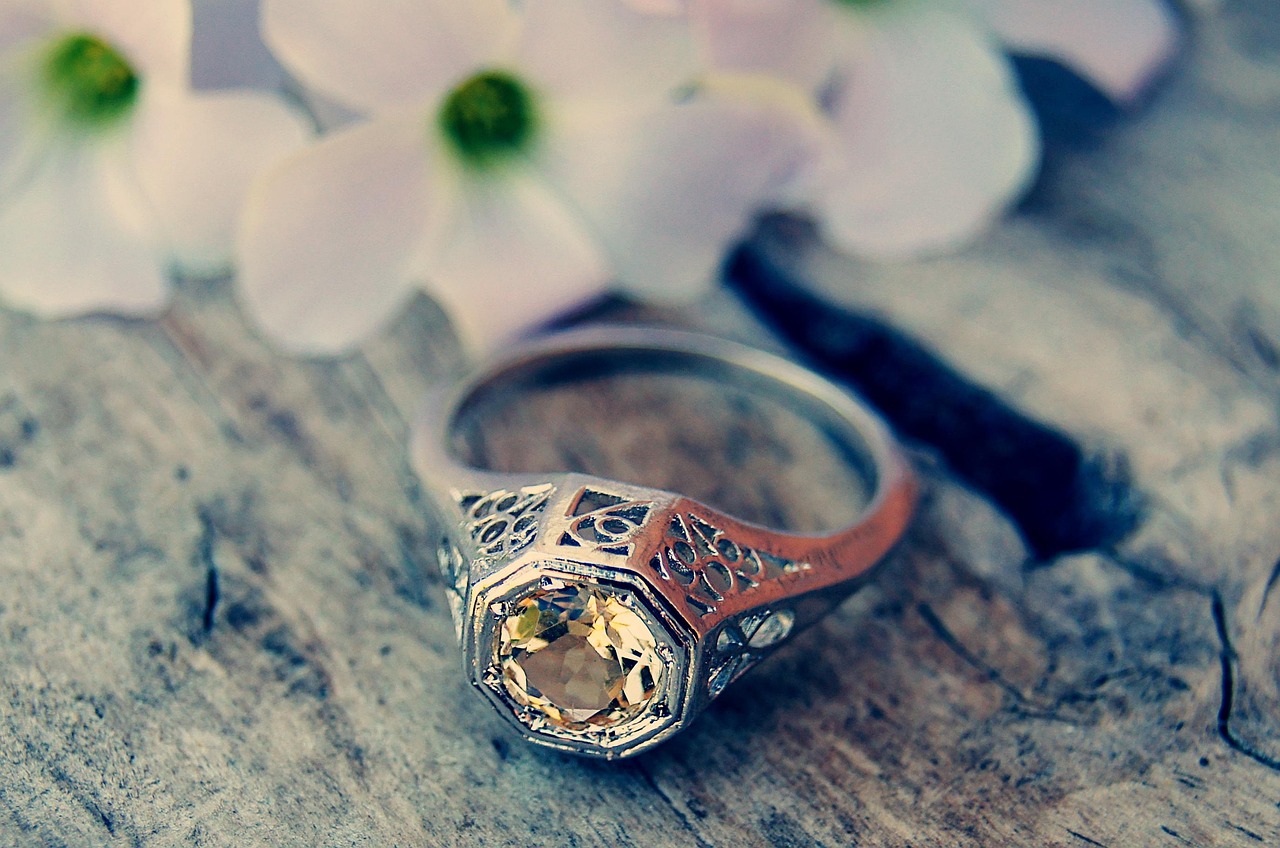
    Original in meaning

    Many couples want the ring to feel like a personal artifact. That may mean incorporating a hidden detail, engraving, or a visual reference that only the two of you recognize. The result can look understated to others while feeling deeply distinctive to you.

    Original in craftsmanship

    Originality can be about how the ring is made: a carefully considered build, refined finishing, and decisions that support long-term wear. A ring can be “different” in a way that also feels solid, balanced, and comfortable—qualities that matter when you’ll be wearing it every day.

    Original engagement rings shown as two people hold hands, with woman in white top blurred in background
    Two hands meet in the foreground, highlighting an original engagement ring as a woman in white lingers softly out of focus behind.

    Start With Your Non-Negotiables

    Before you fall in love with a design, identify what can’t be compromised. This keeps the shopping process focused, avoids decision fatigue, and helps you compare rings fairly. Original doesn’t have to mean impractical; a great ring aligns creativity with daily life.

    • Wearability: Is the ring comfortable and compatible with your lifestyle?
    • Durability: Will the design hold up to daily wear over time?
    • Maintenance: Are you comfortable with how often it may need attention?
    • Budget range: What is your comfortable spend and true max?
    • Timeline: Do you need it quickly or is there room for a longer process?

    Tips: A quick decision filter

    If you’re torn between “unique” and “timeless,” prioritize a silhouette you’ll love for years, then add originality through detail. A distinctive setting profile, subtle texture, or unexpected accent can deliver uniqueness without making the ring feel like a trend you’ll outgrow.

    Common Paths to an Original Engagement Ring

    There isn’t one correct route. Some people start with a center stone and build around it. Others fall for a setting first, then look for a stone that complements it. The most reliable approach is to explore a few proven “paths” to originality and choose the one that fits your priorities.

    1) Start with a distinctive center stone shape

    Shape has an immediate impact on how a ring reads. Choosing a less common shape, or even a familiar shape in a less expected proportion, can create a look that feels original without requiring a highly complex setting.
    2) Make the setting the statement

    Settings define the ring’s architecture: how it sits on the finger, how the stone is held, and how light and space play together. An original setting can be sculptural, minimal, or detail-rich—what matters is coherence and balance.

    3) Add a personalized detail that’s “for you”

    Sometimes the most original choice is a private one: an engraving, a hidden accent, or a design cue tied to your story. This approach works well if you want a ring that looks classic at first glance but becomes more special the closer you look.

    4) Choose a design that supports stacking or stands alone

    Think ahead to how the ring will pair with a wedding band. Some original engagement rings are designed as a stand-alone statement; others intentionally leave room for a band to nest or sit flush. Deciding early prevents later compromises.

    Original engagement rings close-up of woman showing ring on chest with red lipstick and small wrist tattoo
    A design-savvy close-up captures a woman in a white shirt resting her hands on her chest to reveal a ring and a subtle wrist tattoo.

    Custom vs. Ready-to-Wear: Which Route Fits Your Goals?

    Many shoppers assume that “original” automatically means “custom,” but that’s not always true. A thoughtfully chosen ready-to-wear ring can still feel unique, especially if you focus on less common design language. Custom design can be a great fit when you want something highly specific or meaningful—just make sure you understand the process.

    Ready-to-wear: When it makes sense

    Ready-to-wear is ideal if you want a quicker purchase, prefer to see a finished design, or feel confident selecting from curated styles. It can also be a smart option if you want originality through selection rather than invention.

    Custom: When it’s the better choice

    Custom design is best when you have a clear vision, want to incorporate specific details, or can’t find the right combination of features. It can also help if your preferences are unusually specific—like a particular profile, proportion, or design element you haven’t seen elsewhere.

    Tips: Questions to ask before going custom

    • What aspects are truly unique, and what can follow established design principles for comfort and stability?
    • How many revisions are included before the design is finalized?
    • What is the expected timeline from approval to completion?
    • How will the final ring be checked for fit, comfort, and practical wear?

    Design Elements That Make a Ring Feel One-of-a-Kind

    Originality often comes from intentional choices that work together—rather than one extreme feature. When evaluating rings, look at the overall composition: shape, setting, profile, and small details. The most compelling designs usually feel cohesive, not random.

    Silhouette and proportions

    Two rings can share similar components but feel completely different based on proportion. Consider how large the top view is relative to the band, how high the center sits, and whether the ring looks airy or substantial.

    Texture and finishing

    Finishing choices can change the personality of a ring. A smooth, refined finish feels different from a more tactile look. Texture can be a quiet way to make a ring feel original without changing its overall style.
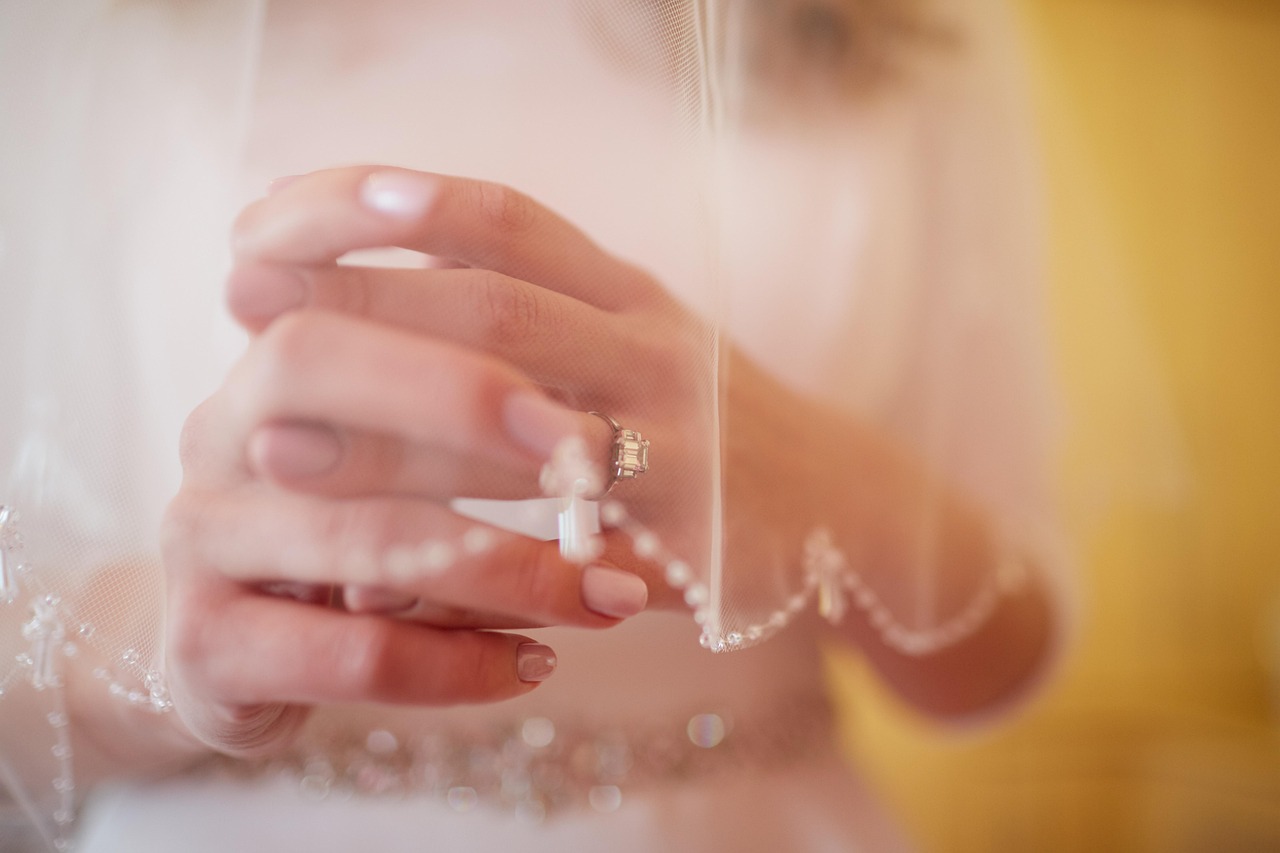
    Negative space and openwork details

    Space can be a design feature. Open sides, cutouts, or airy structures can make a ring feel lighter and more architectural. If you like this look, prioritize comfort and practicality so the ring feels good in everyday wear.

    Hidden details

    Hidden details are ideal for people who want uniqueness that doesn’t dominate the look. A subtle touch can carry a lot of meaning without making the ring feel overly ornate.

    Original engagement rings with clear stones on a reflective surface against a light background
    Two design-savvy metal rings set with clear stones rest elegantly on a reflective surface against a light background.

    How to Balance “Unique” With Everyday Wear

    A ring can be original and still practical. The key is to anticipate how it will behave in your day-to-day life. If you use your hands often, prefer low-maintenance jewelry, or plan to wear your ring constantly, certain design decisions may matter more than aesthetic novelty.

    Profile and comfort

    Consider how the ring sits against your finger and whether it feels smooth along the edges. Rings with a more pronounced profile may look dramatic, but comfort and snag-resistance can be just as important over the long term.

    Band width and feel

    The band is the part you’ll notice most. A very thin band can feel delicate, while a wider band may feel more substantial. The “right” choice depends on your style, your comfort preferences, and how you want the ring to look on your hand.

    Setting security

    If a ring’s design relies on fine, intricate details, make sure the structure still feels secure and wearable. Original settings can be strong and well-considered, especially when the design prioritizes stability alongside aesthetics.

    Tips: A practical wear test

    When you try on a ring (or visualize it), imagine a full day: pockets, hair, gloves, handwashing, carrying bags, and typing. If the ring feels like it would constantly catch or need careful handling, consider a similar style with a smoother profile or a more protected setting.
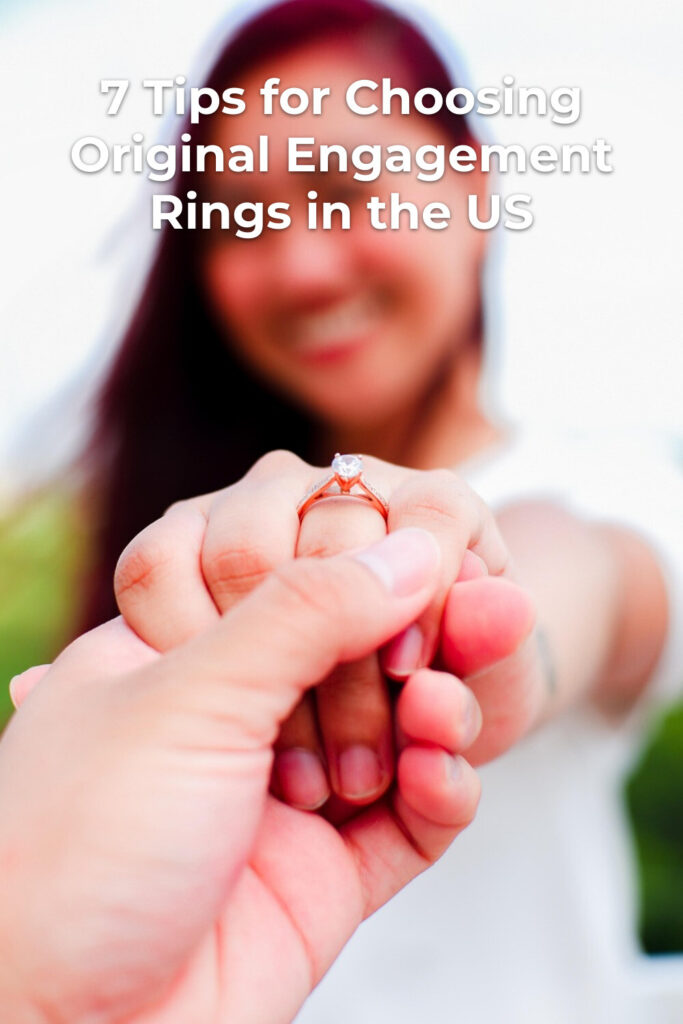
    Building a Clear Budget Without Losing Creativity

    Budget clarity helps you make original choices on purpose rather than by accident. Instead of thinking only in terms of a single number, consider how to allocate what you’re comfortable spending across the elements that matter most to you—whether that’s the center stone, the setting, or design details.

    Set a comfortable range and a true maximum

    A range keeps you flexible. Your true maximum protects you from making a decision you’ll regret later. Original designs can vary widely in complexity, so having boundaries makes it easier to choose confidently.

    Decide where you want the “wow” to live

    Some people want a center stone that dominates the look; others prefer a subtler center with a more distinctive setting. Knowing where you want the impact helps you avoid spreading the budget too thin across features you don’t care about equally.

    Tips: Keep one “flex” category

    Choose one category where you’re willing to adjust—like band width, accent detailing, or overall complexity—so you can protect what matters most if costs shift during the process. This makes it easier to keep the ring both original and aligned with your priorities.

    How to Evaluate a Ring Listing or Product Page With Confidence

    Original engagement rings are often sold with strong visuals and emotional language. That’s not a bad thing, but it’s important to look beyond the hero photo. The more distinctive a design is, the more you should understand how it’s built and what the purchase includes.

    • Look for multiple angles: top view, side view, and on-hand photos
    • Confirm what’s included: center stone, accents, band, and any personalization
    • Check size and scale cues: proportions can look different on different hands
    • Understand your options: any choices available for the setting or details
    • Know the timeline: especially if you’re considering custom or made-to-order

    Tips: Don’t judge originality by a single photo

    Some designs photograph dramatically from one angle but look less special from others. Conversely, some rings look simple head-on but reveal their personality from the profile. Ask for more images or views if you can, and focus on the overall structure—not just one flattering shot.

    Creating an Original Ring Without Overcomplicating It

    There’s a difference between “original” and “busy.” The most memorable rings often have one strong idea supported by quieter choices. If you want a ring that feels distinctive but still refined, aim for a focused concept and consistent design language.

    Choose one signature feature

    Pick the single element you want people to notice first—an unusual silhouette, a bold setting, or a meaningful hidden detail. Let everything else support that feature rather than compete with it.

    Keep the rest cohesive

    Consistency is what makes originality look intentional. If your ring has an architectural setting, consider complementary band lines. If it has romantic detailing, keep the overall proportions balanced so it still feels wearable.

    Tips: The “one change” method

    If you’re starting from a classic style, change only one major category at a time—shape, setting, or detailing—until it feels original enough. This reduces the risk of ending up with a ring that feels visually confusing or hard to pair with a band later.

    Collaborating on the Choice (If You’re Ring Shopping Together)

    Buying an engagement ring can be a solo surprise or a shared project. If you’re shopping together, you can use the process to refine preferences quickly and avoid assumptions. Original rings especially benefit from alignment—unique design choices are more satisfying when both people understand the “why.”

    Get specific about what each of you likes

    Instead of saying “unique” or “simple,” describe what you mean. Do you like a bold top view? A low profile? Clean lines? Vintage-inspired cues? The more specific you are, the easier it becomes to select or create a ring that truly fits.

    Use a shortlist approach

    Narrow to a small set of favorites and compare them side-by-side. This reveals patterns—maybe you consistently prefer certain proportions or a particular setting profile—and it makes the final decision feel grounded rather than impulsive.

    Planning for the Wedding Band Early

    Original engagement rings can introduce pairing challenges if the setting is wide, low, or has an unusual silhouette. Thinking about the wedding band early helps ensure the set looks intentional, whether you want a perfectly flush fit or a contrasting stack.

    Decide what “pairing” means to you

    Some people want the band to disappear behind the engagement ring, while others want it to add a new design layer. Both approaches can work well; the key is choosing deliberately rather than discovering limitations later.

    Tips: Bring band preferences into the ring decision

    If wearing a band flush is important, pay close attention to the engagement ring’s profile and how it sits on the finger. If a gap is acceptable or even desirable, you have more freedom to choose a sculptural or lower-set design.

    After You Buy: Keeping an Original Ring Looking Its Best

    Original designs can include distinctive details that deserve thoughtful care. The goal isn’t to be overly precious with your ring—it’s to understand what keeps it comfortable, presentable, and enjoyable to wear. A little attention helps protect the features that made you choose it in the first place.

    Wear habits and mindful handling

    If your ring has fine details or a more sculptural profile, be mindful in situations where it could catch, scrape, or take impact. You don’t need to baby it, but it’s reasonable to treat it like a daily-wear piece with special design features.

    Tips: Preserve the details that make it original

    Pay attention to the small elements you love most—texture, delicate accents, or a distinctive profile. If you notice roughness, discomfort, or changes in how it sits, address it sooner rather than later so the ring continues to feel as good as it looks.

    Original engagement ring with dark blue gemstone on rough ground, blurred buildings and cloudy sky behind
    A design-savvy original engagement ring with a dark blue stone rests on textured ground beneath a moody skyline.

    FAQ

    What makes original engagement rings different from traditional styles?

    They prioritize a distinctive look, personal meaning, or uncommon design details rather than sticking closely to the most familiar silhouettes and settings, while still aiming to be wearable and enduring.

    Do I need a custom design to get an original engagement ring?

    No—many people find originality through a carefully chosen ready-to-wear design, while custom design is best when you have specific requirements or want highly personal details incorporated.

    How can I make a ring feel unique without making it too trendy?

    Choose a timeless overall silhouette and add originality through controlled details like proportions, texture, a distinctive setting profile, or a subtle personal element that won’t feel dated quickly.

    What should I prioritize first when shopping for a one-of-a-kind ring?

    Start with non-negotiables such as comfort, wearability, budget range, and timeline, then decide whether the ring’s uniqueness should come from the center stone, the setting, or a personalized detail.

    How do I know if a unique setting will be comfortable for everyday wear?

    Focus on the ring’s profile, how it sits on the finger, and whether edges and details feel smooth; imagine daily activities like typing and handwashing to assess snag risk and comfort.

    Can original engagement rings still pair well with a wedding band?

    Yes, but it helps to plan early by deciding whether you want a flush fit or are comfortable with a small gap, since unusual profiles and silhouettes can affect how bands sit together.

    How do I compare two unique rings fairly?

    Compare them using consistent criteria—comfort, durability, maintenance expectations, budget alignment, and how the overall design looks from multiple angles—rather than relying on a single standout feature.

    What questions should I ask if I’m considering a custom ring?

    Ask what parts can be customized, how revisions work, what the timeline is, what the final ring includes, and how the design will be checked for fit, comfort, and practicality before completion.